The Latest News from Research at Kudelski Security
Thank you! Your submission has been received!
Oops! Something went wrong while submitting the form.
Crypto
Cryptography
Data privacy
Defense
Quantum computing
July 5, 2022
NIST Announces First Quantum-Resistant Cryptographic Standards, PQC End of 3rd Evaluation Round
No items found.
Kudelski Security Team
After a long process started in 2016, today NIST announced the first standardized cryptographic algorithms designed to protect IT systems against future quantum attacks. Here is the list of the first winners of the competition:
For digital signatures:
CRYSTALS-Dilithium
Falcon
SPHINCS+
For KEMs:
CRYSTALS-KYBER
Additionally, the following candidate KEM algorithms will advance to the 4th and final round, even though they have not been standardized yet:
BIKE
Classic McEliece
HQC
SIKE
This is exciting news, as it marks a fundamental milestone in a very long process that the cryptography and security community has been following for many years. Quantum computers are rapidly advancing to a state of maturity that will allow soon to solve real-world problems in chemistry, physics, logistics, etc. Although cryptanalytic applications of quantum computers are probably still far away, given the long lifespan of security applications and the slow process of updating IT systems, businesses and governments have started to worry about quantum attacks for a while already. What was holding many stakeholders off from proactively starting a quantum-resistant strategy for their products and services was the lack of accredited international cryptographic standards. Now this obstacle has been removed, so we expect (and we welcome) a wave of renewed interest in quantum-resistant applications.
2022
Cloud-native-security
June 30, 2022
Azure Compliance-as-Code unit-testing with Golang
No items found.
Romain Aviolat
Infrastructure-as-Code (IaC) is great. It allows teams to deploy infrastructure quickly in a consistent and repeatable manner and when coupled with a proper CI/CD process (linting, SAST (Static Application Security Testing), 4-eyes reviews, multi-env, …) it creates a powerful security framework for platform and development teams.
However as great as IaC is, it does not prevent users from making mistakes; it is easy to wrongly expose a service and thus increase your attack surface or to deploy it in a way that conflicts with your compliance requirements.
Luckily Cloud providers offer guardrail functionalities to catch those mistakes and to enforce your compliance requirements.
Azure provides it under the Azure Policy feature; for Google it is called Organization Policies and for AWS (Amazon Web Services) it is Service Control Policies. The implementation methods and features differ between the different cloud providers, but the idea is the same; provide central control over the maximum available permissions for the accounts in your organization.
In this blog post I’ll cover how you can manage these guardrails as-code and how you can code unit-tests to validate them. We will focus on the Azure platform, but it could be easily reproduced on the others.
(all the code present is this blog-post is available on the following Github repository)
Scoping guardrails
You need to start somewhere, and the blank page syndrome can be hard to overcome… My recommendation is to start with low hanging fruits. First, things that you never want to see happening in your production environment no matter what.
Ideally you should also pick things that will have little to no impact on your platform and development teams – it’s always frustrating to rollback or make people angry at the beginning of a new project. Also, keep in mind that you will need the support of these teams to progress on your Cloud-native security journey, so it is best if you have their buy-in day 1.
We’ll start with two simple use-cases:
We’ll forbid the deployment of resources in certain regions.
We’ll forbid certain source-addresses / destination ports patterns when creating Network Security Groups (NSG).
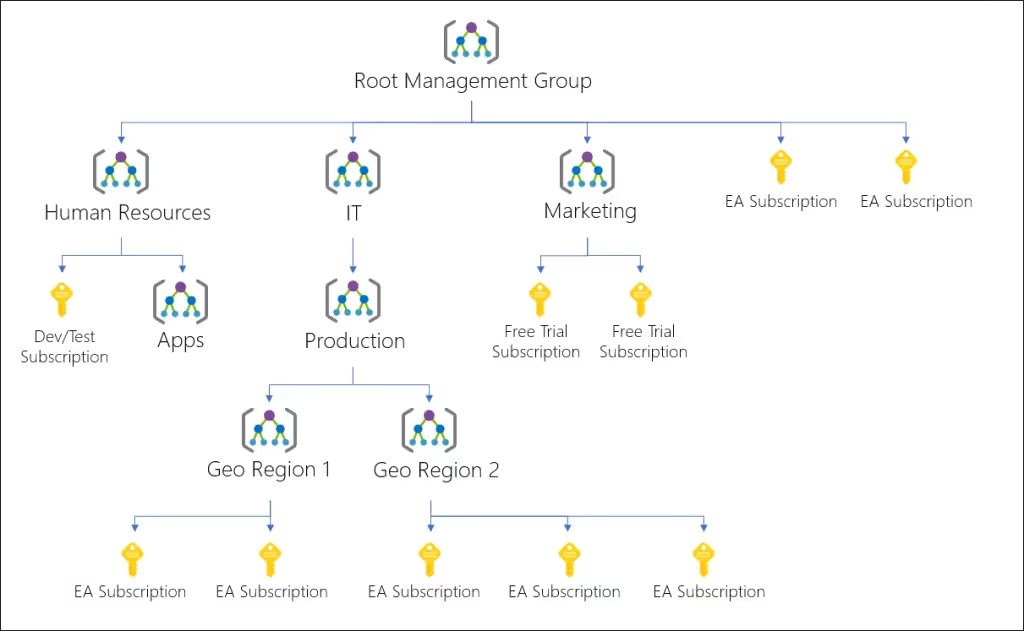
Now we need to define where in the accounts hierarchy we want to apply these policies. Azure recommends organizing Subscriptions under Management Groups. In this blog post that’s where we’ll assign them, but they could be just as readily assigned at the Subscriptions level or at the Resource Groups level as well. Assigning policies at the top of the tree means that all the objects downwards will inherit them.
Creating policies
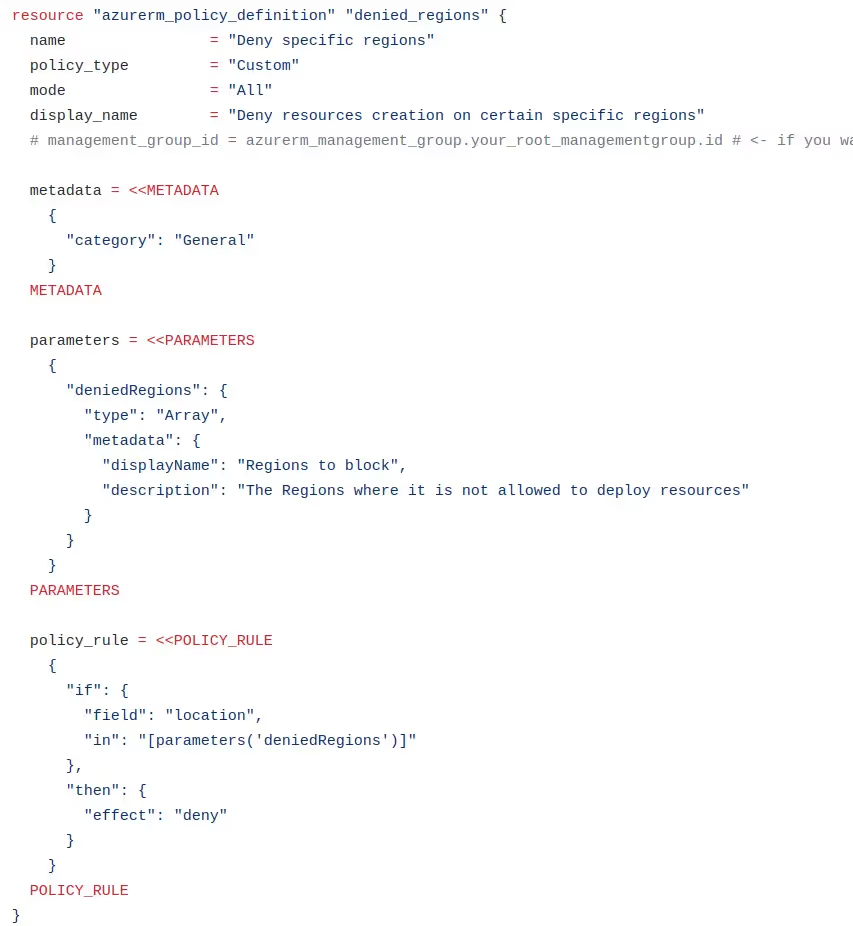
Policies can be defined inside the Azure Portal Policy page under “Authoring / Definition” but we’ll do it as-code using Terraform today.
We’ll focus on the policy for forbidden regions here but the code for both is available here.
Notes:
As you can see this policy takes parameters (“deniedRegions” array) as input so it’s in fact a template.
In the policies definition code we have set the “effect” to “deny” which means that resources meeting these specific conditions will be denied at creation-time.
A smart way to implement policies is to set them in “audit” mode first to identify the potential impact and in “deny” mode to enforce them afterwards.
Assigning policies
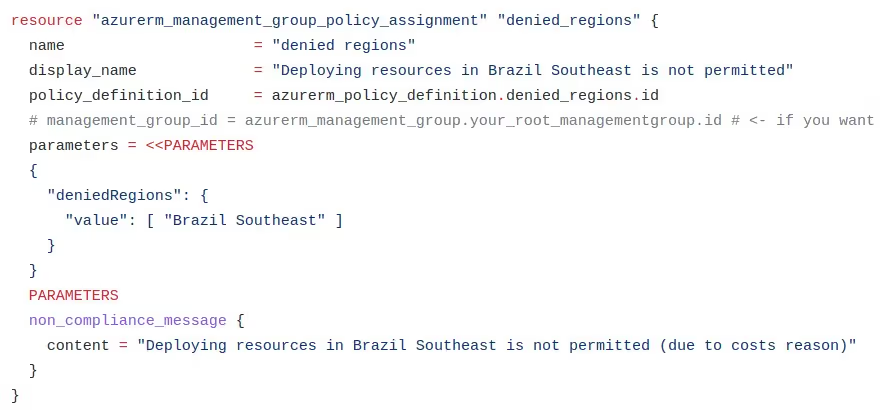
Now that the policies are created, we need to assign them to our Management Group (“Authoring / Assignments in the Azure portal). Without an assignation a policy has no effect.
The “deniedRegions” key inside the parameters block, this is where we can set the variable that is applied inside the policy definition.
Something also useful is the ability to define a non-compliance error message inside the policy assignment resource. This allows us to answer with a meaningful error message for the users when they deploy non-compliance resources, and it gives us the flexibility to define different error messages for the different assignments you may define (per subscription / teams, resources groups).
Testing the policies
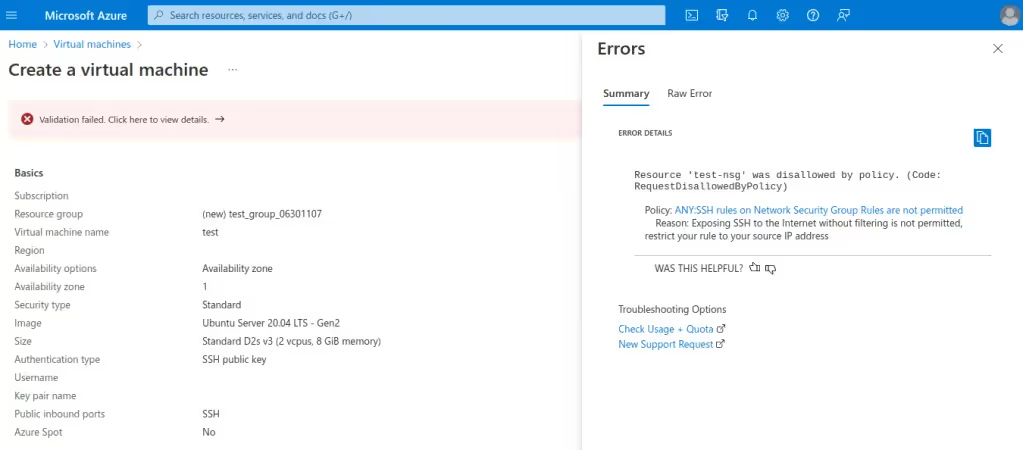
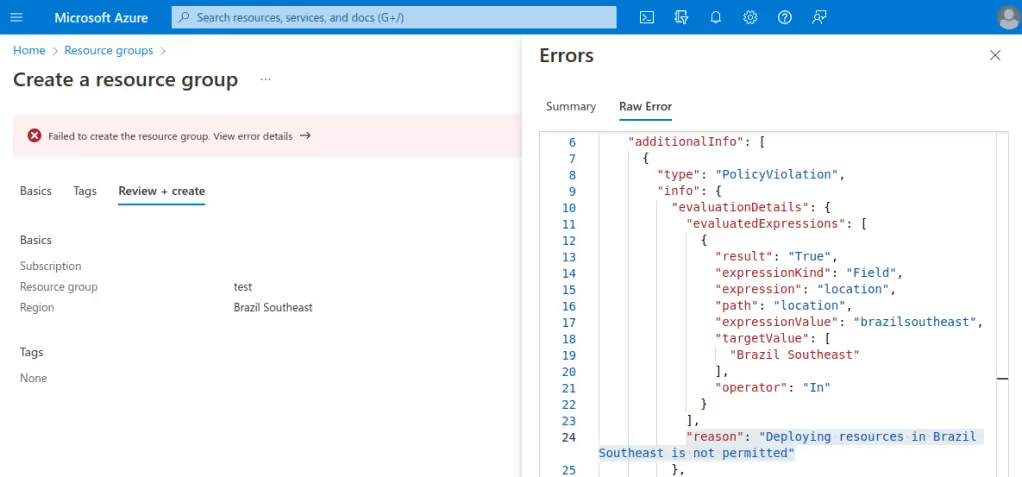
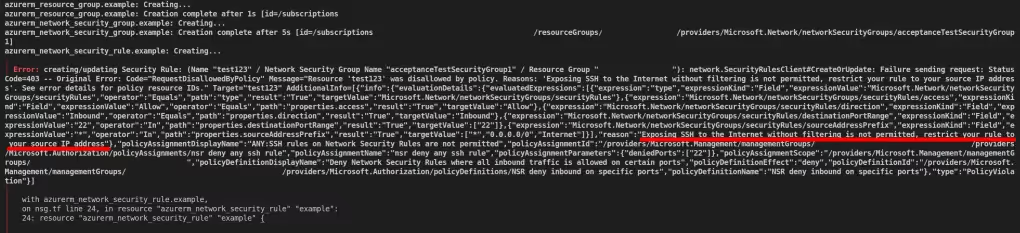
Now that we have created and assigned our policies we can do a quick test from the Azure portal, by trying to create a new NSG rule that voids the policy or by deploying a resource in a forbidden region.
Deploying a NSG that voids the NSG policy
Deploying a resource in a forbidden region
We can see that our policies prevented the deployment of the resources, and that it did so during the evaluation process of the resource creation. This is quite powerful because it will warn users even before deploying the offending resources, instead of crashing with an error message at deployment-time.
The same will happen if we try to deploy the resource as-code, we will find the non-compliance error message inside the query response body.
Managing exemptions
A good policy framework must also support exemptions for certain rare use cases. Azure Policy provides that out-of-the box. We won’t cover exemptions in this blog post but they follow the same logic as policies assignments, you define a scope, a reason and optionally an expiration date for the exemption and that’s it.
I could have stopped here, but I wanted to go a bit further than that. These policies are working as expected, but I still had the following questions open in my mind. How to make sure that:
The policy really blocks what it’s supposed to?
The policy behaves properly over time? For example, if some wrongly scoped exemptions are created?
The policy does not block something it is not supposed to?
The expected policy prevents deployment of a non-compliant resource in case there is overlapping policies?
Some of the questions above could be answered by the principle of least privilege, locking in the policies at the highest org-level and granting access only to certain super-admins. With infrastructure as-code, however, it is usually a service account that is used to push the changes on the platform and even with four-eye reviews, a mistake could happen.
To answer all these questions, I decided to implement unit tests. Initially I thought about doing them using Terraform code, but it was a bit cumbersome to catch and parse error messages and would mean that I had to wrap some bash or Golang around the Terraform code to achieve what I wanted to do.
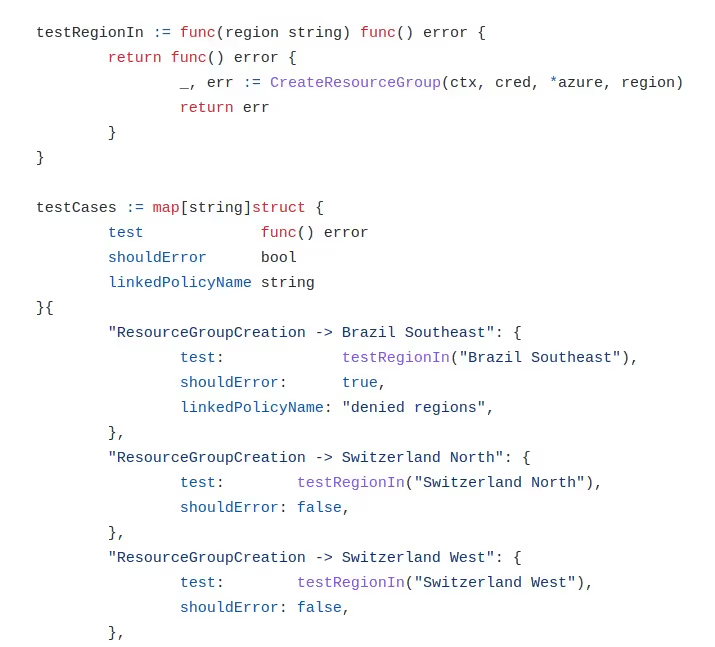
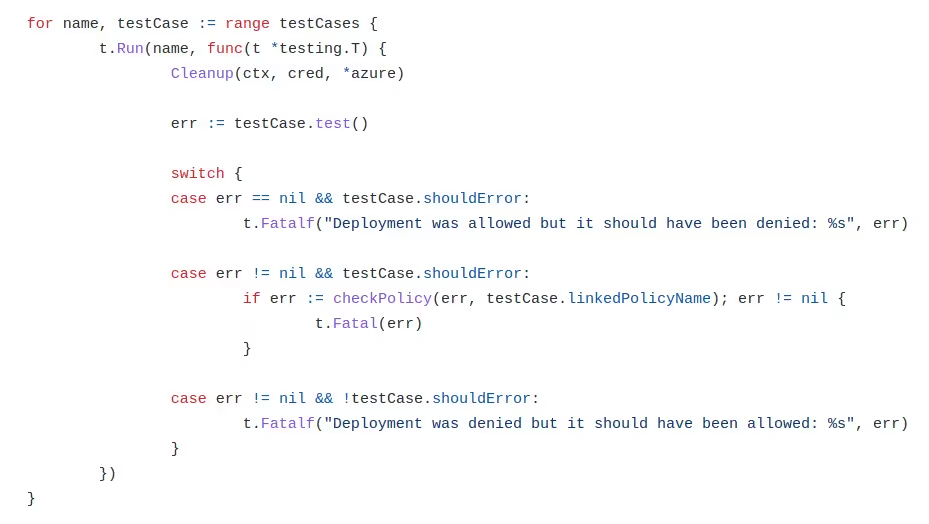
Instead, I decided to implement the resource creation process using Golang code (leveraging the Azure SDK for Golang) and simply define unit tests using the standard testing package.
Here’s an extract of the testing scenarios for the forbidden regions (full code here).
And here’s an extract of the logic to iterate over all the tests (full code here):
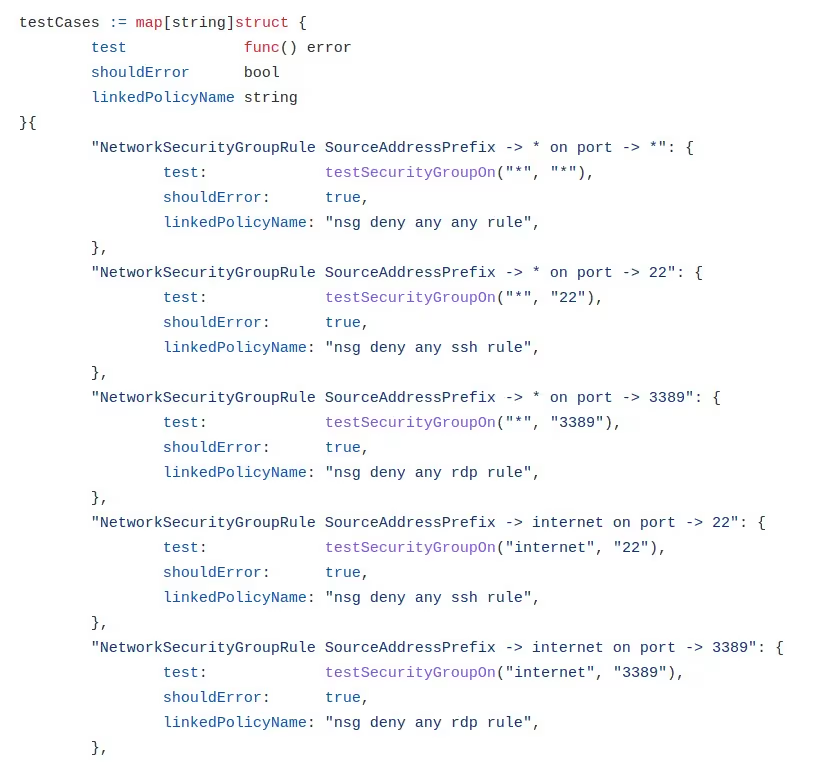
Here’s an extract of the testing scenarios for the forbidden NSGs (full code here).
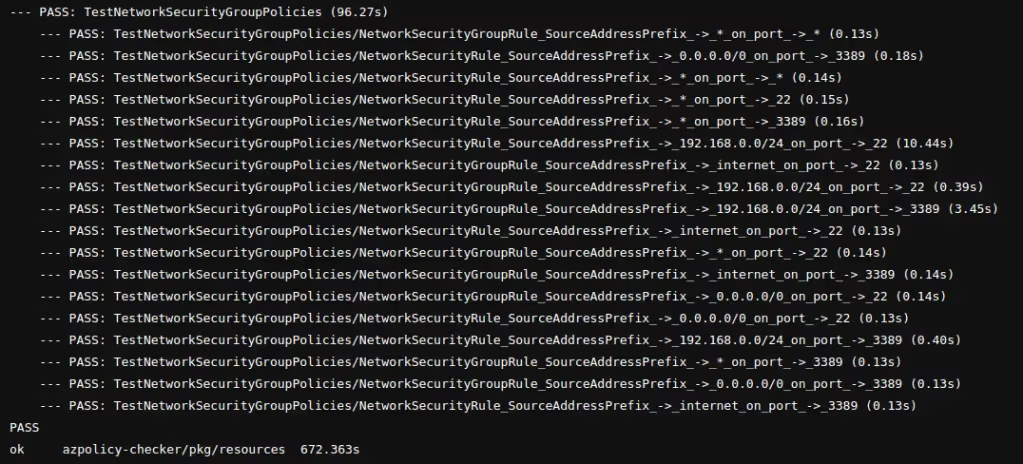
And here is how it looks like when being executed (here the NSG tests):
We can see that all the tests successfully passed as expected.
Wrapping up
In this blog post we saw how to improve our Cloud-native security by implementing guardrails as-code leveraging Azure Policies.
We also saw how to make sure that these policies remain consistent over-time by coding some unit-tests in Golang.
It is understood that all the Terraform code and the unit tests must be part of steps in a Continuous-Integration/Continuous-Deployment (CI/CD) pipeline.
Pretty Good Privacy (PGP) and the open source implementation GNU Privacy Guard (GPG) are encryption solutions following the OpenPGP standard. Even if GPG has been criticized in the past, it is widely used and deployed and has been publicly reviewed for many years. For example, GnuPG VS-Desktop has been recently approved by the German government to secure data at the VS-NfD (restricted) level. Thus it is used in practice to protect sensitive data, for example, to sign and encrypt emails, sign commits, or authenticate packages for several Linux distributions. To decrypt a message, the following command can be used:
$ gpg -d clear.gpg
gpg: encrypted with3072-bit RSA key, ID 6F2C79C919966FC1, created 2021-07-21"Test key <[email protected]>"Hello GPG
Hello GPG
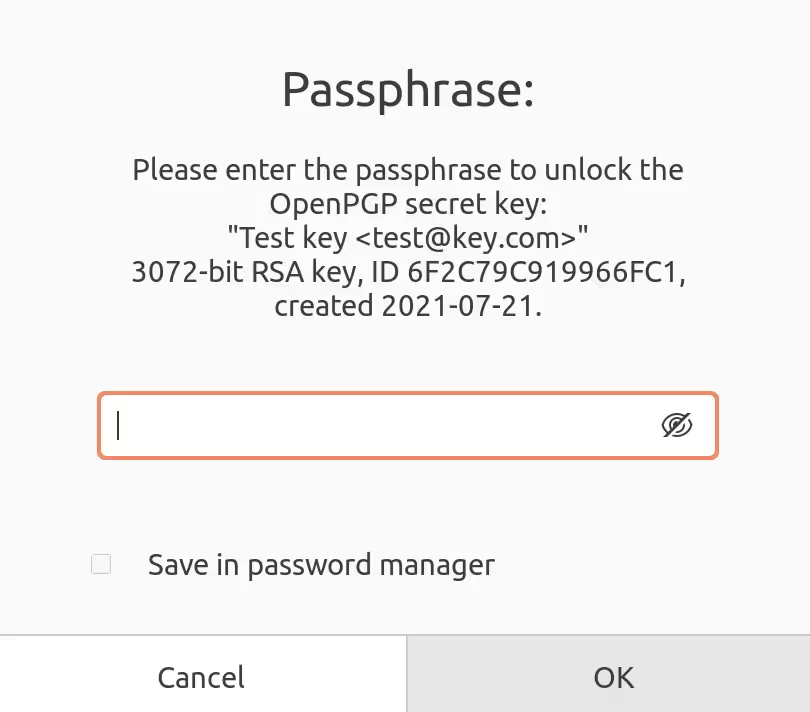
The first time the decryption is called, the system asks the user for their passphrase to decrypt the private key needed to decrypt the file.
Then for future decryption attempts, the passphrase is not asked but read from cache. The same mechanism is used for symmetric-key encryption. The cache time to live has a default value of 10 minutes. After the time to live elapsed, the cached item is cleared from memory.
To avoid having key material directly in the clear in memory, GPG encapsulates such key material before storing it in memory. The idea of that is that if a TPM is available, then the encapsulation key can be stored in a safe memory area. However, TPMs are usually not used, and the encapsulation key stays in regular memory.
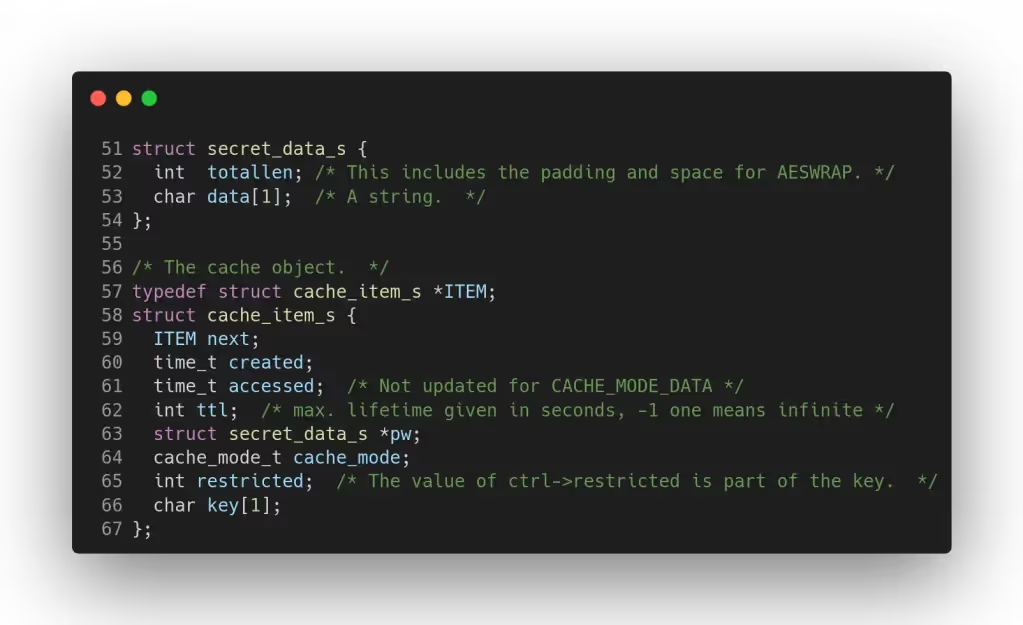
A cached item is stored in the ITEM structure. We find this structure in gnupg/agent/cache.c (GPG version 2.3.4):
Cached item linked list
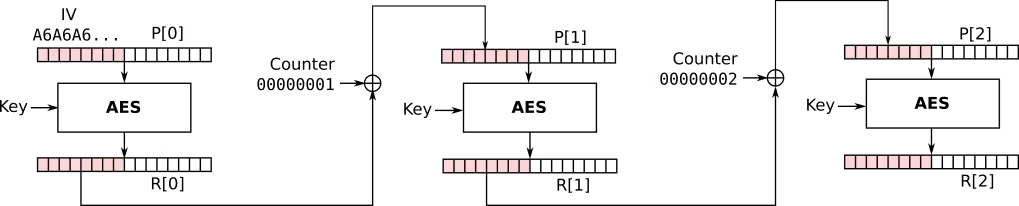
The ITEM structure is a linked list containing the cached item address and additional data. Among them, there are the time of creation and time of last access. These values are unix epoch times, the number of seconds elapsed since January 1, 1970. Then there is the time to live (ttl) field which is the number of seconds gpg-agent has to keep the item in cache. By default it is set to 10 minutes (0x0258 seconds). If gpg-agent found that the last accessed time is older than the time to live, the item is cleared from cache. After that we have the address of a secret_data_s structure. The secret_data_s structure contains the length of the cached item in bytes followed by the encrypted item with AES in key wrap mode. GnuPG uses AES key wrap mode of operation to encapsulate key material in memory as defined in RFC 3394. The AES key wrap algorithm is used to encrypt (wrap) keys or secrets with another key. It is used in several solutions like Apple FileVault 2 or Cryptomator. The mode uses two 64-bit blocks concatenated together as input of AES encryption:
First iteration of AES key wrap
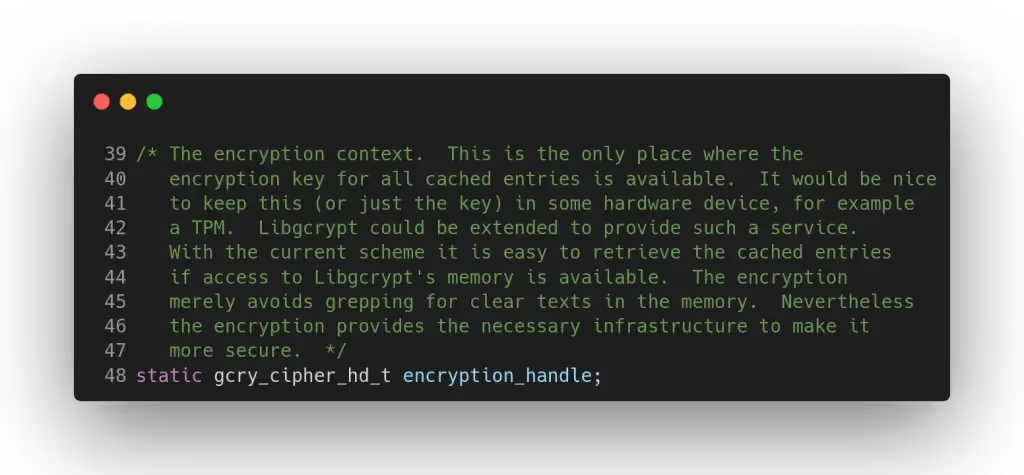
This operation is iterated 6 times, and the final R values obtained are outputted as the ciphertext. Decryption works in exactly the same way but in reverse order. The initialization vector (IV) can be any value but the RFC default value is 0xa6a6a6a6a6a6a6a6. It allows for verification of the integrity of the decrypted key after the decryption. If the last decrypted block yields a value that starts with the IV, decryption is considered correct as long as no other error is returned. GPG uses the implementation of AES key wrap provided by the Libgcrypt library. In GPG, the cached item encryption is used to prevent attackers from simply grepping for passphrases in memory as commented in gnupg/agent/cache.c (GPG version 2.3.4):
However, as we will see later, someone who has access to the memory can also retrieve the encryption key and decrypt cached items anyway. To avoid having sensitive values left in memory after processing, Libgcrypt deletes those values when they are not used anymore. For example, a variable is wiped with the function wipememory and the stack is cleaned with the function _gcry_burn_stack. In Libgcrypt, the function _gcry_cipher_aeswrap_decryptlibgcrypt/cipher/cipher-aeswrap.c on line 81) did not clean a temporary variable containing the last decrypted block. Suppose we use GPG to decrypt some cleartext using a passphrase. At the end of the cached item decryption, the temporary variable contains the IV value 0xa6a6a6a6a6a6a6a6 followed by the first 8 bytes of the passphrase. For example, if a dump of gpg-agent’s memory using gcore or a dump of the whole system memory using LiME can be obtained, then, we should retrieve the constant 0xa6a6a6a6a6a6a6a6 in memory, next to the first 8 bytes of the passphrase. We reported this problem to GPG maintainers. This was quickly corrected in Libgcrypt 1.8.9 and future versions should not be affected by this issue.
Nevertheless, we investigated more to understand if it is possible to decrypt completely the passphrase in cache. We saw that each cached entry has two timestamps created and accessed of type time_t. This information can be leveraged to search for such patterns in memory and retrieve the location of cache_item_s instances. If we can estimate the time of the creation of the cached item, we can search for masked timestamps concatenated in memory followed by the time to live value. For example, the following regular expression matches all timestamps created after July 27, 2021 12:45:52 PM and before February 6, 2022 5:06:08 PM with a time to live of 10 minutes:
To further reduce the number of false positives during the search, for each match, the created time can be checked to be less than or equal to the accessed time. Then, as soon as the ITEM structure has been found, we can access the secret_data_s structure.
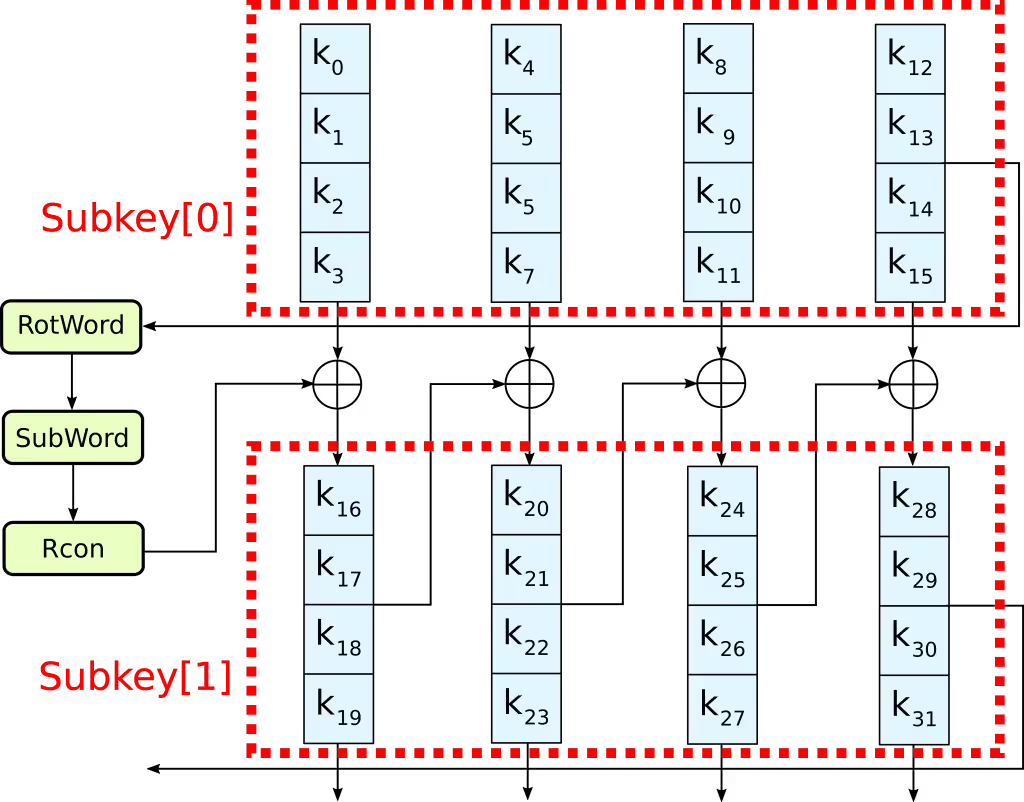
To recover the encryption key, we used a known method to recover AES keys in memory. In AES, before data is encrypted, the AES key schedule is used to derive 11 subkeys that are used later in the algorithm.
AES key schedule algorithm
These subkeys are usually stored consecutively in RAM and there are relations between each consecutive subkeys. Thus, we scan the memory byte per byte trying to see if at this position the AES key schedule relation are verified. If it is the case for two consecutive rounds, there is a very high probability that there are subkeys stored at this location. We scan the process memory until we find a 128-bit expanded AES key. Then we use this key to decrypt the cached item. If the integrity of AES key wrap is verified we know we have properly decrypted the cached item and recovered the passphrase.
At this point, we had everything we needed to implement our solution. Volatility is a widely used forensics framework. It is used to analyze volatile memory dump artifacts to extract data. For example, it has been used in the past to recover Bitlocker volume encryption keys while they are in RAM or to solve challenges of previous SSTIC editions. The framework is highly customizable and allows writing plugins in Python to fit specific needs. Therefore, we developed two plugins for Volatility3. The first plugin retrieves partial (or complete, up to 8 characters) passphrases from memory by searching in gpg-agent‘s memory the constant IV of aes-wrap. This plugin would not work on versions of GPG later than version 2.3.4.
The first 8 bytes of the passphrase were found in the clear in memory. The second plugin retrieves cached items and cache encryption keys from memory and therefore helps recover plaintexts. Here is an example of usage on an Ubuntu 21.10 VM dump:
The plugin successfully found the entire passphrase my_passphrase in memory. The first plugin execution took 6.4 seconds and the second 59.7 seconds on an Intel Core i7-7600U CPU for a 1GB RAM dump.
Memory forensics may be used during a criminal investigation to analyze memory dumps obtained during a search and seizure. After the data has been copied, the investigator may need to obtain the passphrases stored encrypted in cached items to further decrypt conversations. These techniques may also be applied to investigate virtual machines stored remotely in servers that are seized.
Ransomware is a common problem nowadays. These malicious software encrypt files on an infected machine and ask the owner for a ransom so that they can recover their files. It happens that some ransomware rely on well studied tools to encrypt a user’s data. Ransomware such as KeyBTC, VaultCrypt or Qwerty use GPG to encrypt files. In the event that a victim of such a ransomware just noticed what happened when they get infected, the victim or the incident response team could make a memory dump of the whole system and later retrieve the password or decryption key from memory. Thus, thwarting the ransomware threat and retrieving the original files without having to pay a ransom at all. Note that the ransomware would have to rely on symmetric encryption for this to work (gpg --symmetric) and, so far, we have not found any ransomware relying on GPG symmetric encryption.
To conclude, we have analyzed a bug in Libgcrypt where after cleaning memory, it was still possible to read 8 bytes of the passphrase in the clear from a memory dump. We have further analyzed how to decrypt cached items stored in GPG memory. Our work highlights that GPG is a solid encryption solution, but it should be used in conjunction with a TPM or a secure enclave solution to harden the security against physical attacks.
2022
Security Advisory
May 20, 2022
High Severity VMware Vulnerabilities Under Active Exploitation
No items found.
Kudelski Security Team
This bulletin was written by Travis Holland and Eric Dodge of the Kudelski Security Threat Detection & Research Team
Executive Summary
On May 18th, 2022, the U.S Cybersecurity and Infrastructure Security Agency (CISA) released Emergency Directive 22-03 requiring U.S Federal Government agencies to patch VMware vulnerabilities under active exploitation or vulnerabilities CISA expects to be exploited in the next 48 hours. Due to active exploitation of vulnerabilities made public in April, and additional vulnerabilities published in May, the Cyber Fusion Center strongly advises all organizations with vulnerable instances to take immediate action.
VMware has released two security advisories related to vulnerabilities that may be exploited by Nation State and advanced threat actors. VMSA-2022-0014 was issued on May 18th and contains detailed for two newly disclosed vulnerabilities: An authentication bypass issue, assigned, CVE-2022-22972 which impacts VMware Workspace ONE Access, Identity Manager and vRealize Automation, Additionally, a Privilege Escalation vulnerability was also disclosed, the vulnerability was assigned CVE-2022-22973, and impacts VMware Workspace ONE Access and Identity Manager. At this time neither are known to have been exploited in the wild, however, CISA, VMware, and the CFC expect threat actors to begin exploitation of these issues shortly.
In April of 2022, VMware produced a separate security advisory, VMSA-2022-0011, which contained details of eight (8) vulnerabilities, ranging from critical to moderate. The vulnerabilities disclosed in April include remote code execution, authentication bypass, local privilege escalation issues, and more. The vulnerabilities disclosed in April impact a wide range of VMware products, including VMware Workspace ONE Access, Identity Manager, and vRealize Automation. Some of the vulnerabilities disclosed in April are known to havebeen actively exploited in the wild by a wide range of threat actors. VMware has provided patches and workarounds for all identified vulnerabilities; however, the CFC strongly advises organizations to apply patches rather than leverage temporary workarounds as the workarounds can have a noticeable impact on business operations.
For additional details about these vulnerabilities, including versions of VMware software impacted, please review the rest of this bulletin.
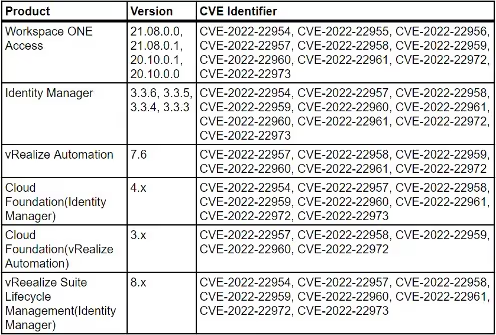
Summary of VMware Product Versions Impacted by April and May 2022 Vulnerabilities
Below is a table that highlights which VMware products are impacted by the vulnerabilities disclosed by VMware throughout the months of April and May. For additional details on these vulnerabilities, please review the contents of this bulletin and, if applicable, any linked sources and content.
VMware Vulnerabilities Disclosed in May 2022 (VMSA 2022-0014)
On May 18th VMware released an advisory for two new vulnerabilities: CVE-2022-22972 and CVE-2022-22973. Those are broken down into an authentication bypass, and a local privilege escalation issue. They require network/local access to the respective VMware product User Interfaces in order to properly exploit the vulnerabilities. Due to the nature of these vulnerabilities, CISA has pushed an emergency directive requiring U.S Government Agencies to patch or mitigate these issues within 5 days. The vulnerabilities are not currently being exploited; it is expected to start occurring within the next 48 hours based on previous reverse engineering of similar vulnerabilities from April 2022.
CVE-2022-22972 is a critical severity authentication bypass vulnerability with a CVSSv3 score of 9.8. This vulnerability allows authentication bypass impacting any local domain users and requiring network access to the software’s User Interface.
Note that for some software systems, such as VMware Workspace ONE Access or VMware Identity manager, the User Interfaces may be intentionally exposed to the internet and thus should be prioritized for remediation.
Component(s) Impacted
Workspace ONE Access
Identity Manager
vRealize Automation
Local Privilege Escalation (CVE-2022-22973)
CVE-2022-22973 is an important local privilege escalation vulnerability with a CVSSv3 score of 7.8. This vulnerability allows a malicious actor with local access to escalate privileges to ‘root
Component(s) Impacted
Workspace ONE Access
Identity Manage
Resolution/Mitigation
VMware recommends patching as soon as possible to remediate CVE-2022-22972 and CVE-2022-22973. The patch instructions can be found in KB88438, also provided below in the sources section. There currently is a workaround; however, it may have an impact on business operations, and patching is highly recommended. The workaround will make admins unable to log into Workspace ONE console via the local admin account. More information on performing the workaround can be found in KB8843; which is available below in the sources section.
VMware Vulnerabilities Disclosed in April 2022 (VMSA 2022-0011)
Multiple vulnerabilities have been identified to impact several VMware products including Workspace ONE Access, Identity Manager, vRealize Automation, Cloud Foundation and vRealize Suite Lifecycle Manager. The Cyber Fusion Center is aware of several threat actors actively exploiting these vulnerabilities for initial access and strongly recommends organizations with vulnerable versions of the software assume breach and investigate deployments for potential compromise. VMware has provided patches to remediate all identified vulnerabilities and patches should be applied immediately.
Details regarding the vulnerabilities disclosed by
Server-side Template Injection (CVE-2022-22954)
Critical severity remote code execution vulnerability exploiting server-side template injection with CVSSv3 score of 9.8. This vulnerability allows a malicious actor with network access the ability to trigger a server-side template injection potentially allowing code execution. This vulnerability is known to have been used by several threat actors to gain initial access to organizations with these VMware products deployed.
Critical severity authentication bypass vulnerability in the OAuth2 ACS Framework with a CVSSv3 score of 9.8. This vulnerability allows authentication bypass which allows the malicious actor the ability to execute any operation due to exposed endpoints in the authentication framework.
Critical severity remote code execution vulnerabilities with a CVSSv3 score of 9.1. This vulnerability allows code execution by triggering deserialization of untrusted data through a malicious JDBC URI.
Component(s) Impacted
Workspace ONE Access
Identity Manager
VRealize Automation
Cross Site Request Forgery (CVE-2022-22959)
Important severity cross site request forgery vulnerability with a CVSSv3 score of 8.8. This vulnerability allows a malicious actor to trick a user into validating a malicious JDBC URI through cross site request forgery.
Component(s) Impacted
Workspace ONE Access
Identity Manager
VRealize Automation
Local Privilege Escalation (CVE-2022-22960)
Important severity local privilege escalation vulnerability with a CVSSv3 score of 7.8. This vulnerability allows a malicious actor with local access to escalate privileges to ‘root.’
Component(s) Impacted
Workspace ONE Access
Identity Manager
VRealize Automation
Information Disclosure (CVE-2022-22961)
Moderate severity information disclosure vulnerability with a CVSSv3 score of 5.3. This vulnerability allows a malicious actor with remote access to leak the hostname of the targeted system potentially leading to targeting victims.
Component(s) Impacted
Workspace ONE Access
Identity Manager
VRealize Automation
Resolution/Mitigation
VMware recommends applying available patches as soon as possible to the vulnerabilities described in this bulletin. The patch instructions can be found in KB88099, also provided below in the sources section.
VMware has provided temporary workarounds; however, they is a high likelihood that these workarounds will impact business operation. As such, the CFC strongly recommends applying patches as soon as possible rather than applying workarounds. Information on performing the workaround can be found in KB88098; which is available below in the sources section.
Active Directory Domain Services Elevation of Privilege Vulnerability
No items found.
Kudelski Security Team
This bulletin was written by Michal Nowakowski of the Kudelski Security Threat Detection & Research Team
Update June 1st, 2022, 1830h UTC (2.30PM EDT)
Microsoft released on May 19th an out-of-band patch to address the authentication issues encountered on Windows Servers with Domain Controller service enabled induced by the initial patch released on May 10th. Please follow Microsoft’s guidance on how to update your Domain Controllers.
Update May 16th, 2022, 1800h UTC (2PM EDT)
Microsoft and the U.S CyberSecurity & Infrastructure Security Agency (CISA) recommend that organizations avoid installing some patches released on May 10th on servers acting as domain controllers. Patches provided by Microsoft on May 10th are causing some authentication issues to users. As such, Microsoft recommends currently only installing the patch on Windows Workstations and Windows Servers without Domain Controller service enabled.
The patches causing issues include the first patches for the vulnerability described in this advisory (CVE-2022-26923). Additionally other patches released by Microsoft (such as a patch for CVE-2022-26925, known as PetitPotam) appear to also cause authentication issues.
Organizations who may have already deployed Microsoft’s patches for the Certificate Services vulnerability described in this blog may consider changing the registry key entry named StrongCertificateBindingEnforcement (described in the “Solutions & Patches” section of this blog post) to a value of “0” in order to disable certificate mapping checks temporarily – while Microsoft works on addressing issues caused by this patch. Alternatively, organizations may choose to review windows event audit logs to identify offending certificates, and then manually map certificates that are causing authentication failures.
This blog post will be updated with the most recent information about this vulnerability as the situation progresses.
Summary
On May 10th Microsoft recently disclosed an Active Directory Domain Privilege Escalation Vulnerability (CVE-2022-26923) which was part of May 2022 Security Updates. It is a high severity vulnerability, which could allow any domain user to escalate privileges to that of a Domain Administrator if Active Directory Certificate Services (AD CS) are running on the domain.
This vulnerability stems from a bug in how machine certificates are issued by Active Directory Certificate Services which fails to check the if the SAM Account Name of the entity requesting a certificate matches the dNSHostName attribute of an issued certificate. Additionally, AD Certificate Services did not explicitly check for a “$” at the end of an account name (used to denote a machine account). By abusing this vulnerability, an attacker can request (& receive) a certificate for the DNS hostname of a domain controller. This certificate can be abused to impersonate a domain controller.
There are already numbers of publicly available Proof of Concept (PoC) exploits for the vulnerability, including detailed write-ups on how it works and how to abuse it. Microsoft has chosen to patch this vulnerability in a staged manner, first enabling auditing of suspicious or misconfigured certificates, and then later disallowing authentication using such certificates. Microsoft’s decision was made in order to prevent potential impact on a client’s Active Directory environment. The patches released May 10th enable additional auditing of certificates that may have been issued in error or could be malicious.
The Cyber Fusion Center strongly recommends that organizations who run Active Directory Certificate Services apply Microsoft’s provided patches as quickly as possible. Applying such patches will enable organizations to begin auditing certificates that may have been issued incorrectly – or malicious certificates that may have been issued due to this vulnerability.
For details regarding how to immediately enable features that block such misconfigured or malicious certificates, please review the patches and solution section of this advisory. For temporary mitigation options, please review the mitigations section of this advisory.
Attack / Vulnerability Details
To successfully exploit this Privilege Escalation vulnerability and perform DCSync attack, an adversary would perform the following steps:
Create a Machine Account on the domain
Note: by default, any domain authenticated user can add up to 10 machines accounts to a domain
Modify the dNSHostName attribute of the newly created machine account to be DNS hostname of Domain Controller
Request & receive a certificate using modified attributes in machine account
Authenticate with requested certificate
Attackers in possession of such a certificate can retrieve a hash of the domain controller’s domain account. This hash could then be used to impersonate a domain controller and replicate all domain user’s password data (known as a “DCSync Attack”) to a system the attacker controls.
Solutions & Patches
Microsoft has released patches for this vulnerability in a staggered fashion in order to limit impact for organizations who may have misconfigured certificates. The patches released on May 10th, enable auditing to help organizations identify misconfigured or malicious certificates that are being actively used for authentication and do not prevent the usage of malicious certificates by default. Organizations can choose to enable enforcement.
Microsoft recommends that organizations leave AD Certificate Services / Authentication systems in “audit mode” for at least a month and work to review audit logs related to misconfigured certificates. Once organizations are confident that there will be no or little operational impact to enforcing additional security requirements to use certificates for authentication, they can enable enforcement by editing the following registry key (only available after the patch is installed):
1 – Checks if there is a strong certificate mapping. If yes, authentication is allowed. Otherwise, the KDC will check if the certificate has the new SID extension and validate it. If this extension is not present, authentication is allowed if the user account predates the certificate.
2 – Checks if there’s a strong certificate mapping. If yes, authentication is allowed. Otherwise, the KDC will check if the certificate has the new SID extension and validate it. If this extension is not present, authentication is denied.
0 – Disables strong certificate mapping check. Not recommended.
Note: Microsoft will issue a patch in May 2023 to automatically enable enforcement
The CFC strongly recommends organizations deploy the May 10th patch and review audit logs for misconfigured certificates prior to this deadline.
Mitigations
Organizations who are not able to patch their Active Directory Certificate Services systems, could potentially consider hardening Active Directory Certificate Services (AD CS) environment by restricting certificate enrollment. Additionally, organizations may consider disabling the ability for regular / non-administrative domain users from enrolling new machine accounts to the domain.
As mentioned previously, the ability for regular users to enroll new machine accounts is enabled by default. Organizations can modify their Active Directory schema by modifying the “MS-DS-Machine-Account-Quota” attribute to disallow non-privileged users from enrolling any machine accounts
Note: Modifying the MS-DS-Machine-Account-Quota attribute does not necessarily prevent exploitation but reduces your overall attack surface for this vulnerability.
What the Cyber Fusion Center is doing
To obtain visibility into any activity potential exploit or attack activity related to the vulnerability described in this document, the Cyber Fusion Center is investigating additional detection capabilities identifying the manipulation of the servicePrincipalName attribute performed using the setspn.exe process. This process is used either to delete values that contain dNSHostNam or add new ones.
The CFC will continue to test and validate its detection methodology, once validated, the CFC will begin deployment of the detection to all relevant clients with Active Directory Certificate Services (AD CS) enabled. MDR ONE Clients will have detection capabilities as soon as the detection is finalized.
In parallel, the latest Windows Security Update added several new Event IDs which are currently being investigated by the Detection Engineering to understand how they could be leveraged for detection in the future.
Practical bruteforce of AES-1024 military grade encryption
No items found.
Kudelski Security Team
I recently presented work on the analysis of a file encryption solution that claimed to implement “AES-1024 military grade encryption“. Spoiler alert: I did not break AES, and this work does not concern the security of AES. You may find advanced research regarding this topic.
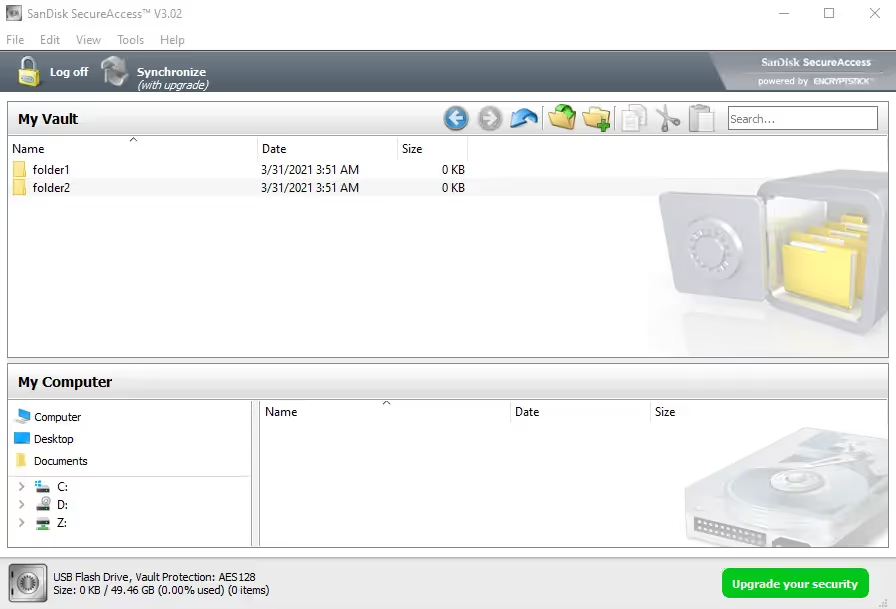
This project started during a forensic analysis. One of my colleagues came with a USB stick containing a vault encrypted with SanDisk Secure Access software. He asked me if it was possible to bruteforce the password of the vault to recover the content. I did not know this software thus, I started to research. It appeared that this solution is distributed by Sandisk by default on any storage device you buy from them.
Sandisk SecureAccess
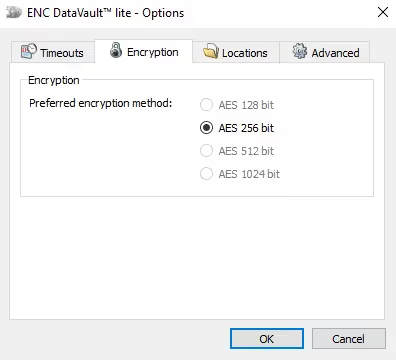
The solution is convenient, it allows a user to run the binary on the disk and after entering her correct password her vault is unlocked and the files are accessible. Once the software is closed, the files are encrypted back and not accessible anymore. So far nothing uncommon, but one thing drew my attention. In the Options menu, you can choose your “Preferred encryption method“.
I could choose ( if I would bought the premium version of the software) between several methods: “AES 128 bit“, “AES 256 bit“, “AES 512 bit” and “AES 1024 bit“. It was surprising to me since AES keys are defined in the standard to be either 128, 192 or 256-bit long but not 512 nor 1024 bits. Thus I was definitely interested to know what was behind this solution.
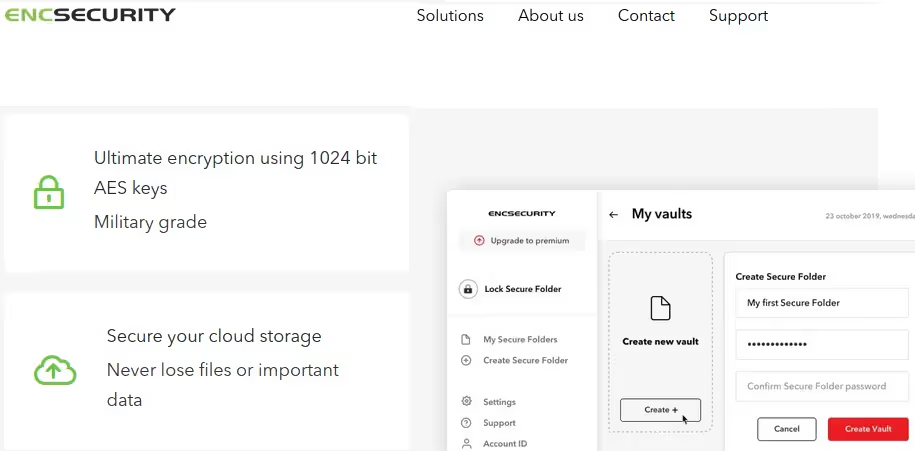
I dug a bit deeper and I discovered that the solution is developed for SanDisk by a company called ENCSecurity. The interesting part is that the solution is general and distributed to Sony and Lexar as well under different names. ENCSecurity also sells their own paying version with more options. I was surprised that the solution was not supported yet by John the ripper nor Hascat. In addition, the security claims of their website are really strong.
ENCSecurity website
They claimed to provide “Ultimate encryption using 1024 bit AES keys, Military grade”. Thus for all those reasons, I decided to analyze the solution to figure out how it was implemented.
The binary is a PE packed with UPX. PE explorer allowed me to unpack it and still run properly. In the ENCSecurity version of the software, an option allows enabling the log of the application. At the beginning of the log I had:
05:11:42.633 D utils.cpp 372 showMessage returned 005:11:42.633 I encmainwindow.cpp 738 Starting ENCDataVault70 version: 7.1.1W
05:11:42.633 I encmainwindow.cpp 739Date: 28.04.202105:1105:11:42.633 I encmainwindow.cpp 740 Qt library version: 5.9.605:11:42.638 I encmainwindow.cpp 741 OpenSSL system library: OpenSSL 1.0.2q 20 Nov 201805:11:42.638 I encmainwindow.cpp 742 OpenSSL version: OpenSSL 1.0.2q-fips 20 Nov 201805:11:42.638 I enclogging.cpp 322 Application name: "ENCDataVault70"
I knew it used OpenSSL and Qt libraries and I got the version number as well. It allowed me to create a Ghidra Function ID database on the same libraries and Ghidra matched some of the function signatures in binary. It simplified a lot the analysis since all the Qt functions could be left apart since they concern the GUI and the interesting functions use OpenSSL for Cryptography algorithms.
In fact from a general point of view, I was analyzing a password hash function. The function takes as input a user password and hashes it to a key which is later used to encrypt or decrypt data. Usually, the password hash function takes as input a unique and randomly generated salt to avoid precomputed attacks like dictionary or rainbow table attacks. Another common parameter of the hash function is the iterations number which allows to adapt the work factor. The higher the iteration number is the longer it will takes to compute the hash and thus, the harder it will to bruteforce the password for an attacker. Currently the are various recommended algorithms like: PBKDF2, Scrypt or Argon2. Argon2 is the winner of the Password Hashing Competition and is now considered as the state of the art for password hashing.
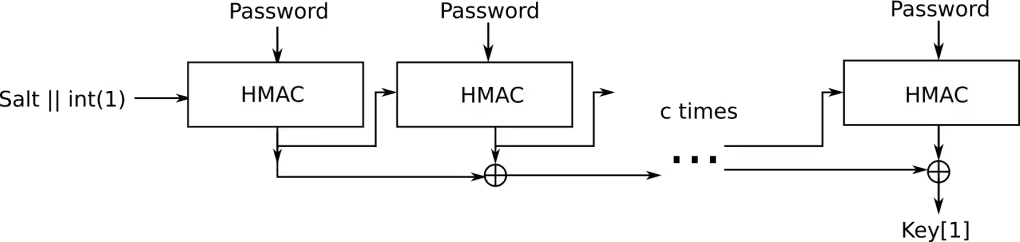
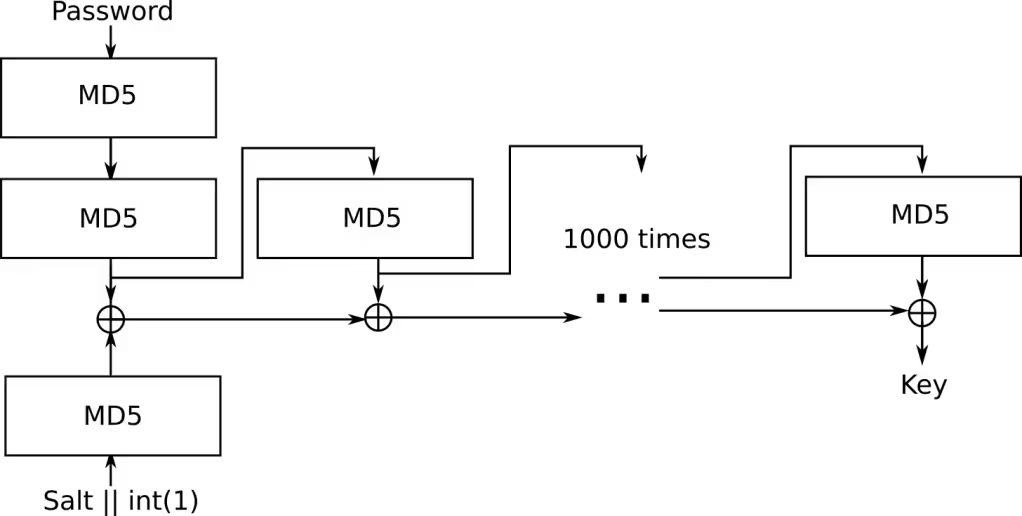
For this analysis, I only needed to focus on PBKDF2. Its design is simple:
It uses a HMAC function with the user password used as the input key. The input message is simply the salt concatenated with the constant 1. In the previous figure, c is the number of iterations. At the end we obtain a key. However with the current construction, the key cannot be larger that the output of the HMAC. So how do we construct 1024-bit keys? PBKDF1 was originally designed with this limitation. However, in PBKDF2, the solution was found to iterate several time the construction but with the input message to be the salt concatenated with constant 1 to obtain the first key part key[1], then the constant 2 is used to obtain the second key part key[2] and so on … Then the derived key is simply the concatenation of all the key part obtained during the iterations.
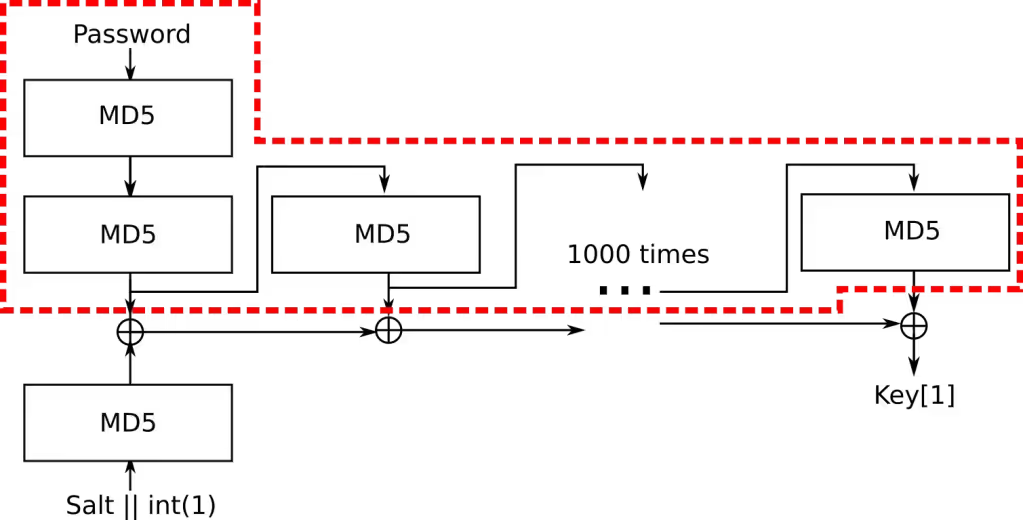
If we go back to our binary, the key derivation function was not identified directly by Ghidra Function ID and I had to reverse it manually. Thankfully, some calls to the MD5 hash function were identified under several layers of calls. Finally, after some efforts, I was able to reverse it. Here is how it looks:
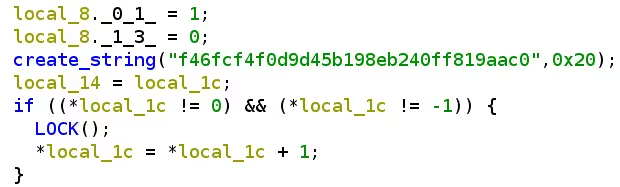
The design is similar to PBKDF2 but they used MD5 hash which is not an HMAC function. The last thing missing was the generation of the salt. I struggled hard to find where this was generated but finally, I figured out it was hardcoded in the code directly.
Hardcoded salt in the code
It looks randomly generated but it is definitively not unique since all vaults created with the software would use the same salt for the key derivation. In addition, users using the same password would end up with the same decryption key. Later I discovered that the same salt value is also shared among all the vendors: SanDisk, Sony and Lexar. A less critical problem is that the number of iterations is also fixed and set to 1000. This number of iterations was good when PBKDF2 was designed but nowadays the iteration number has to be higher. For example, OWASP recommends now 310000 iterations when PBKDF2 uses HMAC-SHA-256. Nevertheless, the construction itself of the key derivation function is flawed.
The part in red does not depend on the salt or the constant. Thus it allows making precomputation attacks even if the salt is randomly generated by precomputing the part in red and XOR the result with the salt afterward. It also reduces the complexity of generating large keys since the part in red can be reused at each iteration. This shows once again that trying to implement custom Cryptography often leads to failure. This was the first problem I reported to ENCSecurity and CVE-2021-36750 was issued for this problem. ENCSecurity later patched the problem by using OpenSSL implementation of PBKDF2-SHA256 together with a randomly generated salt and 100000 iterations.
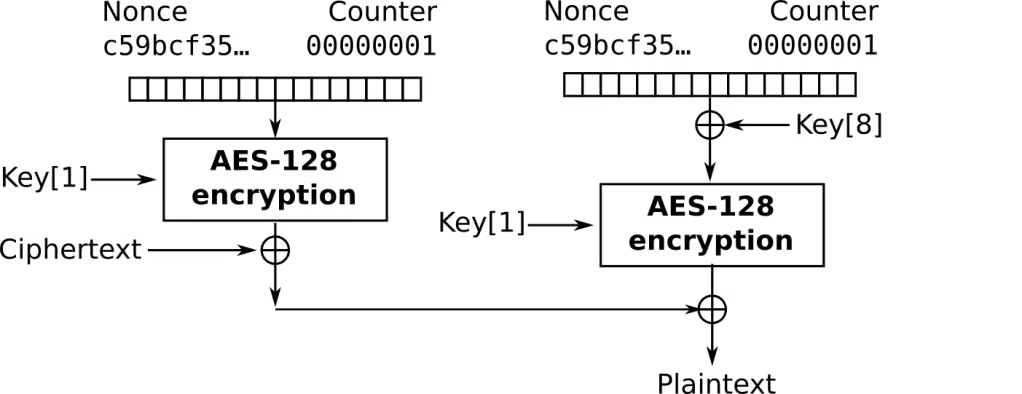
Now that I got the key derivation function, I checked how the password was verified to be correct. In fact, a file name filesystem.dat sored in the folder C:\Users\user\AppData\Local\ENCSecurityBV\ENCDataVault70\ENCDataVault contains an encrypted magic value. When the decryption of this magic value gives 0xd2c3b4a1 then the password is considered correct. The decryption algorithm used OpenSSL AES encryption. In fact for the AES-128 option, the encryption is simply AES in CTR mode with a 128-bit key generated from the key derivation function described earlier. However for the other modes the construction is more curious.
It uses multiple AES encryptions. Two for AES-256 option, four for AES-512 and eight for AES-1024. Each time AES encryption is performed with a 128-bit key. The key parts generated previously with the key derivation function are XORed to the first eight bytes of the nonce prior to the encryption and finally, all the results are XORed together. Once the password is checked to be correct eight file encryption keys are decrypted with the same algorithms. Those keys are used to encrypt and decrypt the file stored in the vaults. This is a common way to proceed since it prevents re-encrypting all the files if a user changes her password. Only the file encryption key has to be re-encrypted in this case.
I got everything I needed to implement a John the ripper plugin that allows everybody to bruteforce AES-1024 military grade encryption! The plugin is now integrated into the main repository and also includes also the bruteforce of the new key derivation function based on HMAC-PBKDF-SHA256.
The latest point I needed to elucidate was how the files themselves are encrypted. First I thought they used the same encryption algorithm based on AES. For AES-128 is still the same method, AES in CTR mode. However, I was not able to decrypt the vault using other options. I came back to Ghidra and reversed the algorithm further. It turned out that the file decryption algorithm is different.
“AES-1024″ encryption
It appears that only two iterations of AES is performed for any other option and only the last file key, for example, key[8] for AES-1024, is used and XORed with the nonce and counter. However, the construction is closed to CTR mode of operation and thus also has the malleability property. It means that if an attacker has access to the encrypted data he can make modifications that would not be detected during the decryption and the same modification is applied to the decrypted file.
In addition, the previous construction gives only a maximum security level of 256 bits since we theoretically have to bruteforce the first file key, key[1], and the last one key[8]. But we can do more, if we assume we know that two blocks that have the corresponding plaintext equal to zero we can write the following formula.
The plaintext is not involved in the equations since it is zero. Then we can decrypt each part of the equations to have:
Finally, we XOR both equations and we obtained the following result.
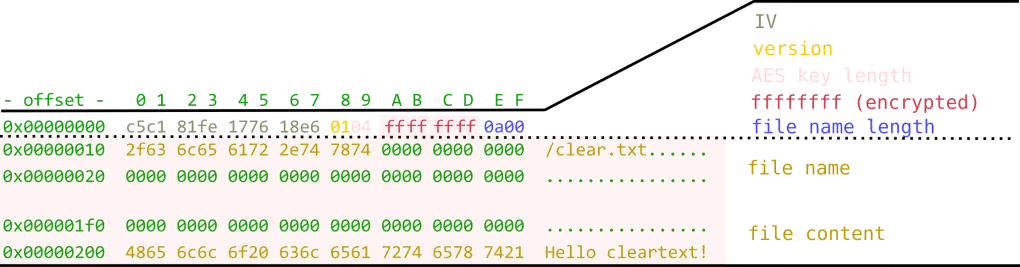
There is no further dependency on the last file encryption key and thus it shows a reduction to 128 bits of security. Indeed we only need to bruteforce the first file key until we obtain the right part of the equation which is known. We made the assumption that we had found two separate blocks matching the encryption of a zero block. In fact, files are encrypted in a way that includes some zero blocks. Let’s look at the encrypted file format.
Encrypted file format
The IVs are in clear followed by the file name length. Then the file name is stored encrypted followed by zero blocks until offset 0x200 where the encrypted file content starts. Thus, our previous analysis holds for this solution and shows that we have only a level of security of 128-bits for all the encryption options. Those problems were also reported to ENCSecurity and CVE-2021-36751 was attributed to that.
This analysis shows again that it is difficult to roll a custom cryptographic algorithm and also that the level of security of a solution does not depend on the number of encryptions performed.
2022
Security Advisory
May 6, 2022
BIG-IP iControl REST API Authentication Bypass
No items found.
Kudelski Security Team
This bulletin was written by Yann Lehmann of the Kudelski Security Threat Detection & Research Team
Update May 18th, 2022, 1800h UTC (2PM EDT)
According to a recent report from the U.S. Cybersecurity and Infrastructure Security Agency (CISA) and the Multi-State Information Sharing & Analysis Center (MS-ISAC) released on May 18th, exploitation of the vulnerability has been observed on both government and private sector’s network.
Several POCs of exploits have since been released to the public, making the exploitation of that vulnerability much more accessible, including to less sophisticated actors. The Cyber Fusion Center (CFC) strongly urges its clients to apply the required patches to their affected devices. If any BIG-IP’s management ports or self IPs are or were publicly exposed, the CFC recommends to consider those devices as compromised and hunt for malicious activity. CISA and MS-ISAC have provided numbers of signatures for that purpose in the “Detection Methods” of the following CyberSecurity Advisory.
Summary
iControl REST is an evolution of F5 iControl framework. Leveraging this Representational State Transfer (REST) API, an authenticated user can accomplish anything that can be accomplished from the F5 BIG-IP command line. It is an extremely powerful API.
On May 04, 2022, F5 disclosed a critical CVE, CVE-2022-1388. It may allow an unauthenticated attacker with network access to the management port or the self IP addresses of the BIG-IP system to leverage the iControl REST component. This is because some requests to iControl REST can directly bypass the authentication mechanism. Due to the capabilities of this component, anyone with network access to the management port or the self IP addresses can execute arbitrary system commands and modify services or files. From the nature of the iControl rest component, this is a control plane vulnerability that does not expose the data plane.
At the time of writing there is no publicly known exploit of that vulnerability and F5 did not disclose any details on the requests that are able to bypass the iControl REST authentication. Moreover, with a good architectural design of the BIG-IP appliances the management port and the self IP addresses should not be directly exposed without control. However, according to CFC experience, such undisclosed requests are frequently quickly reversed-engineered by security researchers and malicious actors. As such the CFC recommends mitigating the risk immediately by patching. In addition, two others less-impacting vulnerabilities, CVE-2022-26415 and CVE-2022-29474, will also be mitigated by patching.
Affected Systems
This CVE-2022-1388 impacts only the following BIG-IP versions.
If you are running a later component that the one mentioned in the fixed column above, that version should contain the fix and you are not impacted.
Solution
F5 provided fixes for the most recent branches of BIG-IP devices. The CFC recommends immediately patching your vulnerable version. If it does not exist, the CFC recommends upgrading to a newer branch.
Temporary workarounds and mitigations
Until it is possible to install a fixed version, F5 provided temporary mitigations which restrict access to iControl REST to only trusted networks or devices. As this decreases the attack surface drastically, the CFC recommends applying the described mitigation steps immediately, until the BIG-IP devices have been patched.
Those mitigation include restricting or blocking iControl REST access through management interface or the self IP addresses. Another possibility to mitigate the CVE consists in modifying the httpd configuration.
The CFC also recommends reviewing the audit logs with the BIG-IP appliance for any suspicious activity.
What the Cyber Fusion Center is doing
While there are currently no known exploits, the CFC is currently contacting all Security Device Management (SDM) clients on F5 to organize the patching of all their impacted appliances and ensure there are no traces of exploitation of this CVE.
On February 23rd, the UK National Cyber Security Center (NCSC) with the US Cybersecurity & Infrastructure Security Agency (CISA) and other security agencies released information that the threat actor group known as “Voodoo Bear” or “Sandworm” has been leveraging a modular and fairly sophisticated implant dubbed “Cyclops Blink”.
Cyclops Blink appears to be a replacement of the previously discovered and documented VPNFilter modular implant framework, also previously leveraged by Sandworm. The VPNFilter and Cyclops Blink implants primarily target Small Office/Home Office (SOHO) network devices. The VPNFilter implant was previously used by the threat actor to redirect and manipulate traffic and infected devices were also used to maintain persistence on victim networks.
The devices infected by Cyclops Blink have been incorporated into a large-scale botnet operated by the threat actor, which appears to have first become active as early as June 2019. As of today, of the 1500+ impacted IPv4 that were reported, around 40% are geolocated in the United States.
In its current iteration, Cyclops Blink is highly modular and provides attackers several capabilities (as well as writing and deploying implant modules on the fly). Cyclops Blink has been observed primarily targeting SOHO devices from WatchGuard (Watchguard Firebox appliances). Additionally, Cyclops Blink is deployed persistently on infected WatchGuard devices by abusing the firmware upgrade mechanism.
While Cyclops Blink has only been observed on WatchGuard devices as of today, an assessment of the malware reveals that it could also be compiled and deployed onto other architectures and firmware.
Organizations with WatchGuard firewalls should review the solution section of this advisory for details on how to identify a potential infection and restore the system to a known good state. If the Watchguard management interface was exposed to the internet, organizations should assume the appliance has been compromised and investigate the system for signs of the implant prior to upgrading.
Affected Operating Systems
All Watchguard Firebox appliances are currently known vulnerable. As such organizations with Firebox appliances must be upgraded to the latest versions for the Firebox appliances as soon as possible. The latest Firmware for WatchGuard Firebox appliances is available for download from: https://software.watchguard.com/
Before upgrading any appliances, it is critical to assess whether your Firebox appliance may have been infected with Cyclops Blink. Watchguard, with the assistance of the NSA, CISA, and UK NCSC have provided with different methods to investigate and identify a potential infection as described in https://detection.watchguard.com/
Technical Details
CISA and the NCSC both describe the Cyclops Blink malware as a successor to an earlier Sandworm tool known as VPNFilter, which had infected over half a million routers before it identified by Cisco and the FBI and dismantled in 2018.
This implant is a multi-stage, modular platform with versatile capabilities to support both intelligence-collection and potentially destructive cyber-attack operations. It targets devices running firmware based on Busybox and Linux and is compiled for several CPU architectures.
The first stage primary ensures persistence (via crontab) which sets it apart from other IOT malware such as Mirai. Furthermore, it implements various redundant mechanisms to resolve the address of the second stage deployment server. The second stage once downloaded exposes the usual modules of a remotely management implant Command-and-Control including:
However, some of the most interesting modules are implemented in a third stage and are deployed independently as “plugins”. One such plugin implements a packet sniffer that allows inspection of traffic and consequently theft of credentials.
The Cyclops Blink malware comes in the form of a firmware update which abuses Watchguard’s standard firmware upgrade to install the malicious firmware. It leverages a vulnerability in the firmware update process where the Hash-based Message Authentication Code (HMAC) can be recalculated due to a hard-coded key in WatchGuard Firebox devices used to initialize hash calculation. This allows persistence between reboots.
The Cyclops Blink malware has the following capabilities (most critical ones listed):
• Add a new module to Cyclops Blink. • Update the Cyclops Blink Linux ELF executable. • Update the list of C2 server IPv4 addresses • Resend the current Cyclops Blink configuration to all running modules • Gather all system information like sysinfo, /etc/passwd, /proc/mounts/, …
The full technical details are linked in the reference section.
Solution
Firmware upgrades are available and if you have a legitimate firmware running in your Fireboxes you need to upgrade to the latest versions.
If your Fireboxes have been impacted by a malicious firmware you first need to remediate as described in watchguard’s documentation listed below:
To mitigate the risks until upgrading to the latest version the CFC recommends:
• Ensuring network devices’ management interfaces are not exposed to the internet. • Ensuring strong authentication material, rotated regularly, on Firebox devices management interface. • Monitoring firewall management activities on Fireboxes that have not yet been updated
What the Cyber Fusion Center is doing
The CFC has created hunting campaigns and compiled IOCs to identify potential communication with known Cyclops Blink C2 servers.
Implementing a ZK-focused authenticated-encryption scheme
No items found.
Kudelski Security Team
In the last few years, several practitioners have proposed zk-focused cryptographic constructions such as hashing and encryption primitives that operate on binary and prime fields and that have a low multiplicative complexity. They are also called arithmetization-oriented primitives. Some examples are the Reinforced Concrete, Rescue and MiMC hashing functions. These constructions typically target zkSNARKs and STARKs -based applications.
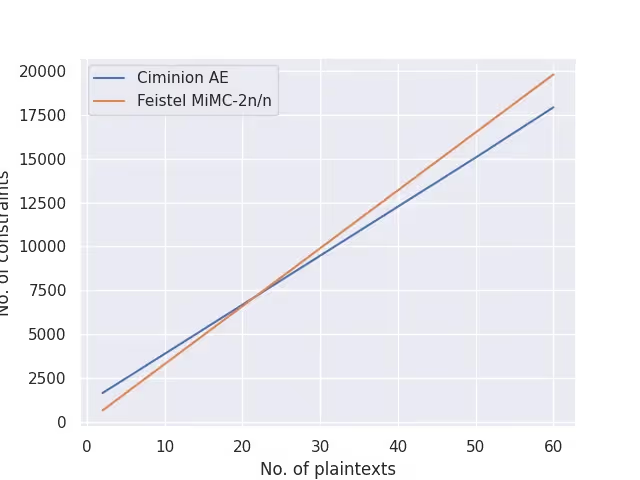
In this post, we focus on Ciminion, an authenticated-encryption scheme proposed by Dobraunig et al. and presented at EUROCRYPT 2021 and describe how it can be implemented using a domain specific language (DSL) for writing zkSNARKs circuits. Then, we compare our implementation with the MiMC cipher in Feistel mode (which uses a permutation that is widely used in circuits), and show how our Ciminion implementation outperforms it for a large number of plaintexts.
Introduction
zkSNARKs make it possible to convince another party that a particular statement is true restricting other information about the statement to a minimum. In this case, the statement consists on a deterministic arithmetic circuit with inputs and outputs. The recent availability of domain specific languages (DSLs) for creating zk-focused applications and circuits (some examples are circom2 and Leo) allows to speed-up the creation of privacy- friendly applications.
There are certain categories of applications that can be easily described using zkSNARKs:
Digital economy : Via zkSNARKs it is possible to prove that a person’s funds are higher than a certain value without revealing the exact amount and that this value belongs to a specific interval and has certain properties (think about a range proof with a greater degree of expressiveness). Further, by implementing a digital signature scheme such as ECDSA or EdDSA as a zkSNARK circuit, we can prove that a signing operation, described as a set of constraints, has been performed correctly.
Private authentication and authorization: Via zkSNARKs we can prove that we own a particular official identification document and that a certain field contains a specific value or lies in a particular interval and not revealing the rest of the fields of the document. In a way, we can obtain the same privacy capabilities that an attribute-based credential system provides. Moreover, proving that a value belong to a list of candidates without revealing it is easy to implement in a circuit and makes it possible to implement group-based authentication systems.
In this article, we focus on zkSNARKs DSLs, which provide a direct path for building privacy-friendly applications. We refer the reader to differentresources for learning the specifics of zkSNARKs, together with recent advances such as PlonKup, elastic SNARKs and Nova.
Describing circuits with a DSL
Using a DSL such as circom2, one can describe a zkSNARK as an arithmetic circuit with inputs (which can be private, public or a mix of both) and outputs. The circom2 compiler transforms the circuit description into a Rank-1 Constraint System (R1CS). Other tools such as snarkjs rely on the output of the circom2 compiler to provide the verifier and prover components that can be used to build applications based on zkSNARKs.
ZK-focused cryptographic primitives
Arithmetic operations in the circuit are always performed modulo a large prime and in the case of circom2, within the scalar field of the pairing-friendly curve BN2541 by default (whose security level was decreased to 103 bits in https://eprint.iacr.org/2019/885). However, it can be compiled to use the BLS-12-381 curve.
A zk-application might need to perform a hash operation, to encrypt a sensitive value or to derive an authentication tag of a message. Even if typical constructions such as SHA-3 and an AES modes could be implemented in a DSL, the performance in terms of number of constraints of the resulting circuits would be affected by schemes that rely on bitwise operations. For this reason, in the last few years several practitioners have proposed constructions such as the MiMC, Poseidon, and Rescue hashing algorithm and ciphers such as GMiMC and Ciminion. These constructions mainly operate on prime and binary fields and try to reduce the number of expensive arithmetic operations such as multiplications.
Ciminion
Ciminion is an authenticated-encryption scheme that was presented at EUROCRYPT 2021 by Dobraunig et al. It has been designed to target zero-knowledge proof applications such as zkSNARKs, STARKs and multi-party computation. It requires a limited number of field multiplication and it can be implemented over a prime field.
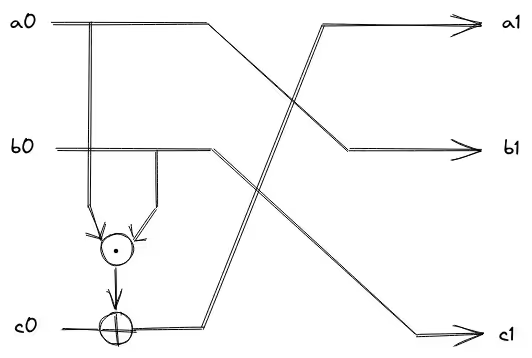
Ciminion reduces the amount of field multiplications by using the Toffoli gate and the Farfalle construction in order to minimize the number of rounds. In contrast, to other schemes such as MiMC that uses the power mapping f(x) = x^3, the Toffoli gate transforms a triple (a, b, c) into a triple (a, b, ab + c).
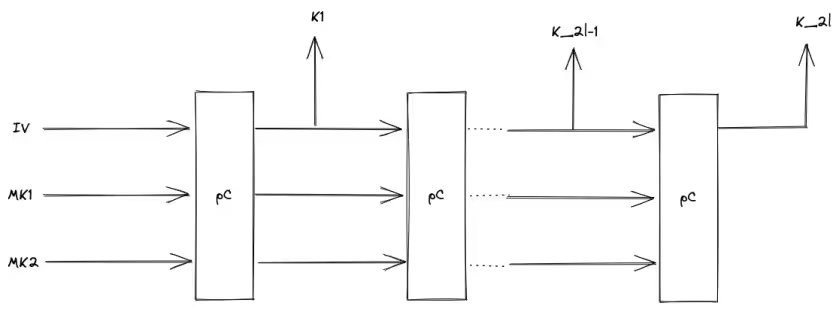
Farfalle is a permutation-based construction for a pseudorandom function (PRF) that focuses on parallelization and was designed by the Keccak Team in 2016. It typically uses a family of permutations with different number of rounds, and three layers: a mask derivation function, a compression layer (pC) and a expansion layer (pE). The Farfalle construction was designed with versatility in mind and can be transformed into an AE construction.
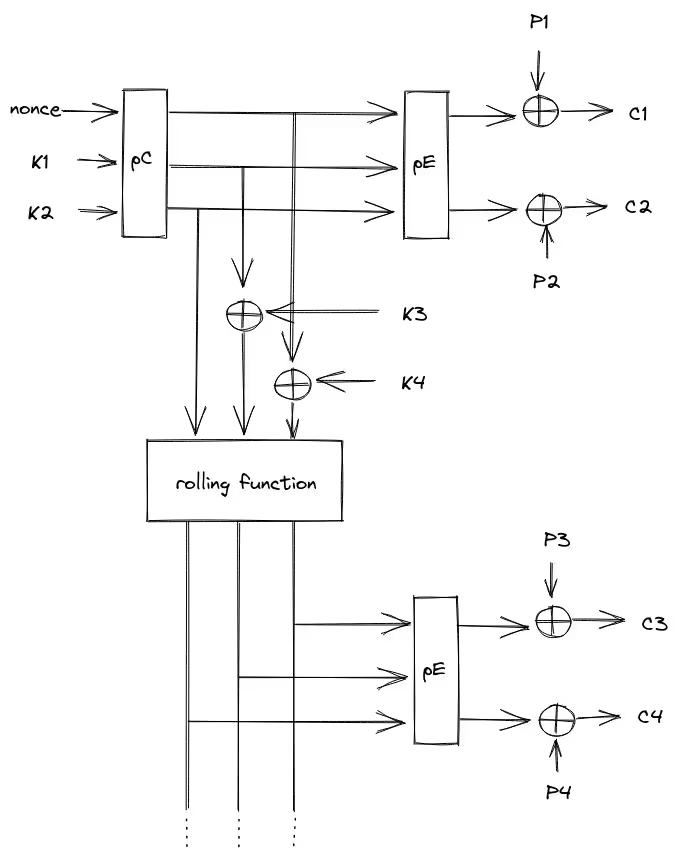
Ciminion structure and components
Ciminion receives the following input parameters: a nonce N and two subkeys (K_1 and K_2). It first applies the permutation pC to them and ouputs an intermediate state. Then, this state is transformed by the pE permutation. Two of the resulting elements are used to encrypt the first two plaintext elements P_1 and P_2. The rest of plaintext elements P_2i and P_2i+1 are processed as follows: another pair of subkey elements are added to the intermediate state. Then, the rolling function and the pE permutation are applied to obtain another two field elements that are finally used to encrypt the subsequent pair of plaintext field elements.
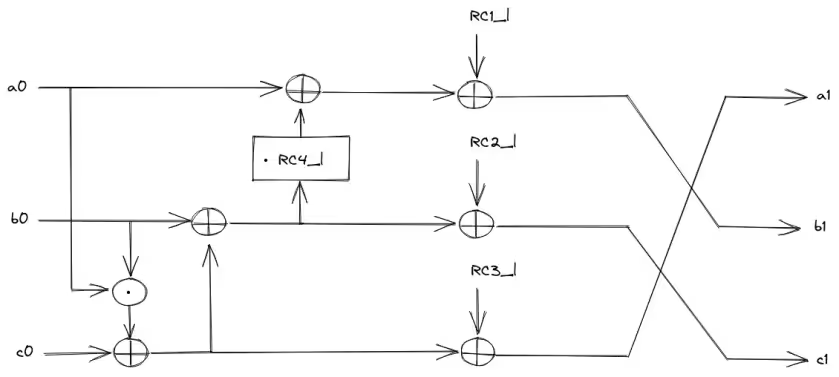
Both the pE and pC permutations transform a triple (a, b, c) using the round function with different number rounds:
The Ciminion round function, adapted from the original paper
RC are the fixed round constants. They are generated using SHAKE-256 and can be precomputed before performing the authenticated-encryption operation. Finally, the rolling function performs the Toffoli gate operation:
The Ciminion rolling function, adapted from the original paper
In Ciminion, a set of subketys needs to be generated for performing authenticated-encryption. This is performed using two master keys, MK1 and MK2 and a public IV. Ciminion expands the master key elements using a sponge construction that relies on the pC permutation:
SubKey generation in Ciminion, adapted from the original paper
Implementing Ciminion in circom2
For a given circuit written in circom2, the compiler generates the proof and a R1CS version of the circuit in the form of (A * B) – C = 0. Further, a zkSNARK implementation such as snarkjs can use either Groth16 or PLONK to verify the proof.
In circom2, each circuit is considered a component that can be imported in another circuit in a way that it is possible to generate a library of reusable gadgets such as circomlib. Constrains in the circom2 library are described using the “===” operator and by default, all the signals are private.
We refer the reader to the circom2 documentation for installation instructions and language details. We have found hardhat-circom and the circom2 syntax plugins for vscode and vim very useful.
The rolling function
In this section, we explain how to implement the Ciminion components in circom2.
First, we start with the smaller components and we start composing them in a bottom-up fashion til arriving at the Farfalle-like construction of Ciminion. The rolling function it is the simplest component operation of Ciminion. It just performs the Toffoli gate operation. This is a component with 3 inputs and 3 outputs, being the triple transformed the output:
pragma circom 2.0.3;

template Rolling() {
    signal input s0;
    signal input s1;
    signal input s2;

    signal output b0;
    signal output b1;
    signal output b2;

    b0 <== s2 + s0*s1;
    b1 <== s0;
    b2 <== s1;
}
The pC and pE permutations
The Ciminion round function involves the following inputs: the triple a, b, c (e.g. a_0, b_0, c_0), four round constants (e.g. RC_0, RC_1, RC_2, RC_3) and 3 outputs: a_1, b_1, c_1, that is, the output triple after performing the transformation operation. Then, we can instantiate the permutation (round function f_i) to create the iterated permutations pC and pE:
pragma circom 2.0.3;

template Permutation() {
    signal input a0;
    signal input b0;
    signal input c0;

    signal input RC0;
    signal input RC1;
    signal input RC2;
    signal input RC3;

    signal output a1;
    signal output b1;
    signal output c1;

    signal a0_mul_b0_plus_c0_plus_b0;

    a0_mul_b0_plus_c0_plus_b0 <== a0*b0 + c0 + b0;

    a1 <== c0 + a0*b0 + RC2;
    b1 <== a0 + RC3*(a0_mul_b0_plus_c0_plus_b0) + RC0;
    c1 <== a0_mul_b0_plus_c0_plus_b0 + RC1;
}
Once we have the permutation implemented, we only need to iterate during a specific a number of rounds and the corresponding list of round constants:
template IteratedPermutationN() {
    signal input a0;
    signal input b0;
    signal input c0;

    signal output a1;
    signal output b1;
    signal output c1;

    var c[536] = [
          292334644102394411537362212093572878140,
          250282066453690133315708418387534650045,
          25210252274841859825108081164557115781,
          16246747660448753010909888379129524409,
          131669148524554050620166690622542333908,
          73395003443371763039182051680716568403,
    [...]
Given a number of rounds nRounds per permutation, we instantiate one Permutation component per iteration (in circom2, a value can be assigned only once to a signal). The outputs of a permutation component i are redirected to the input of a permutation component i+1 and the final triple consists of the output of the permutation component nRounds – 1:
The key generation operation in Ciminion takes as input the IV and two master keys. It iterates the permutation pC (permutation N in the Ciminion reference code) on this input in order to generate the subkeys K_i. The output corresponds to the first value of the output triple (a1, b1, c1), that is a_i for subkey K_i. We can generate a component that is instantiate according to the number of sub keys e.g. nKeys:
pragma circom 2.0.3;

include "permutation.circom";

template KeySchedule(nKeys) {
    signal input s0;
    signal input s1;
    signal input s2;

    signal output keys[nKeys];
    component p_n[nKeys];

    for (var i=0; i<nKeys; i++) {
        p_n[i] = IteratedPermutationN();

        if (i == 0) {
            p_n[i].a0 <== s0;
            p_n[i].b0 <== s1;
            p_n[i].c0 <== s2;
        } else {
            p_n[i].a0 <== p_n[i-1].a1;
            p_n[i].b0 <== p_n[i-1].b1;
            p_n[i].c0 <== p_n[i-1].c1;
       }
       keys[i] <== p_n[i].a1;
    }
}
The Farfalle-like structure
Finally, we have all the components to generate the authenticated-encryption primitive.
This component will use:
the key generation component to generate the nSubKeys subkeys.
the permutations pC and pE
the rolling function
the MAC generation algorithm for a given ciphertext
We receive as inputs: the nonce and the two master key elements, nPairs of plaintexts and we output: a TAG element that authenticates nPairs of ciphertexts:
template CiminionEnc(nPairs) {

    var nSubKeys = 2*nPairs + 3;

    signal input MK_0;
    signal input MK_1;
    signal input nonce;

    signal input PT[nPairs*2];
    signal output CT[nPairs*2];
    signal output TAG;
The first part of the encryption operation starts the key schedule:
Then, the permutation pC is applied to the supplied nonce and to the first pair of subkeys. Then, for each pair of plaintexts, the rolling and pE permutation are applied:
circom2 allows to debug and test a circuit implementation via Mocha. In this section, we show how we could test the Ciminion implementation that we have created. First, we’ll need to declare a main component in the circuit description that we want to test. We start with the Ciminion rolling function:
component main = Rolling();
Via the ffjavascript package we can perform finite field arithmetic operations within the BN254 curve scalar field and can compare the results. For instance, we can generate random inputs for the Ciminion rolling function and execute the function in JavaScript:
$ mocha rolling.js
Rolling function ✔ Conformancetest (47ms)
1 passing (52ms)
Finally, we can also test that encryption was performed correctly by decrypting the result. In that case, we can first write a circuit that decrypts a set of ciphertexts and call both circuits from mocha.
In order to reverse the encryption operation, we need to obtain the plaintexts as:
We have compared the number of constraints required for implementing Ciminion with those of MiMC in encryption mode (particulary Feistel MiMC-2n/n). The MiMC construction is typically used in circom2 circuits. We see that Ciminion scales better for larger plaintexts, due to the utilization of the Farfalle construction in comparison to the MiMC construction based on the Feistel structure.
We have released the code and tests utilized in this article in our GitHub repository.
Acknowledgments
Part of this work was done during the 2nd 0xPARC Learning Group.
Notes
1The BN254 curve security level has been estimated in around 103 bits at the time of writing this post. See https://eprint.iacr.org/2022/586.
Last update: 14th July 2022
2022
Security Advisory
April 25, 2022
“INCONTROLLER” / “PIPEDREAM” ICS Toolkit Targeting Energy Sector
No items found.
Kudelski Security Team
This advisory was written by Travis Holland and Eric Dodge of the Kudelski Security Threat Detection & Research Team
Summary
Incontroller/Pipedream is a collection of sophisticated tools thought to be created by group dubbed “Chernovite” by Dragos. Chernovite is assessed to be a a state-sponsored adversary, with the intention for use in future operations. The primary focus for this toolkit is for use in the electric and natural gas verticals; however, it is not limited to solely those. At this time, the CFC has no intelligence that Pipedream has been successfully deployed in the wild at this time. This has provided researchers time to evaluate the tools proactively. This is a suite of utilities designed to allow for access to and manipulation of Schneider Electric and Omron PLCs, as well as Open Platform Communications (OPC) Unified Architecture OPC-UA servers. Dragos, an ICS focused cyber security company, has broken Incontroller/Pipedream into five categories: Evilscholar, Badomen, Mousehole, Dusttunnel and Lazycargo.
Evilscholar: Provides the capabilities to discover, access and manipulate Schneider Electric PLCs.
Badomen: Provides the capability to scan, identify and access Omron software and PLCs.
Mousehole: The tool is designed around interacting and accessing OPC Unified Architecture (UA) servers which allow for enumerating nodeids and brute forcing credentials.
Dusttunnel: Remote operation implant to establish persistence and command and control.
Lazycargo: Interface that drops and exploits a known vulnerable ASRock driver to elevate credentials.
When properly used these tools allow for an attacked to scan for devices, brute force passwords, close connections, and even crash the targeted device. PLC implants are utilized to execute untrusted code from the PLCs, these implants could be on an impacted PLC for long durations, requiring firmware forensic analysis to reveal its presence.
The CFC has worked with its ICS-aware Network intrusion Detection System (IDS) partner, Claroty, who has written and published detection signature for PipeDream. All clients of the CFC’s MDR for O.T have had these signatures updated for their Claroty deployments.
Affected Systems
This impacts the following systems typically located in electrical substations and communicating through IEC-104 protocol:
Systems vulnerable to CVE-2020-15368; ASRock driver exploit
Schneider Electric MODICON and MODICON Nano PLCs, including (but may not be limited to):
TM251, TM241, M258, M238, LMC058, and LMC078
OMRON Sysmac NJ and NX PLCs, including (but may not be limited to):
NEX NX1P2, NX-SL3300, NX-ECC203, NJ501-1300, S8VK, and R88D-1SN10F-ECT
Incontroller/Pipedream is a sophisticated and modular set of tools that an attacker can leverage once they have established access within an environment. The foothold is established by any vector available to the attacker and is followed up with utilization of the ASRock driver exploit (CVE-2020-15368) to further escalate their privileges, and to move through the environment. The ASRock exploit is rather trivial, and only requires administrative access to further escalate privileges and execute arbitrary code with kernel privileges.
The modular architecture and automation of the tool allows for easy addition of more components as needed (such the ASRock exploit) could easily be swapped in favor of another exploit or tool. Depending on the PLC type there are different actions and objectives that the threat actor would look to achieve.
Capabilities of the tooling per impacted vendor
Schneider Electric Devices:
Rapidly scan and identify all Schneider PLC’s on other network via UDP multicast over port 27127
Brute force Schneider PLC passwords via CODESYS over port 1740
Conduct denial-of-service attacks to prevent network communication to the PLC
Drop connections, forcing re-authentication to the PLC to gather credentials
Crash the PLC, for a power cycle and configuration recovery
Pushing custom Modbus commands/packets
Retrieving file/directory listings
Deleting files
Adding a route if the device gateway IP exists on a different interface
Connecting to specific devices
Omron devices:
Scanning for Omron via FINS protocol over port 9600
Parsing out HTTP response from Omron devices
Retrieving MAC addresses of devices
Polling for what devices are connected to the PLC
Backup and restoration of arbitrary files to or from the PLC
Loading custom agents on the PLCs to allow for additional capabilities
Wiping the device’s memory and resetting it
Activating the Telnet daemon
Connecting to the device via the Telnet daemon and uploading or executing payloads and commands
Perform a network capture
Killing processes on the device
Transferring files to the device
Connecting and communicating with attached servo drives
OPC UA:
Identify OPC UA servers
Connect to OPC UA servers via default or compromised credentials
Reading/Writing tag values for data on OPC UA servers
Brute forcing credentials
Outputting log files
Currently Known Indicators of Compromise (IOCs)
RwDrv.sys (RWEverything)
AsrDrv104.sys (AsrPolychromeRGB)
AsrDrv103.sys (AsrPolychromeRGB)
ProcessHacker.exe
Solution/Mitigation
There is currently no evidence of Incontroller/PipeDream being deployed for disruptive or destructive effects. It is known to utilize standard ICS protocols and actions to live off the land natively. Proper monitoring of any suspicious use of the ASRock driver can help mitigate a portion of the toolset seen within Incontroller/PipeDream. It is important to note that utilization of the AsRock Driver exploit requires the attacker to already have administrator level privileges on the host, however, future exploits may have different requirements.
The Cyber Fusion Center recommends the following for mitigation, discovery, and recovery:
Appropriate network segmentation, and strong perimeter controls
Leverage Secure Remote Access with Multi Factor Authentication and monitored sessions
Jump Servers monitored with Endpoint Detection and Response (EDR) technologies
Active endpoint monitoring on HMIs, Engineering Workstations, and Historians
Strong password policies and management
Patch management
Only allow connection to ICS/SCADA infrastructure through certain engineer workstations
Disable the Schneider NetManage discovery service
Monitoring for new outbound connections from PLC’s
Additionally dedicated ICS monitoring can aid in quickly identifying things outside the baseline that could be indicative of movement and attacks within the ICS infrastructure. Examination of non-baseline activity, and restricting access to the following destination ports:
TCP 502; Modbus
UDP 27127; primarily used for discovery scanning
UDP 1740-1743, TCP 1105, and TCP 117470; CODESYS
TCP/UDP 9600; default communication port for Omron
What the Cyber Fusion Center is doing
While there are currently no known active deployments of this tooling, the Cyber Fusion Center’s O.T Intrusion Detection System (IDS) partner, Claroty, has developed and published network signatures designed to detect the potential presence of this tooling. All clients of the CFC’s MDR For O.T service have had these new detection signatures deployed on their behalf.
Lapsus$ Threat Actor Demonstrates Access to Backend Okta Tooling
No items found.
Kudelski Security Team
Summary
Okta is one of the premier identity providers in the World and is trusted by thousands of customers. The recently known Lapsus$ threat actor group, that has been very active lately targeting Microsoft and Nvidia, has allegedly breached Okta’s customers environments. The group published screenshots of environments that they were able to access. The threat actor claims that they have acquired full admin access to Okta.com and they also claim that “our focus was ONLY on Okta customers”.
While Okta has confirmed that an attempt to breach Okta in late January 2022 was investigated and contained at the time, Okta has now acknowledged that after thorough investigation they have currently identified approximately 2.5% of their customers who have been impacted thus far.
Only customers of the “core” Okta product are possibly impacted, there is no impact to Auth0 customers, nor to customers leverage their HIPAA and FedRAMP certified platforms. Okta said that the impacted customers have already been contacted by email.
Finally, Okta’s investigation showed that during a five-day window of time (Jan 16-21, 2022) the threat actor had access to a third party (contractor) support engineer’s laptop. The impact is limited to the access of the support engineer. Support engineers have access to limited data like Jira tickets or list of users and can reset passwords, multi-factor authentication (MFA). But Okta confirmed that they are unable to create and delete users, neither are they able obtain those passwords or download customers databases.
What the CFC recommends
If your organization is using Okta and has been notified by Okta that you are impacted, the CFC strongly recommends contacting your incident response partner to help understand the potential extent of the attack campaign.
We also recommend quickly suspending accounts that may have had their credentials or MFA devices reset by the threat actors prior to validating that such access has not been abused by the threat actor.
Even if Okta has not identified that you are an impacted customer, the CFC strongly recommends that all Okta customers take the following actions:
Search the Okta system logs for signs of compromise since January 16, either in a SIEM or directly in Okta logs. This can include things like password change or MFA device or token updates.
The MDR Detection Engineering and IR teams recommend searching for the following event types:
user.account.reset_password
user.mfa.factor.update
system.mfa.factor.deactivate
user.mfa.attempt_bypass
user.session.impersonation.initiate
Compile a list of accounts that were found in Okta since the beginning of 2022 and review with the owners of the accounts whether those changes are legitimate
Follow best practices regarding identity management with a specific focus to MFA
What is the CFC doing?
The CFC leverages Auth0 as a Multi-Factor and Authorization provider. Due to these events the CFC is closely working with Auth0 to ensure our internal users are not impacted. The Kudelski Security DevOps and Security Engineering team has worked with Okta to confirm that this time Auth0 platform is not known to be impacted by these events.
However, although Okta has not yet identified any suspicious activity with regards to the Auth0 platform, the Kudelski Security has worked to ensure no suspicious activity was identified with regards to user MFA devices.
Additionally, it’s important to note that the CFC does not leverage Auth0 to store internal user credentials. Auth0 is used to provide Multi-Factor Authentication and Authorization to provide access to internal CFC systems and infrastructure. This dual vendor strategy ensures that no single vendor is a single point of failure. Successful compromise of the CFC’s environment would require that a threat actor compromise both the CFC’s identity and credential provider (Azure Active Directory) and Auth0 in order to gain access to internal CFC systems or that threat actors active a “single vendor” break the glass scenario that would notify the Kudelski Security DevOps team. No such activity has been identified.
The CFC will continue to monitor the situation and will provide updates to clients as more information is available. At this time, there is no indication that the CFC’s Auth0 deployment has been affected and no indication that a threat actor has been able to reset MFA devices.
CFC Response to Russia / Ukraine Tensions and Potential Cyber-Attacks in Retaliation to Western Sanctions
No items found.
Kudelski Security Team
As the current situation continues to evolve, the Kudelski Security Cyber Fusion Center is continuously adapting our response to events, intelligence, and new details being released. For details on how the CFC is responding to newly released information, please review the following updates.
Notified Vulnerability Scanning Clients of Newly Identified Vulnerabilities Known to be Actively Exploited
On March 3rd, the United States Cybersecurity and Infrastructure Security Agency (CISA) updated their catalog of known commonly exploited vulnerabilities and added 95 new entries after increased analysis of suspected Russian intrusions. The bulk of these newly added vulnerabilities appear to have been actively exploited by Russian threat actors, and as such, should be prioritized for remediation. In response to this new set of known exploited vulnerabilities, the CFC has reviewed vulnerabilities found for clients of the Kudelski Security’s Vulnerability Scanning Service, the CFC proactively updated all impacted clients with the list of known exploited vulnerabilities on their internet-exposed systems.
2. Fine Tuning of Volume Shadow Copy (VSC) Auditing for MDR For Endpoint clients with CrowdStrike Falcon
For clients of the CFC’s MDR for Endpoints service, the CFC continues to fine tune the extra visibility on enabled to identify tampering with Windows Volume Shadow Copy (VSC) “backups”. The CFC has analyzed and reviewed all alerts generated and is working with clients for to gather additional input regarding the legitimacy of the activity observed. The CFC will await client’s feedback in order to fine tune configurations prior to enabling the VSC deletion features in order minimize disruption of any legitimate activity.
3. Analysis and Vigilance of New WMI and SMB Worm used to deploy HermetricWiper in Ukraine
The CFC has continued to monitor information and research about the malicious software deployed against Ukraine. As part of this monitoring, the Kudelski Security Detection Engineering team analyzed the worm component named “HermeticWizzard” to ensure the CFC’s security analysis team remained informed about how destructive attacks against Ukraine were carried out. As an example of this analysis, the following diagram was created by our team describing the logic and potential indicators of compromise of this new worm component:
4. Validation of Newly Deployed Claroty Signatures for MDR for O.T Clients
For our MDR for O.T clients, on February 27th, Claroty released a new threat bundle that included new and updated detections for HermeticWiper and additional detections for newly discovered malware dubbed “SockDetour”. SockDetour is a highly stealthy malware used as a secondary implant on compromised Windows servers since at least July 2019. As we already ensured all our Claroty Continuous Threat Detection (CTD) deployments are configured to receive automatic signature updates, all MDR for O.T. clients have already benefitted from these extra detection capabilities.
5. Continuous Vigilance and Advisory Development
In addition to the previous measures, the CFC released an advisory on Cyclops Blink, a new malware that appears to be a replacement of the previously discovered and documented VPNFilter malware. While Cyclops Blink is known to only target SOHO devices from WatchGuard so far, an assessment of the malware reveals that it could also be compiled and deployed onto other architectures and SOHO networking equipment. This information leads CFC to continuously monitor this threat and its evolution in order to identify potentially infected system and provide clients with mitigation and remediation steps as soon as possible.
Summary
As communicated previously, the Kudelski Security Cyber Fusion Center is aware of and actively monitoring the current global tensions resulting from the events surrounding Russia and Ukraine. The United States Cybersecurity and Infrastructure Security Agency (CISA) has published an advisory regarding potential Russian attempts to utilize cyber-attacks for force projection and as a response to western sanctions.
There are currently no specific threats targeting the United States, other NATO members or partner countries. However, Russian interests have recently expressed discontent with ongoing sanctions and have shown willingness to target “sensitive” assets. Additionally, the CFC is aware of several cyber-criminal groups (such as the Conti ransomware group) who have pledged to attack critical infrastructure of “Russian enemies” in the event that a cyber-attack is launched against Russia. In light of these threats and the ongoing situation with Ukraine, the Cyber Fusion Center is operating with increased vigilance and is actively monitoring for potential cyber-attack related activity as part of these increased tensions. This increased vigilance will continue until tensions ease.
Additionally, the CFC is aware of active deployment of data wipers (dubbed “HermeticWiper”) being discovered and potentially deployed in critical infrastructure within Ukraine. These wipers have also been discovered on systems of Ukrainian government contractors based in Latvia and Lithuania.
The CFC will continue to monitor the situation and provide our CFC analyst team and clients any additional technical and cyber security related insights.
What the Cyber Fusion Center is doing
1. Identified Known Exploited Vulnerabilities discovered on vulnerability scanning client perimeters
For clients using Kudelski Security’s Vulnerability Scanning Service, the CFC has proactively reviewed vulnerability scan results for internet-exposed systems for vulnerabilities that are known to be actively exploited, according to CISA.
The CFC has prioritized identifying vulnerabilities known to be used by Russian Threat Actors. For clients who have known exploited vulnerabilities on their internet perimeter, the CFC has opened cases to communicate which assets may be vulnerable and should be remediated as soon possible.
Cyber Fusion Center strongly suggests clients who use the Kudelski Security Vulnerability Scanning service to validate their vulnerability scanning scope to ensure all internet facing assets are being properly scanned.
2. Enabling Additional visibility into wiper and ransomware technical precursors or MDR for Endpoint clients
Based on guidance from our Detection Engineering and Incident Response organizations, the CFC is working to enable additional CrowdStrike visibility (Volume Shadow Copy – Audit) for technical precursors of ransomware across the client base. As this additional audit visibility may generate false positive CrowdStrike detections, the CFC will be investigating all volume shadow copy related activity, escalating activity believed to be suspicious, and tuning as appropriate.
The CFC will monitor for the effects of the auditing policy mentioned above, and for clients with CrowdStrike’s Prevent module, the CFC may recommend enabling specific Crowdstrike features that prevent the deletion of Windows “backups” (volume shadow copies). The CFC will communicate with clients and get approval prior to enabling any preventative controls.
Note: No additional auditing is currently required for clients with Microsoft Defender for Endpoint.
3. Enabling automatic updates of Claroty threat detection signatures for MDR for O.T clients
The CFC has worked to ensure all Claroty Continuous Threat Detection (CTD) deployments are configured to receive automatic updates to passive Claroty threat signatures. Additionally, we’ve worked with Claroty to confirm that the Claroty team will release additional threat signatures as the situation evolves.
4. Continuous monitoring and vigilance
The Kudelski Security Incident Response, Detection Engineering, and Cyber Fusion Center teams continues to monitor events and provide guidance to both our clients and the CFC.
Please note that that the CFC is working diligently to provide the best detection and response capabilities possible during this time of heighten tension. However, some of the activities performed in order to provide better service may lead to an increased number of security events that need to be triaged and investigated on your behalf by the CFC.
This bulletin and guidance will be updated as the situation develops.




 Threat Alert CenterLearn More About Our Detection and Response Services