Every Path Is Worth Trying Now: Preparing Your Perimeter for Agentic Attack Frameworks


For years, a surprising number of systems were protected less by their design than by economics. The forgotten upload form, the ten-year-old application nobody wants to touch, the partner API that was never quite locked down: they were exposed, but attacking them took more time and patience than most attackers were willing to spend.
That protection is gone.
The Third Wave Has Arrived
On November 13, the FBI issued a FLASH alert on ARTEX. Days later, the Cloud Security Alliance convened more than 800 CISOs for an emergency briefing, some of whom had already been hit. The result is The Third Wave: ARTEX and Agentic Offensive Frameworks (AOFs), led by Gadi Evron, Rich Mogull, David B. Cross and Rob T. Lee, with authors including Phil Venables, Heather Adkins, Jen Easterly, Chris Inglis, Rob Joyce and Ed Skoudis.
I was glad to contribute to it. It is one of the most useful documents I have read this year because it is not built on predictions, but on what practitioners have seen work, and fail, against real adversaries.
An AOF is an autonomous orchestrator. It uses AI reasoning models to direct a small team of agents and standard offensive tools through an intrusion campaign from end to end. The operator gives it a target and a goal; the framework plans the work, divides it across its agents and tries another route when one fails. Observed campaigns cost roughly $145 to $1,500 in model fees, and some reached privileged access in under three hours.
One sentence in the briefing stood out to me more than any other:
“The threshold for exploitation is what changed. Paths that were impractical for a human attacker are practical for an AOF.”
It resonated with what I see as a CISO, what my peers are telling me and what our SOC and incident response teams are dealing with right now. My colleagues in incident response have described what these attacks look like from inside an investigation. This post focuses on the other side of the problem: what you can do before the attack starts.
Why Prevention Matters More Than Ever
Once an agentic attack is inside, defenders are at a structural disadvantage. You investigate and respond at human speed, while the systems attacking you operate at machine speed. Our teams have seen activity on the order of 1,500 commands an hour. Containment at that stage is still possible, but it becomes harder and more disruptive, and partial cleanup may not be enough. The briefing reports organizations being re-compromised within hours.
I’ll be honest: I am worried about the speed at which this is moving, and the collective response is too slow. Fixing the internet, along with all the legacy applications, forgotten endpoints and over-privileged integrations connected to it, will take years. We don’t have years, and the briefing expects upcoming models to remove the need for a dedicated framework altogether.
So the realistic goal is not to become invulnerable. It is to buy time. The more layers and roadblocks you put in front of your systems, the more opportunities you create to slow the attacker down and give your people time to think.
Your Perimeter Is Wider Than Your Inventory
These frameworks go after web applications by default, and every internet-facing application is a potential target. The question is not whether yours will be probed. It is what the framework will find when it is.
Often, it will not be a CVE with a patch waiting to be applied. It could be the file upload path everyone assumed was closed, only to discover that it does not require authentication. That upload path can become the first entry point.
It could also be the leftovers: debug endpoints that were never switched off, staging instances spun up for a project and forgotten, or old API versions kept alive “just in case.” It may be an application written a decade ago without modern security practices in mind, still online because it continues to do its job.
None of this is new. What is new is that an AOF can check paths a human attacker might have skipped. Once it finds one, it can harvest the credentials and API keys it can reach and pivot towards multiple other systems at the same time.
Your Third Parties Are Part of Your Perimeter
The scenario I worry about most does not start with you at all.
Criminals do not need to target you directly. They can compromise one of your suppliers, SaaS providers or integrators, find credentials or keys connected to your environment, and use them to gain access to your infrastructure.
From your side, this can be extremely difficult to catch. What you see in your logs may be a valid API call from a known partner, using valid credentials and returning an HTTP 200 OK. It looks like normal business activity because, by the measures available to you, it is.
Prevention here is largely about limiting what a stolen partner credential can do. Know which third parties hold keys to your environment and how quickly you could revoke them. Scope those keys to the minimum required, prefer short-lived credentials over long-lived API keys, and restrict where they can be used from.
One of the board-level questions in the briefing is simple: “Which vendors have access to our environment, and how fast can we cut them off?” Most organizations I speak to cannot answer that quickly.
This is also why defending against agentic attacks is a collective effort. Your security depends on your partners’ security, and theirs depends on yours. Sharing what we observe quickly and openly is no longer a nice-to-have.
Assume the Door Opens: Design for Blast Radius
A recurring pattern in the cases we have seen is the use of webshells as an initial foothold. The framework compromises the application, drops a webshell and uses it to move down to the host and further into the network.
If you accept that an internet-facing application may eventually be compromised, the most important question becomes: what does that compromise give the attacker?
This is why systems need to be isolated within their functional boundaries. An internet-facing application should not share infrastructure unnecessarily with other systems or have a direct path into your corporate network. Its secrets should not live on the host. They should be vaulted, tightly scoped and easy to rotate.
The host itself should also run EDR, because you cannot contain what you cannot see. Know exactly which systems are covered, which are not and why.
Isolation can determine whether you lose one system or a much larger part of your estate.
Put Roadblocks in the Way
Put a WAF with managed rules and hot patching in front of every external-facing system. It will not stop everything. The briefing notes a case where a WAF stopped the reconnaissance but missed the breach, and business logic abuse can look like legitimate traffic. But virtual patching can close known holes in hours instead of weeks, and every additional layer the attacker has to work through buys you time.
Geo-fence services that do not need global exposure. If a service is only used in one country, it should not be reachable from everywhere. The same principle applies to administrative interfaces and partner-only endpoints.
Reduce your attack surface, starting with web applications on your external perimeter. Keep patching, retire what you can and restrict what you cannot.
Use deception too. The briefing found that canaries and decoys slowed or stopped attackers. AOFs harvest the keys they find, so make sure some of those keys are tripwires.
A Simple Funnel to Decide Where to Start
Most organizations cannot fix everything at once. Start with a complete inventory of your internet-facing applications, including the forgotten ones.
Then ask these questions about each application in the order an attacker would encounter them. Every “no” moves the application further down the funnel. Assess the applications at the bottom first, then work your way back up.
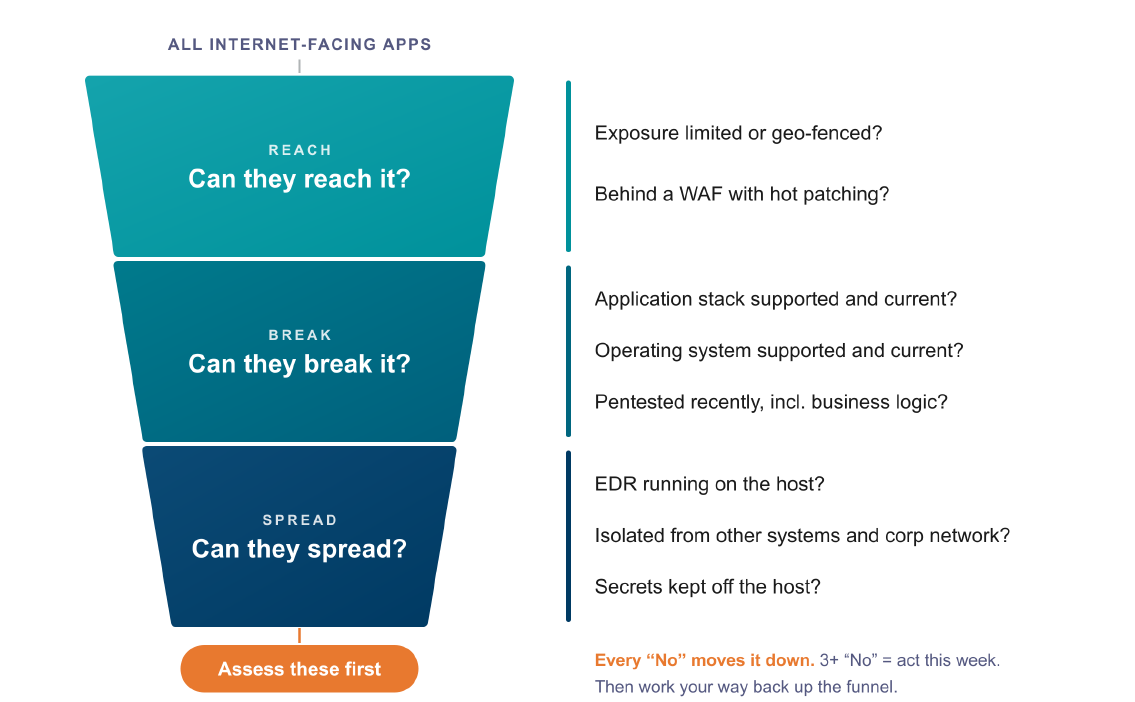
Can They Reach It?
- Is its exposure limited, either through geo-fencing or by keeping it private if public access is unnecessary?
- Is it behind a WAF (L7) with hot patching and automatic mitigation, plus network filtering (L3/L4)?
Can They Break It?
- Is the application stack supported and up to date?
- Is the operating system supported and up to date?
- Has it been penetration tested recently, including business logic and unauthenticated paths?
Can They Spread From It?
- Is EDR running on the host?
- Is it isolated, with no infrastructure shared with other systems or the corporate network?
- Are its secrets kept off the host, vaulted, scoped and easy to rotate?
Three or more “no” answers mean the application needs attention this week. Any “no” in the final group means one compromise could become many.
Prepare Now, Not After the First Incident
Secure access to an open-weight model for defensive use. Commercial models may refuse security work at exactly the wrong moment. The briefing confirms that “responders with approved access were still refused during investigations.” Have a vetted, self-hosted fallback ready so you do not lose precious hours.
Agree on containment authority in advance. Decide now which systems your team can isolate without case-by-case sign-off, including whether they have authority to shut down compromised production systems. That conversation is much easier to have before an incident than during one.
Test your environment with these frameworks. Assess your perimeter with the same class of tools, safely and as soon as possible, to identify the paths an attacker’s framework may find first.
Run your next tabletop exercise now. Make it an agentic intrusion that starts with a third party, arrives with valid credentials and hits several systems at once. Find out where your process breaks before an attacker does.
We’re Here to Help
At Kudelski Security, we are seeing these attacks first-hand, and what we learn in the field shapes how we help organizations prepare. Whether you need to map and assess your external perimeter, test your environment against agentic attack techniques, review how well your critical applications are isolated, or run a tabletop exercise, we're ready to support you.
You won’t outrun a machine. But you can put enough roadblocks in its path to give your people time to think.