When the Skies Stop Moving: Aviation, AI, Global Disruptions, and the New Reality of Operational Resilience


A nationwide FAA ground stop is not exactly what anyone wants to see on their Friday itinerary. But on November 13, a telecommunications failure affecting FAA air traffic control systems resulted in a nationwide ground stop across the United States. For several hours, landings were allowed but departures were halted while the FAA worked to stabilize the system and restore normal operations. It was disruptive, consequential, and it raised important observations and questions about the technology infrastructure supporting one of the most complex transportation systems in the world.
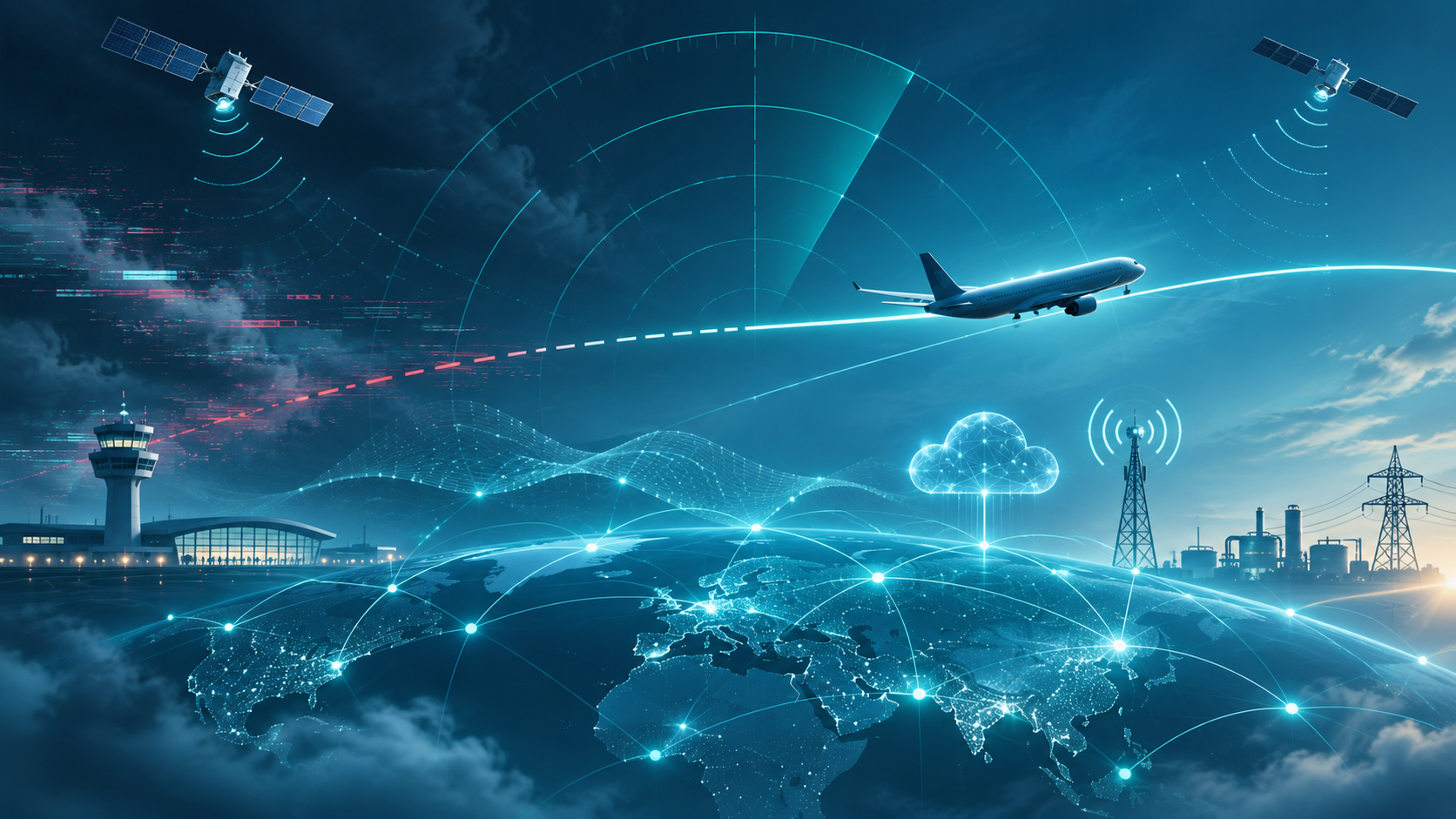
What I find interesting is that this incident didn't happen in isolation - we’re already living in a world that is experiencing increasing disruptions to critical infrastructure. Across the globe, we're seeing GPS interference affecting aviation navigation, telecommunications outages, power failures disrupting connectivity, cyber incidents targeting critical infrastructure, and technology failures with consequences that extend well beyond the systems where they originate.
These events aren't necessarily connected, and we shouldn't assume they are. However, they do highlight a common challenge - our critical infrastructure is increasingly interconnected, and our ability to operate safely and effectively depends on systems that many organizations don't own, control, or fully understand. Given this historic event, there are several things I think deserve our attention:
Why an Outage Can Still Be a Cybersecurity Concern
The FAA's initial investigation identified instability in legacy telecommunications equipment after an unusually high volume of connection attempts flooded its network. Officials reported that the issue affected communications and radar feeds across multiple air traffic control facilities.
Please note - the FAA stated that there was no indication of a cyberattack and confirmed that its recently introduced SMART system was unrelated to the incident. While that's an important distinction, it doesn't make the incident any less relevant to the cybersecurity and resilience conversation supporting the availability of a system. A technical failure that disrupts critical services can have enormous operational, economic, and safety implications, regardless of whether it was malicious.
Both the cause and the response matter. But the business impact still needs to be managed, and understanding the difference between a cyberattack, a technology failure, and an infrastructure dependency issue matters at a foundational level.
Aviation Disruption Extends Beyond the United States
The European Union Aviation Safety Agency (EASA) has continued to raise concerns about growing GPS/GNSS interference across several regions, including the Baltic Sea, Black Sea, Eastern Mediterranean and Middle East. These incidents include both jamming and spoofing. Jamming blocks or disrupts legitimate signals, while spoofing feeds false information to navigation systems. Both can create serious challenges for aviation safety and navigation.
Aviation is only one part of the equation. GPS and other satellite navigation systems support maritime operations, telecommunications synchronization, financial transactions, logistics, and portions of our electrical grid infrastructure.
We're also seeing other forms of infrastructure disruption around the world:
- Power grid failures in countries including Cuba and Ukraine have resulted in widespread telecommunications and internet disruptions.
- Government-imposed internet shutdowns have restricted connectivity in multiple countries.
- Failures at telecommunications interconnection facilities have affected internet availability across entire regions.
- Cloud and technology service disruptions have demonstrated how a problem with a shared service provider can affect organizations across industries and geographic boundaries.
While some of these incidents are deliberate, some are accidental, and others are consequences of geopolitical instability or aging infrastructure. And yet they all share an important characteristic: the disruption of one critical dependency can have consequences across an entire ecosystem.
Redundancy and Resilience Are Not Interchangeable
Common-mode failures are an uncomfortable reminder that redundancy on paper doesn't always translate into resilience in practice. Having a backup system is ideal, but only if that backup system does not depend on the same network, provider, configuration, power source, or underlying infrastructure as the primary system.
We need to understand dependencies, identify single points of failure, test failover capabilities, and validate that recovery processes honestly work when they're needed - not only for our primary environments, but it’s also necessary to understand our partner and provider environments have the same network hygiene.
What happens when a telecommunications provider experiences an outage? What happens when a cloud service becomes unavailable? What happens when GPS signals are unreliable? What happens when a third-party technology provider introduces a change that creates unintended consequences in a connected environment?
These are no longer hypothetical questions - resilience requires understanding how systems interact, where dependencies exist, and what happens when those dependencies fail.
AI Isn't Always the Culprit, but It Requires Thoughtful Governance
The FAA's AI-supported SMART system is a data aggregator and does not feed information into the air traffic control system. While it still generated questions about whether the new technology had any relationship to the ground stop, that clarification is important, and it's a good reminder that correlation does not establish causation.
While I'm genuinely excited about the potential for AI to improve aviation operations and critical infrastructure (better data analysis, improved situational awareness, predictive capabilities, and smarter decision support can be incredibly valuable), innovation in safety-critical environments requires guardrails.
We also need thoughtful architecture, independent validation, operational testing, strong change management, human accountability, and clearly defined fallback procedures. We need to transparently understand what happens when technology becomes unavailable, produces inaccurate information, or behaves in ways we didn't anticipate.
Aviation Resilience Is an Ecosystem Responsibility
No airline operates on its own - every flight depends on a much larger ecosystem of airports, telecommunications, technology providers, energy, ground operations, and other critical services. When one part of that ecosystem experiences disruption, the effects can quickly spread. And this isn’t unique to aviation. Banking, healthcare, energy, transportation, and other critical industries face the same interconnected reality.
So, our approach to risk needs to evolve beyond protecting what sits inside our own network. We need to understand where critical dependencies exist, where third-party or concentration risk could create systemic exposure, and how we respond when disruption begins somewhere we don’t control. Just as importantly, resilience can’t remain a collection of separate industry conversations - the systems are interconnected, and our planning, collaboration, and response should be too.
The bigger lesson from the FAA incident may not ultimately be what failed, but how far that failure was allowed to travel. In large, interconnected environments, equipment will fail, mistakes will happen, and routine changes will sometimes have unintended consequences. The real test of resilience is whether those problems remain isolated or become the first domino in a much larger disruption.
Segmentation, change and configuration management, traffic monitoring, failure containment, and third-party oversight all contribute to limiting that blast radius. We cannot design systems on the assumption that nothing will go wrong. We must design them so that when something does go wrong, the impact stops there.
Translating Technical Risk Into Business Risk
A telecommunications failure may start as a technical event, but it can quickly become canceled flights, displaced crews and aircraft, disrupted cargo, lost revenue, and significant recovery costs. GPS interference may begin as a navigation issue, but it can become a safety concern, an operational constraint, and a financial risk. The same is true in the cloud – a service outage can quickly affect customers, regulatory obligations, business continuity, and the ability to deliver critical services.
Organizations that manage risk effectively understand these connections before something goes wrong, not while everyone is scrambling to recover. That means moving beyond identifying vulnerabilities and documenting technical findings to understanding exposure, prioritizing risk based on business impact, setting meaningful recovery objectives, and making sure leadership understands where the real dependencies and vulnerabilities exist. Resilience must be an enterprise responsibility, shared across cybersecurity, infrastructure, architecture, operations, business continuity, risk management, and executive leadership. Redundancy matters, but so does the ability to isolate failure and stop the domino effect. We need to design infrastructure not just to function when everything goes right, but to contain the consequences when something goes wrong.
Resilience Is the Measure That Matters
My overarching takeaway is simple: modernizing aviation technology is essential, embracing AI is exciting, and strengthening cybersecurity is critical. But none of those investments mean much without resilience built into the foundation. As technology dependencies become more interconnected and disruptions increasingly originate beyond our direct control, the goal shouldn’t be technology that never fails. It should be systems designed to withstand failure, contain disruption, and recover safely, supported by truly independent redundancy, tested contingency plans, understood third-party dependencies, and people who know how to operate when technology doesn’t cooperate.
Ultimately, there’s an important distinction between investing in technology and investing in the resilience of the business. In aviation, success isn’t measured by how sophisticated the technology is, but by whether the system remains safe, dependable, and resilient when things don’t go according to plan. The cloud is a great place to innovate, but it doesn’t exempt anyone from having a really good contingency plan. Are we doing enough to understand the interconnected dependencies behind our critical infrastructure, or are we still looking at risk primarily within the boundaries of our own environments?