The Latest News from Research at Kudelski Security
Thank you! Your submission has been received!
Oops! Something went wrong while submitting the form.
Cryptography
Data privacy
Research
June 30, 2021
Oramfs: Resizable ORAM, Remote Storage Agnostic, Written in Rust
No items found.
Nils Amiet
Today we are excited to release oramfs, a simple, flexible, Free Software ORAM implementation for Linux written in Rust. It is designed to support different ORAM schemes and encryption ciphers. It is storage- and cloud provider agnostic and supports any UNIX filesystem without requiring specific plugins or server-side support.
Oblivious RAMs
When looking at privacy of storage solutions, encryption alone is not sufficient to prevent access pattern leakage. Unlike traditional solutions such as LUKS or Bitlocker, an ORAM scheme prevents an attacker from knowing whether read or write operations are performed and which parts of the filesystem are accessed. This level of privacy is achieved by making extra access requests than necessary, shuffling the blocks composing the storage layer, and writing and re-encrypting data back and forth every time, even when just a read operation is performed. This obviously comes with a loss of performance, but brings additional security compared to other solutions.
Our solution: oramfs
With oramfs users can enjoy total privacy while storing their files on untrusted local or remote storage, such as a public cloud. Our solution is resizable, so there is no need to re-initialize a larger ORAM when space becomes a problem. With oramfs, a whole filesystem is encrypted and read/write access patterns are hidden from the remote server. Our initial release supports a simple implementation of Path ORAM, one of the first modern, tree-based ORAM schemes, but the design supports arbitrary schemes and we plan of releasing more optimized ones soon.
To setup the ORAM, two inputs are required: a public directory and a private directory.
The public directory can be any locally mounted directory, including remote volumes mounted as a local directory. This could be a remote FTP directory, or a remote cloud storage mounted locally. Just mount the remote storage (or use a local storage if you want) and you’re good to go. For example, Rclone supports mounting a variety of cloud storage providers as local directories.
The private directory is the local mount point for a virtual storage that is presented to the user after entering the right secret passphrase, and is used to access files stored in the ORAM. Any operation performed on the private directory has an impact on the public directory. And if that public directory is a mounted remote storage, then it is safely and transparently synchronized to the remote server whenever an operation is performed on the private directory.
In order to be fully storage agnostic, oramfs is file-based: the ORAM structure is split into blocks (or nodes of blocks) and every block or node is saved to the public directory as a separate file. FUSE is then used to recombine these files into a single virtual loop device that is eventually accessed through the ORAM scheme itself. All this is completely transparent for the user.
Example usage
Let’s go through an example where we setup an ORAM that transparently synchronizes data to a remote FTP server. This would also work with any other remote storage supported by Rclone, such as SSH, Google Drive or S3.
We assume that a remote directory has already been mounted at the local mount point public/ and also an empty directory private/ has been created.
We initialize a new ORAM called myoram, by answering the interactive questions. This will automatically format the underlying filesystem with EXT4 but this option can be overridden if wished.
$ oramfs add myoram public/ private/
Please enter desired ORAM total size in bytes,
or press enter to use default [default: 16000000 (16 MB)]:

Adjusting ORAM size to closest valid value: 16711680 bytes
Please enter path to client data directory to use, or press enter to use default [default: /home/foobar/.config/oramfs/myoram]:

Please enter path to mountpoint directory to use, or press enter to use default [default: /tmp/oramfs_myoram]:

Successfully added ORAM myoram.
Please enter path to mountpoint directory to use, or press enter to use default [default: /tmp/oramfs_myoram]:
Successfully added ORAM myoram.
Finally, we mount the ORAM (will prompt the user for the password) and write a file to it:
$ oramfs mount myoram
It looks like this ORAM is mounting for the first time. Initializing it first...
Please enter an encryption passphrase to secure your ORAM: ****
Please type it a second time to confirm: ****
Starting ORAM...
Running as a daemon...
Mounting filesystem to private directory...
Formatting EXT4 filesystem...
mke2fs 1.46.2 (28-Feb-2021)
Creating filesystem with16320 1k blocks and 4080 inodes
Filesystem UUID: 7de4f86e-adb8-4587-bf68-814267ef5ab6
Superblock backups stored on blocks:
8193Allocating group tables: done
Writing inode tables: done
Creating journal (1024 blocks): done
Writing superblocks and filesystem accounting information: done
Mounting directory...
[sudo] password for foobar:
Setting private directory owner...
[sudo] password for foobar:
Setup complete! ORAM filesystem mounted to private directory at: /home/foobar/git/oramfs/private
$ echo hello world > private/somefile
When finished, we can unmount it:
$ oramfs umount myoram
That’s it! Files written/read to/from the private directory are encrypted and access patterns are hidden from the FTP server.
By the way, we will be presenting oramfs on Wednesday July 7th at 4:10pm CEST at Pass the SALT.
2021
Crypto
Cryptography
June 23, 2021
Intro: Understanding the oxygen protocol
No items found.
Kudelski Security Team
When Kudelski Security approaches a security assessment of a FinTech company such as Oxygen, we always aim to provide a full suite of coverage to ensure that the architecture, application, and operation of the environment is sound and free from known vulnerabilities or DeFI style attacks.
In the case of a DeFI ecosystem, there are always moving parts of dependencies, relationships, and workflows that may be dynamic. You may not always know the workflow, even if you know the components. In this manner, it is important to always understand the picture of the entire system, review the flow, understand the purpose and functionality and then view the system from the point of view as an attacker.
As a philosophy, a protocol such as Oxygen – in addition to providing the financial functions that it has been designed to provide – must protect its components from impact/liquidation even if one of the dependent components introduces a failure or economic scenario that is not intended.
While not every security risk can be uncovered by a single review, the artifacts that are created can be used as input for the organization to build security risk and operational controls into its system to better handle unintended system interactions. Whether it be economic or system level attacks, the security of the system takes review, continuous testing, analysis from experts in the form of pen testing or bug bounty, and review by legal and economic experts.
Within this lens, we are undertaking a series of assessments related to the Oxygen Protocol and supporting architecture and openly discussing the methodology to drive understanding further into the industry. We will conduct a series of reviews and audits of the Oxygen Protocol functionality and interfaces, as well as collaborating with Oxygen going forward to assess future enhancements, changes, or additions to Oxygen’s protocols.
As they state, beginning with prime brokerage, Oxygen intends to replicate a growing range of products offered by investment banks, helping to build finance without Wall Street. As a DeFi ecosystem, Oxygen intends to enable delivery of these services to individuals and institutions alike, democratizing access to sophisticated investment, risk management and liquidity solutions.
As a security provider, understanding the outcome desired by Oxygen drives our review criteria and also identifies which sorts of fraud, risk, and security controls that must be built into this sort of system. Traditional entities are built upon years of security learnings and audits, and any project intending to replicate this functionality should also deliver equivalent functional controls.
These controls deliver protections such as:
Protection of the environment in case of denial of service attack
Protection of the funds in case of economic attack
Protection of the users in case of scenarios of monetary abuse, account abuse, or collusion
Protection of the infrastructure from compromise by malicious entities
Protection of the all components from accidental impact by dependent projects or internal resources
Security projects utilizing a STRIDE methodology along with appropriate control points and attack trees generally can understand and prioritize their risk surface, similar to how Oxygen is progressing.
As a protocol, Oxygen is built on the growing and liquid Serum ecosystem which leverages an on-chain orderbook to match borrowers and lenders to provide fair rates. And it is made possible by the massive throughput and ultra-low costs of the scalable Solana blockchain. Kudelski Security has previously performed assessments for Solana and has compiled a repository of knowledge which will be leveraged to better understand and review the Oxygen system.
In a follow-up article, we will discuss our process and outcomes from the review of the Oxygen ecosystem. Much can be learned from the attention on the Contracts Mechanism, Finance Logic, Yields, Borrowing, Lending and Leverage mechanism security controls and constraints, as well as other related funds safety considerations – such as whale attacks and collusion.
We will also discuss how “formal verification analyses” can confirm that formulas, cryptography and mathematics, etc. in the software faithfully implement the specified intent of the protocol.
Our final update will include the methodology of testing, which includes a discussion of the benefits of architecture review, dynamic testing of key financial risk scenarios such as edge situations, liquidity events, and more versus scripted testing or a pure static analysis.
More to come…
2021
Blockchain
June 4, 2021
Code Assessment of the Concordium Blockchain
No items found.
Nathan Hamiel
Concordium is a science-based proof-of-stake blockchain created with business applications in mind. It is the first blockchain with identification built into the protocol to meet regulatory requirements, while delivering a user-friendly platform that can handle smart contracts.
The Concordium Platform is designed to be fast, secure and cost-effective, which is why Concordium and Kudelski Security have been working together to perform threat modeling, code review, and “scenario based” assessment of the underlying code and logic of the Concordium software.
As documented in the White Paper, Concordium implements a Network Layer, Consensus Layer, and Identity Layer. These three layers interact with each other to process transactions and to execute the scalable/secure transactions.
From a logical perspective, the system is made up of several different well-defined components and layers.
The transactions are sent into a transaction layer and are distributed to all full nodes of the network
The consensus layer takes transactions from the transaction pool and “bakes” or proposes a block validating all the transactions within the block
The finalization of the blocks is performed by the finalization in the consensus layer
The baking layer and the finalization layer makes up the “Konsensus” consensus layer
All transactions blocks and votes are sent between the nodes via the peer to peer layer
At the beginning of the engagement, we first wanted to focus on the critical parts of the code which ensured that the foundation was solid, and that consensus and execution remained safe. We focused much of the security review on the following components and their interconnection.
Haskell & Rust Code that make up the foundational components of the system
Security effectiveness and correctness of the consensus layer
Security effectiveness and correctness of the execution layer
During discussions with the core team, we quickly identified some key areas of overall concern
Are there any scenarios in which the link between consensus and execution fails at unexpected points, or with security concerns?
Are there any scenarios in which financial loss can incur within the systems including token manipulation or reassignment?
We ruled the following components out of scope for this first engagement
Analysis of the functional virtual machines (VM), Smart Contracts, and Identity layers
Haskell code under Acorn
Deployment of the infrastructure or hardware at scale to validate findings
Operational execution of the code to perform a pen test of running binaries (memory review, attacks to binaries, theft of secrets)
Operational assessment of alerting and monitoring when non-ethical behavior is present in the system
Participation in any running testnet environments.
Detailed analysis of third-party libraries #included in the system
Following the review, we have come to these conclusions which we have presented to the project team as part of the report output
During the threat modeling exercise, we worked collaboratively with the Concordium team to identify the most important threats to the project. We used this information to guide the code review phase of the project.
During the code review, we found no critical or high-risk scenarios that put the tokens of the system at risk and we made a number of suggestions to improve overall documentation, code quality, and conformance to best practices.
Following the completed review, and during follow-on tests, scenarios were discovered in which unused network messages and test code could cause availability concerns on the network even though these errors would not cause a loss of funds. We completed a follow-on review, looking specifically at the network code and identified a few issues that the Concordium team fixed.
We look forward to continuing the effort with Concordium to bring trust into their ecosystem through diligent review of the critical components of their ecosystem
2021
Quantum computing
May 27, 2021
Taking the (quantum) leap with go
No items found.
Kudelski Security Team
Heard about the quantum threat glooming on the horizon? Today, we dive into post-quantum, or quantum-resistant crypto, which is not to be mixed with quantum cryptography (see our previous blog entry on that), and unbox our post-quantum Go library.
Post-Quantum Cryptography
The arrival of quantum computers threaten the security of traditional cryptographic algorithms. Shor’s, Grover’s and Brassard’s algorithms are few examples of tools that enable powerful quantum attacks on the public key cryptography as we know and use it. The hardness of some schemes such as RSA or Diffie-Hellman is not granted anymore, prompting us to find replacements that rely on alternative assumptions, namely post-quantum cryptography.
Lattice-based cryptography
Lattice-based constructions make for the majority of post-quantum schemes. A lattice is a set with an order relation, meaning that every two elements have unique supremum and infimum. The most important lattice-based computational problem is the Shortest Vector Problem (SVP), which entails finding the shortest vector in a given lattice. The security of most of the lattice-based constructions can be reduced to the security of the SVP problem, which appears to be resistant to attacks by both classical and quantum computers.
The CRYSTALS Suite
The CRYSTALS algorithms are promising candidates for the post-quantum area, and are finalists of the NIST post-quantum cryptography standardization process. They stand out because of their great performance, the main drawback being their relatively large outputs size.
The first protocol of the CRYSTALS suite is Kyber, a Key Encapsulation Mechanism (KEM), that secures the exchange of key material over an insecure channel. It uses asymmetric encryption to transmit a short symmetric key. This symmetric key is then used to encrypt the longer messages. Briefly, Kyber is built using a security transformation that turns Regev’s weakly secure encryption scheme into a strongly secure one.
The second protocol is Dilithium, a Digital Signature Algorithm (DSA), that produces a signature on a message that is verifiable by anyone holding the public verification key associated to the secret signing key. Dilithium follows a Fiat-Shamir construction, sampling a mask and rejecting until the signature is binding yet hides the signing key.
The security of those protocols is parametrized by various factors such as the size of the lattice. Kyber and Dilithium can be instantiated to offer a light, recommended, or very high security level, and are respectively designated as Kyber512, Kyber768, and Kyber1024, or Dilithium2, Dilithium3, and Dilithium5.
Side-Channel Attacks
A thorough cryptanalysis is necessary but not sufficient to guarantee the security of a library. The last decade has seen the number of publications about a new class of attacks arise (Meltdown, SPECTRE, Zombiland…). Side-channels attacks target the implementation of algorithmically secure crypto systems and can exploit information gained from the implementation itself.
Often overlooked, side-channel attacks can be used to weaken or break entirely the security of an infrastructure. Not paying enough attention to side-channel vulnerabilities can lead to devastating breaches, as we have seen with NSA’s TEMPEST system that could reconstruct the entirety of a computer’s screen by listening to its electromagnetic emissions, or more recently with the SPECTRE attacks, that can manipulate a process into revealing sensitive data, such as passwords, after monitoring the cache hits and misses timing. This is why we make it a priority to offer as much protection against said side-channel attacks as possible with our implementation.
Our library
The Go language has gained popularity amongst cryptographers because of its simplicity and security properties. Writing and maintaining Go code is easy and a great fit for projects of all scale, from proof-of-concepts to complete infrastructures.
In our library, we offer an implementation in Go of the CRYSTALS protocols. The open-source code is available in the crystals-go repository. While there are existing implementations that consist of a straightforward translation from the official implementations available in C to Go, we made the choice to deviate from the reference to provide additional security and performance properties. Correct behavior of our code is ensured and tested via known-answer tests provided by the CRYSTALS’s authors.
API
In this section, we provide hands-on examples on how to use our library. First, the crystal-go module can be installed via:
go get -u github.com/kudelskisecurity/crystals-go
In order to have a clear separation between the parameters and the algorithms, we define generic methods that work with all possible sets of parameters, and invoke them on an instance of Kyber or Dilithium that completely defines the parameters to be used. Hence, a user first has to define which level of security they want to work with by creating an instance of Kyber or Dilithium among Kyber512, Kyber768, Kyber1024 and Dilithium2, Dilithium3, Dilithium5:
k := NewKyber512() //Creates a Kyber instance with light security level
d := Dilithium3() //Creates a Dilithium instance with recommended security level
The user can now generate a public and private key pair by calling:
pk, sk := k.KeyGen(seed)
or
pk, sk := d.KeyGen(seed)
Once the parameters are defined and the keys are generated, the core functionalities of Kyber and Dilithium can be called.
Kyber’s main functions are Encaps and Decaps. A typical flow of Kyber is:
//Select the parametersk := NewKyber512()
//Generate the keys and openly disclose the public key.pk, sk := k.KeyGen(seed)
//Generate a shared secret and a ciphertext. Similarly to the seed, the random//coins used during the encapsulation can be given or deleguated to the method.c, ss := k.Encaps(coins, pk)
//Send the ciphertext to the private key holder, which decapsulate it to recover //the shared secret (ss = ss').ss' := k.Decaps(c, sk)
Similarly for Dilithium, the main methods Sign and Verify are typically used as follows:
d3 := Dilithium3() //Creates a Dilithium instance with recommended security levelpk, sk := d3.KeyGen()
msg := []byte("This is a message.")
sig := d3.Sign(sk, msg)
verified := d3.Verify(pk, sig, msg) //The boolean verified is true for honest runs
A seed and coins of 32 bytes can be given as argument and allows for reproducibility for example, or is useful if the user does not trust the environment to generate good randomness and wants to use randomness from their own source. They can be nil in which case the randomness will be generated during the key generation process using Go’s official crypto/rand library.
This section is not exhaustive of the features offered by our library and we refer to our README for a more complete description.
Security
Our library stands out because of its security properties. Among the vulnerabilities reported on the original implementation, we integrate countermeasures for most of them, providing a library that is both theoretically and practically secure. We predict that new attacks will be published as the candidates are refined, and expect changes in the code to occur as the security of our library is treated as a continuous process.
We recall that side-channel attacks are high-risk threats and encourage users to prefer libraries with strong implementation security, such as our library, over implementations that lack these guarantees.
Performance
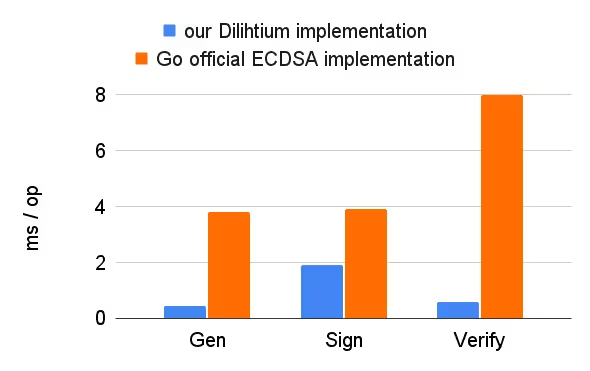
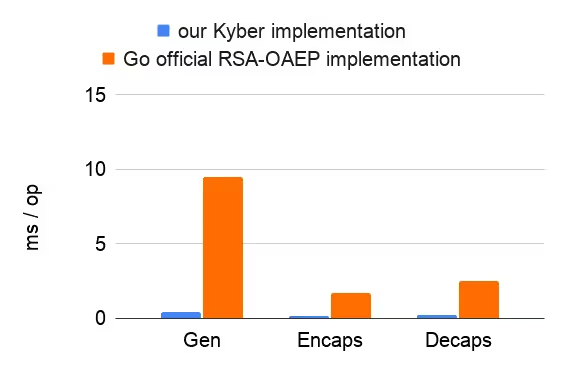
In order to provide an insight on the computation and communication costs of our library, we report in the following table the runtime in milliseconds and the outputs size in bytes of our implementation for a recommended security level.
KeyGen
Encaps.
Decaps.
Public Key
Ciphertext
Kyber768
0.40
0.19
0.22
1 184
1 088
KeyGen
Sign
Verify
Public Key
Signature
Dilithium3
0.43
1.90
0.60
1 952
3 293
Performance overview for a recommended security level
The relatively large outputs size can impact some applications but is never considered a bottleneck. Furthermore, we show in the following graphs that the performance of current classical security public-key and signature schemes (ECDSA and RSA-OAEP) can be excelled by our implementation. This difference can be explained by the very simple arithmetic the CRYSTALS suite relies on.
Runtime of Dilithium against Go’s official ECDSA implementation
Runtime of Kyber against Go’s official RSA-OAEP implementation
Takeaway
Our post-quantum library is easy to use, fast and secure. The practicality of our library should be used as motivation to integrate post-quantum alternatives in your infrastructures, to protect your data well into the foreseeable future without compromising on the performance.
2021
Research
May 14, 2021
Advancing Rust Support in Semgrep
No items found.
Nils Amiet
At Kudelski Security, we perform quite a few security and cryptography reviews involving Rust code. Rust support in tooling has been lacking. We’ve developed some tools internally to assist in our reviews, but we were looking for a more general and mature framework that supports multiple languages. Semgrep is great great tool for performing static analysis and its support for multiple programming languages makes it valuable for developers and security professionals alike. Experimental support for Rust was recently added to Semgrep and we will see how to use it by going through a quick example, which will demonstrate some limitations. Then we’ll see how we improved this Rust support increasing usability for the scenarios we and many others find ourselves in everyday.
First we install Semgrep from PyPi:
$ pip install semgrep
Then, we create a file named rules.yml with the following contents. This defines a very simple rule that matches those exact two lines defining a variable x and a variable y. We could of course define more complex rules, but this is not the point here:
rules:
- id: my-rule-id
patterns:
- pattern: |
let x = 0;
let y = x * 2;
message: "Found a match for my custom rule."languages: [ rust ]
severity: WARNING
After that, we clone our codebase and run Semgrep on that directory using our custom rules. Semgrep then tells us which parts of the codebase match those rules.
$ git clone [email protected]:ing-bank/threshold-signatures.git
$ cd threshold-signatures
$ semgrep --config rules.yml .
running 1 rules...
semgrep error: invalid pattern
--> rules.yml:44 | - pattern: |
5 | let x = 0;
6 | let y = x * 2;
7 | message: "Found a match for my custom rule."Pattern could not be parsed as a Rust semgrep pattern
But this is not working!? Well, it appears that the two lines of Rust code in the semgrep pattern are not valid Rust code by themselves. If you try to compile a Rust source file containing only those two lines, it won’t work.
$ cat test.rs
let x = 0;
let y = x * 2;
$ rustc test.rs
error: expected item, found keyword `let`
 --> test.rs:1:1
  |
1 | let x = 0;
  | ^^^ expected item

error: aborting due to previous error
Indeed, the Rust grammar is defined in a way that this should be wrapped in a function definition to be valid:
$ cat test.rs
fn main() {
let x = 0;
let y = x * 2;
}
$ rustc test.rs
warning: unused variable: `y` --> test.rs:3:7 |
3 | let y = x * 2;
| ^ help: ifthis is intentional, prefix it with an underscore: `_y` |
= note: `#[warn(unused_variables)]` on by defaultwarning: 1 warning emitted
Obviously, this produces a warning, but it now compiles.
To parse the pattern defined in our rule, semgrep uses tree-sitter, a parser generator, and more specifically, a modified version of the tree-sitter-rust grammar in the case of Rust source code. Similarly to the Rust compiler, this grammar won’t accept these two lines just by themselves. So we need to update the pattern in our rule:
rules:
- id: my-rule-id
patterns:
- pattern: |
fn $F(...) {
let x = 0;
let y = x * 2;
}
message: "Found a match for my custom rule."languages: [ rust ]
severity: WARNING
Note that we used some special semgrep pattern syntax here: metavariables ($F) and the ellipsis operator (…). Indeed, Semgrep extends the tree-sitter-rust grammar to support additional language features only for semgrep patterns. This lets us match any function with any parameters without having to hardcode that for every possible case.
Now, if we run Semgrep again with our updated rule, we get some matches in our test.rs file:
$ semgrep --config rules.yml .
running 1 rules...
test.rs
severity:warning rule:my-rule-id: Found a match for my custom rule.
1:fn main() {
2:  let x = 0;
3:  let y = x * 2;
4:}
ran 1 rules on 20 files: 1 findings
2 files could not be analyzed; run with --verbose for details or run with --strict to exit non-
This would be less painful if we could write only those two lines as the pattern for our rule. Additionally, the whole function is being printed out, but we only wanted to search for those two lines. For long functions, this makes it difficult to see which line matched.
Well, this is now possible thanks to a contribution we made to Semgrep:
We extended the tree-sitter-rust grammar to support a list of statements directly as a pattern and we updated the CST to AST mapping to make it work. So it is now possible to write rules directly containing a list of statements:
rules:
- id: my-rule-id
patterns:
- pattern: |
let x = 0;
let y = x * 2;
message: "Found a match for my custom rule."languages: [ rust ]
severity: WARNING
Semgrep now accepts that pattern and only prints the lines we wanted to match:
$ semgrep --config rules.yml .
running 1 rules...
test.rs
severity:warning rule:my-rule-id: Found a match for my custom rule.
2:  let x = 0;
3:  let y = x * 2;
ran 1 rules on 20 files: 1 findings
2 files could not be analyzed; run with --verbose for details or run with --strict to exit non-zero if any file cannot be analyzed
Note: Since these changes were recently merged, they will only appear in the next semgrep release. You will have to build from source to see them immediately.
We love being able to write rules more easily now and hope this will be helpful to others too. Our hope is that this expanded support leads to quicker identification of bugs and security issues in Rust code. Happy bug hunting.
2021
Security Advisory
May 12, 2021
Security assessment of multiplier.finance
No items found.
Kudelski Security Team
In this post, we will talk specifically about the work we performed as part of our security assessment of the Multiplier.Finance environment. The public report provided to the Multiplier team will be published within the FAQ section of their web portal.
Executive Summary: There are no unresolved security findings present in the system following our review. There are zero (0) critical, high, or medium vulnerabilities in our final audit report.
The Multiplier.Finance environment is a multi-tier infrastructure within AWS, operated on Binance Smart Chain (BSC), and uses its own governance tokens (bMXX). Even though, they had completed an initial audit of their smart contracts, the Multiplier team wished to bring additional confidence to their community with a completed review of the entire infrastructure and deployment environment.
When Kudelski approaches an engagement such as one of the scope of this, we propose a multiple-phase review because security is always much larger than just a smart contract review. Security of an “App” or a “DAPP” or a “Site” is about the infrastructure, flows, contracts, wallets, and any other ingress and egress flows and control points that could impact the money flow. Even though the math under a blockchain is very solid at this point, contracts and infrastructure are not inherently secure, so it is the sign of a mature project to ask for a complete assessment of their work.
Initially, we performed a re-review of the Smart Contracts as it is always best practice to have multiple reviews of critical components, and our review of the Smart Contract code was the 2nd such review. We found no critical or high risk issues in the smart contracts, and all of our low/informational findings were related to dependencies or minor concerns with style or flow.
The reviews are based on the commit hash: MCL-SmartContracts: cff17d6e07b51e7468a4aba72ae83b309b98d561
All third-party libraries were deemed out-of-scope for this review and are expected to work as designed. Based on the criticality of the dependency, we looked at the current state of the third-party libraries included when necessary.
Our general process for this review included:
Threat Model & Architecture Review
Validate technical design claims and cryptographic coding underlying the behavior and intent of the technical systems written in the smart contracts
Deliver focused analysis of scenarios of system abuse through error or malicious actors
Deliver analysis of fundamental correctness of transactions
Code Review
Perform a code-review of provided code, especially focusing on code written by the internal team, assuming third-party libraries act as expected
Validate implementation choices in code, completeness, and assumptions according to the design provisions and deployment
Recommendations
Provide recommendations for security and logic related improvements and corrections to the code, infrastructure, and architecture, if found
We maintained a complete and consistent view across the known components and followed a systematic approach as we conducted the threat model workshop and code review. First threat actors of concern were identified and data flows between the system components were requested. Based upon the understanding of each component from documentation and the interviews, remote follow-up meetings were held with team members of Multiplier.Finance for clarification of any technical or functional details, followed by a code review.
In addition to infrastructure, the following scenarios were in scope for the Threat Model & Assessment:
KSI-001: Using components with known vulnerabilities
KSI-002: Lack of input validation that results in a loss of funds
KSI-003: Market manipulation through collusion or market flooding
KSI-004: Direct execution of delegate contracts in multi- phase process
KSI-005: Replay of valid transaction
KSI-006: Weakness to front running attacks
KSI-007: The use of inherently weak randomness to generate confidential values
KSI-008: Owner tampering and manipulation
KSI-009: Misuse of Solidity functions for determining contract ownership
Upon analysis of the infrastructure, contracts, and control points – we determined that the Multiplier team has handled all of these threat scenarios effectively.
As a result of our code review & assessment, we discovered 0 High, 0 Medium, 3 Low, and 15 Informational findings. The Multiplier team resolved all of these findings to our satisfaction.
We want to thank the Multiplier team for choosing Kudelski Security.
About Multiplier Finance
Multiplier.Finance operates a system known as “Multi-Chain Lend.” Multi-Chain (Lend) is an algorithmic money market system designed to bring secure and unique lending and borrowing opportunities like flash loans onto the Binance Smart Chain. The protocol designs are architected and forked based on Aave with revenue sharing components for liquidity providers and token holders that govern the protocol. bMXX, a BEP-20 token, will be the governance token of Multi-Chain (Lend).
2021
Audit
Blockchain
Cryptography
TSS
April 8, 2021
Audit of ING’s Threshold ECDSA Library – And a dangerous vulnerability in existing Gennaro-Goldfeder’18 implementations
No items found.
Kudelski Security Team
ING (Dutch bank) recently released their own implementation of the popular Gennaro-Goldfeder’18 Threshold ECDSA signature scheme in the form of a library written in Rust. Kudelski Security audited their code, our report is available here. During the audit, we found a potentially serious problem in the protocol itself (not dependent on ING’s implementation, but rather on the need of a security assumption in the original protocol that is not given for granted in many real-world cases.) This problem might allow a single malicious attacker to delete or lock funds and blackmail all other peers.
Threshold signature schemes (TSS) have seen a growing interest and rapid adoption in the last few years, mainly driven by blockchain applications such as Bitcoin. A blockchain transaction (such as the transfer of funds, or the execution of a smart contract) in its basic form is created and verified by the network via a digital signature generated by a private signing key (usually held in a user’s wallet.) This presents a security challenge: anyone with access to the private signing key can issue an (irrevocable) transaction. Clearly an unacceptable risk for highly regulated environments such as large financial institutions, which cannot afford to lose billions of dollars with a single, irreversible transaction executed by a malicious hacker who manages to exfiltrate a high-value key.
TSSs solve this problem by splitting the generation of the signature between N different users, with the possibility of configuring a threshold parameter T such that any subset of T users (among the N authorized ones) is sufficient to generate the signature, but any subset of T-1 or less users is not. This reminds a bit of another similar cryptographic primitive, called “secret sharing schemes” (SSS) but it’s actually different: In a SSS, a subset of T among N users collaborate to have a leader reconstruct a secret (for example, a signing key.) But, after the reconstruction, the leader knows that secret and can further use it however they wish, even without requiring the collaboration of the other users, so it is again a security risk. In a TSS, instead, the signing key is never fully reconstructed! Each one of the T users interact in a complex multi-party computation (MPC) protocol by contributing with a partial signature. Those partial signatures are then recombined by a leader to obtain a single valid signature. The difference is that the leader cannot reuse the data collected to generate a different signature, so the scheme is highly interactive and requires different rounds of complex, interlocking encryption, signatures, and zero-knowledge subprotocols.
The appeal of TSS for many applications is that they are backward-compatible with already deployed signature schemes: the signature generated by a TSS is indistinguishable by a “normal” signature in respect to a certain public key, so at the end the verifying user does not care whether the signature was generated in a “standard” way or in a TSS way, because there is only one single public key to check against, and the verification algorithm is unmodified. So, for example, it is not necessary to modify the Bitcoin protocol to support a new type of signatures, it is just sufficient to add TSS support client-side.
Not all signature schemes are equivalent in respect to “TSS-ization” though. Certain schemes, such as BLS or Schnorr signatures, are much easier to implement in a TSS way. Others, such as ECDSA, are much more complex. It just happens by bad luck that ECDSA is the currently adopted standard in Bitcoin and many other important blockchains. Existing TSS schemes for ECDSA are quite difficult to analyse and implement and they are prone to issues, either in their design or code.
During our audit for ING we stumbled upon one of these issues. ING’s library implements GG18, one of the most popular TSS schemes for ECDSA. One of the features of GG18 is the “key resharing protocol”, which allows an old committee of peers to refresh the shares of the secret key across a new committee (for example, if it is necessary to add new members, or to remove some.) The key resharing protocol is a delicate procedure that has been covered by many recent attacks. One of these attacks, the “forget-and-forgive”, is described as:
The proposed mitigation is:
This mitigation is implemented correctly by ING. However, we found that such mitigation is insufficient – and might actually make things worse – if a robust broadcast channel is not available, by allowing a single malicious attacker to delete or lock funds and blackmail all other peers.
A robust broadcast channel is a reliable way of broadcasting messages in such a way that all parties receive the same broadcast message. This is easily achieved if a trusted third party relay is available, but for the general case of peer-to-peer networks, it is not always trivial. For example, the naive solution of sending a broadcast message as N distinct direct point-to-point connections is clearly not robust, because a malicious sender could transmit a message X to certain peers and a different message Y to other nodes.
This is exactly the scenario that enables a devastating attack in the GG18 resharing protocol. Let’s say a group of 4 peers (A, B, C, D) with threshold value 3 (any 3 of them is necessary and sufficient to sign) wants to add a fifth peer E to the committee (still with threshold value 3). So they start the resharing protocol, and in order to avoid the “forget-and-forgive” attack they conclude the protocol with the final round described in the mitigation above.
However, E is malicious. After the resharing protocol concludes, E crafts different messages for different peers instead of broadcasting a final “ACK”:
E sends “ACK” to A and B
E sends “not ACK” to C and D
Now see what happens: A and B think that everything went fine, so they discard the secret key material (their “shares”) that was related to the old committee configuration, and migrate to the shares for the new committee configuration. C and D, however, follow the proposed mitigation to the “forget-and-forgive” attack: they assume that something went wrong and will not save the new shares to disk, falling back to the old shares. And now we have a problem: a single malicious adversary, E, has managed to “segment” the group of peers into two committees, one old and one new, where none of them has enough information to reconstruct the secret without E’s collaboration! So Eve can blackmail the committee, withholding all the funds associated to the wallet being shared.
Under the right circumstances, this attack can be devastating. It is important to notice that this has nothing to do with ING’s implementation, nor with a flaw in the security proof of GG18, but rather with the security model not taking into account real-world implementations of the communication channel. Countermeasures against these kind of attack can only be implemented at an application level, so developers have to be careful when adopting existing GG18 solutions.
We are grateful to ING for the trust they gave us, and found very stimulating working together with their tech team.
2021
Blockchain
March 2, 2021
Code Assessment of Proton Chain
No items found.
Kudelski Security Team
Proton Blockchain – “The Payment Blockchain” is a software blockchain developed by Metallicus, Inc., based on the foundation of EOSIO which identifies itself as having advantages over blockchain solutions due to its Speed, unique Identity ID, Signing system, and Fee structure.
During the initial phase of the project, we recognized that the main code base is comprised of a fork of the EOSIO block chain project with the tag v1.9.1.
This code was de-scoped from the assessment as we recognized that the EOSIO project is well used and therefore was essentially previously reviewed. The project did use the forked version in the Proton Chain repository as a reference when needed.
In this post, we will talk specifically about the work we performed as part of our security assessment for the Metallicus team. For a more in-depth overview of Proton and its roadmap, you can read about it on the Proton blog.
The source code for the project was supplied by Metallicus through the GitHub repository at https://github.com/ProtonProtocol and specifically under the proton.contracts project.
The assessment was conducted by the Kudelski Security Team, with the tests taking place in the 4th Quarter of 2020 and focused on the following objectives:
Perform manual source code review of C++ and other used languages
Perform review of smart contract platform for security vulnerabilities and logic errors
Perform review of third-party libraries used in systems
Perform analysis of any custom encryption used in development of platform and verification of third-party encryption libraries
Analyze the contracts layer in the proton contracts to ensure that the logic is sound, that there are no security issues, and that the platform is free from vulnerabilities
A separate engagement, also performed in the 4th Quarter of 2020 was a review of the Proton Swap tool, which is a tool allows users to swap an XPR based on the Ethereum blockchain to mainnet XPR – which opens all other functions of the Proton Blockchain.
The findings during the review were less than many of our other projects of similar size and complexity, with the findings being mostly initialization issues, arithmetic operational checks, resource allocation and code clarity on permission checks.
We believe that the reason for the rather low severity of the findings is due to the detailed threat modeling, discussion, and walkthroughs with the core development team. In addition, detailed security assessments have been performed on EOSIO and that also contributed to a lack of findings, but we recommended to the project team that they continue to monitor bug fixes on the EOSIO core and incorporate those updates and bug fixes.
In this code assessment, we performed the following tasks:
Security analysis and architecture review of the original protocol
Review of the code written for the project
Assessment of the cryptographic primitives used
Compliance of the code with the provided technical documentation
The review for this project was performed using manual methods and utilizing the experience of the reviewer. No dynamic testing was performed, only the use of custom-built scripts and tools were used to assist the reviewer during the testing.
Code Safety
We analyzed the provided code, checking for issues related to the following categories:
General code safety and susceptibility to known issues
Poor coding practices and unsafe behavior
Leakage of secrets or other sensitive data through memory mismanagement
Susceptibility to misuse and system errors
Error management and logging
Cryptography
We analyzed the cryptographic primitives and components as well as their implementation. We checked in particular:
Matching of the proper cryptographic primitives to the desired cryptographic functionality needed
Security level of cryptographic primitives and their respective parameters (key lengths, etc.)
Safety of the randomness generation in general as well as in the case of failure
Safety of key management
Assessment of proper security definitions and compliance to use cases
Checking for known vulnerabilities in the primitives used
Technical Specification Matching
We analyzed the provided documentation and checked that the code matches the specification. We checked for things such as:
Proper implementation of the documented protocol phases
Proper error handling
Adherence to the protocol logical description
As a result of this assessment, we did not find any critical shortcomings in the reviewed components.
Metallicus quickly patched all the problems we identified and let us review their changes to confirm their effectiveness.
Notice that we did not find any evidence of malicious intent, flawed logic or potential backdoors in the codebase.
We would like to thank Metallicus, Inc. for trusting us, for their availability and the pleasant collaboration throughout the assessment!
2021
Crypto
Privacy
Research
February 2, 2021
Benchmarking privacy-preserving motion detection
No items found.
Nils Amiet
This blog post is about benchmarking the IoT prototype we have been building for the FENTEC project, using functional encryption. For more information, please see the two previous blog posts we wrote on this topic:
The prototype is composed of three elements: a camera, a gateway, and a backend. This prototype is based on ffmpeg and is implemented as 3 bitstream filters, one for each element in the system.
Camera
The camera captures and encodes video in H.264 format. It extracts the motion vectors of the H.264-encoded stream and encrypts them using functional encryption thanks to the CiFEr library. Those encrypted motion vectors are then bundled as side data, alongside the AES encrypted video stream. This is possible because motion vectors are stored in H.264 Network Abstraction Layer (NAL) units of type H264_NAL_SEI and the image data of the video itself is stored in NAL units of type H264_NAL_SLICE and H264_NAL_IDR_SLICE. These different NAL units can therefore be encrypted differently without causing any problems. The SEI messages are additional messages that can carry any data format and must not be video-related. Therefore, we store the functionally encrypted motion vectors in these. The video image data is stored in the 2 other types of NAL units mentioned above. Symmetrically encrypting NAL units of that type is enough to make the video unreadable by anyone not possessing the encryption key.
Gateway
The gateway uses the corresponding functional encryption key to evaluate whether there is motion or not within a group a video frames. For each group of frames, if there is motion, the gateway forwards the symmetrically encrypted group of frames to the backend. Thus, the amount of data transmitted over the wire is reduced to the interesting segments, where there is motion in the video. Since the video stream is encrypted, the gateway cannot determine anything about the image data inside the video, and therefore does not need to be trusted. The untrusted gateway can perform the computationally intensive motion detection on behalf of the potentially low-powered camera.
Backend
Unlike the gateway, the backend can decrypt the received AES encrypted video stream because it knows the symmetric encryption key. The decrypted video stream contains only frames of the original video where motion was detected by the gateway. The backend is able to play the video.
Performance metrics
Frames per second
We measure how the number of motion vectors used affects the number of frames that can be processed per second on the camera side and on the gateway side. We also measure how turning on functional encryption of the motion vectors affects performance. In any given frame, there are a certain number of motion vectors. We do not need to use all of them but we are interested in knowing what is the performance impact of using a certain number of these.
Side-data size
We measure how the additional side-data size varies as the number of motion vectors used changes. Additionally, does functional encryption of the side-data have an impact on the output video sent to the gateway?
Backend video size
The gateway removes the segments in the video stream where no significant movement occurs. A segment is a group of pictures (GOP). We define a threshold maximum value for the sum of the motion vector norms and call it the GOP threshold. If the computed value exceeds the GOP threshold, the gateway considers that movement is detected. In that case, the segment is forwarded to the backend. Otherwise, it is removed. We measure the size of the stream received by the backend and compare it to the size of the original input video produced by the camera to see how much traffic can be spared.
Measuring system performance
Environment
The benchmarks were run on a single machine, running all three elements of the system (camera, gateway and backend). This machine is a five year old desktop computer with an Intel i7-6700k CPU clocked at 4.0 GHz, with 4 cores and 8 threads. It also has 32 GB of memory.
Results
All measures were performed with a pre-recorded 1080p H.264 video at 30 frames per second as input for the camera.
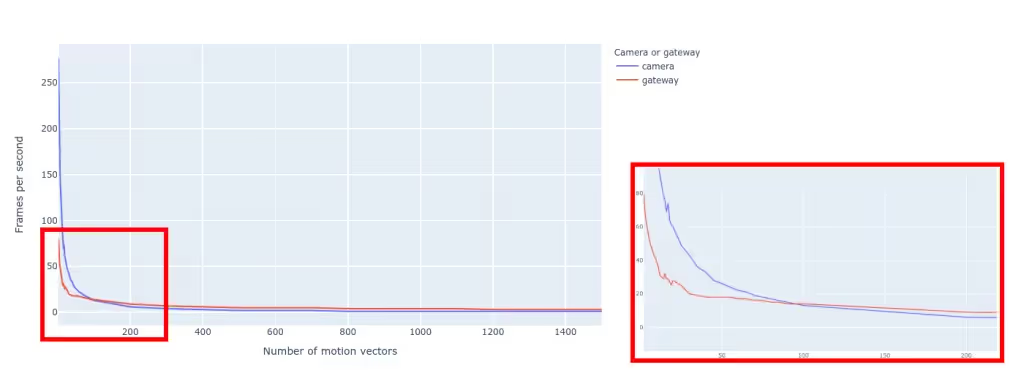
Figure 1 shows the number of frames per second for a given number of motion vectors used, on the camera and on the gateway, and encrypted motion vectors.
We can see that the camera outputs more frames per second for smaller numbers of motion vectors (up to 95). Then, the gateway and the camera appear to be able to output similar FPS rates, for larger numbers of motion vectors.
The camera is still able to deliver a stable 30 frames per second with 40 motion vectors. The gateway drops below 30 frames per second if the number of motion vectors is greater than 13.
With a small, but large enough number of motion vectors of 3, the camera outputs 233 FPS and the gateway is able to output 67 FPS. Therefore, it would even be possible to process a 60 frame per second video in real-time without any slowdown, with encryption of the motion vectors.
Figure 1: Camera and gateway FPS (MV encryption=on)
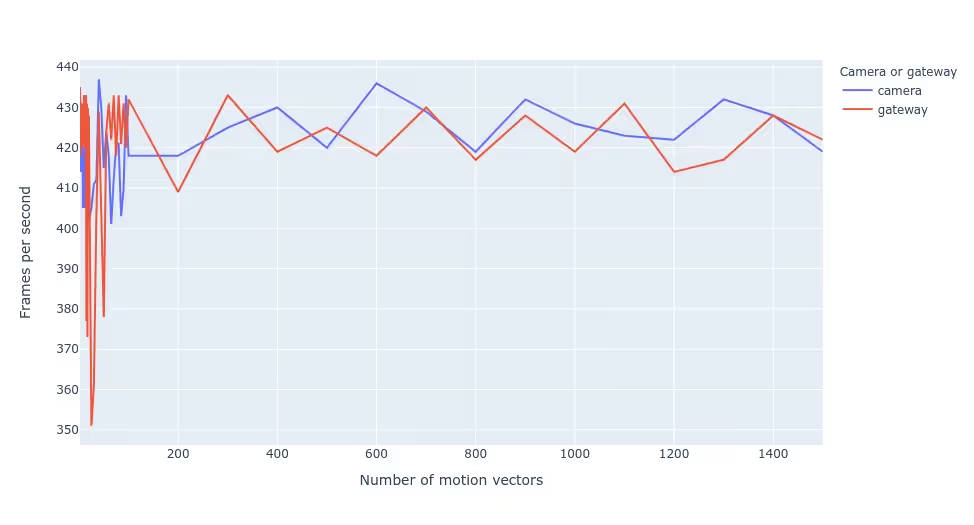
The results of the same measures, but with motion vector encryption disabled are shown in Figure 2.
Figure 2: Camera and gateway FPS (MV encryption=off)
When motion vector encryption is disabled, the camera and gateway do not seem to be affected by the number of motion vectors and deliver a stable performance of 419 FPS on average.
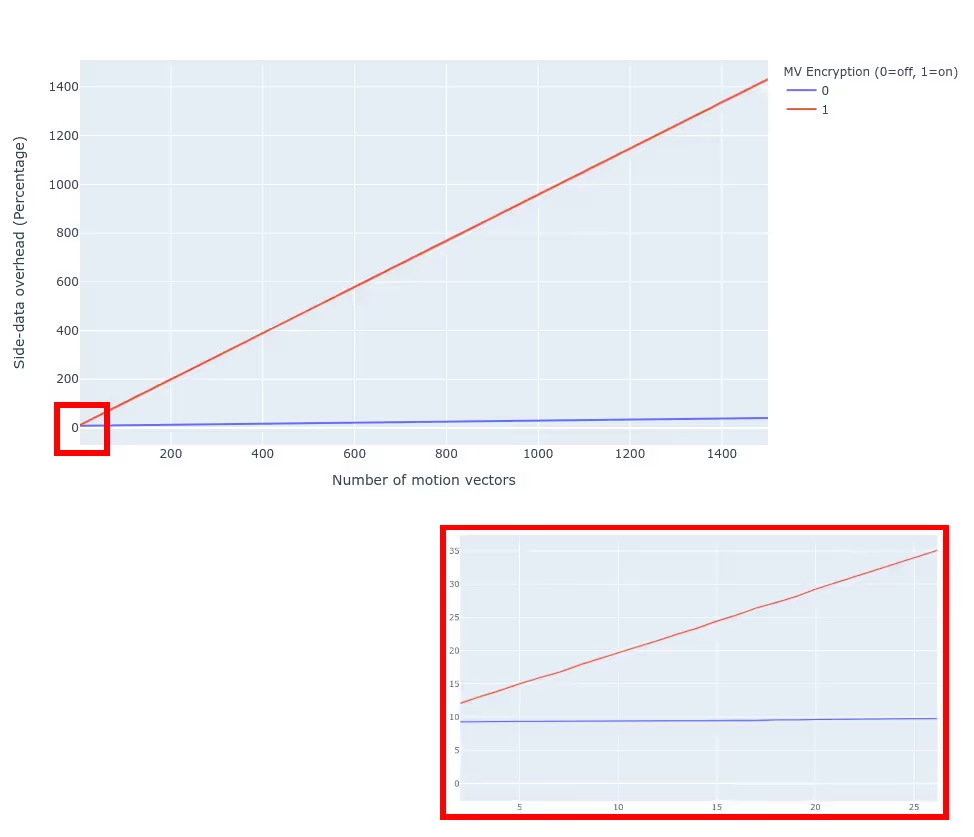
Motion vectors compose the side-data sent alongside the video stream from the camera to the gateway. The overhead size added to the overall stream for a given number of motion vectors used is shown in Figure 3.
Figure 3: Side-data overhead (Percentage of input video size)
We see that for a small number of motion vectors (1 to 10), when encryption is disabled, the overhead size is roughly 10%, and in the 10%-20% range with encryption. This is still acceptable. However, as the number of motion vectors grow to greater numbers, such as 1500, the overhead without encryption is 41%, and 1431% with encryption. It is therefore suggested to use a small number of motion vectors to minimize the overhead. This is not a problem since motion detection can be performed properly with only 3 motion vectors. With 3 motion vectors, the overhead is only 13% with encryption, and 9% without encryption. Thus, encryption adds very little overhead with a small number of motion vectors.
It was empirically observed that, as soon as the backend system has started playing the gateway stream, there is no significant delay other than the one due to network latency. If the number of motion vectors is increased, it may happen that the camera or the gateway become unable to process the stream fast enough. Indeed, since the source video is 30 frames per second, if the gateway cannot process frames at that rate, then the backend system will receive frames slower than the video playback speed. When that happens, the video may play slower than expected. As previously shown in Figure 1 above, we have seen that the maximum value for the number of motion vectors, for which processing can happen at least at 30 frames per second, is 40 for the camera and 13 for the gateway. However, only 3 motion vectors are sufficient for proper movement detection. There is therefore plenty of room for processing videos with higher frame rates.
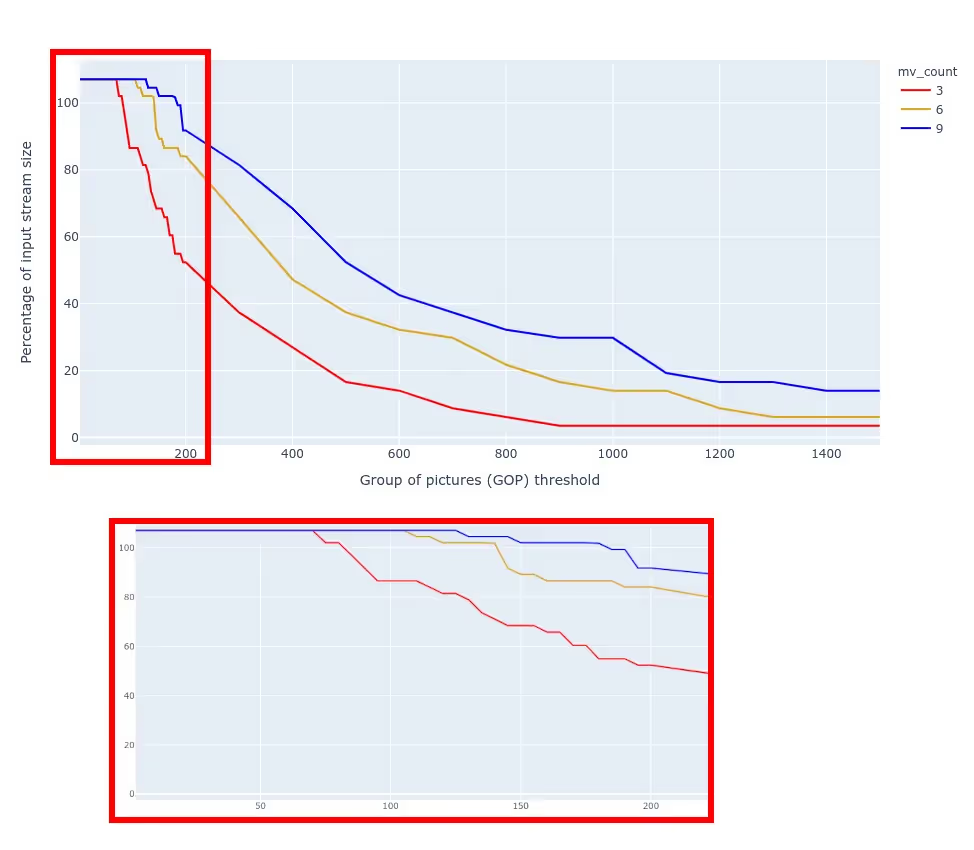
We used a 10MB video as input and measured the size of the output video sent to the backend with various values for the Group of Picture (GOP) threshold. The same measures were performed with 3, 6 and 9 motion vectors. The results are shown in Figure 4.
Figure 4: Backend stream size (percentage of input stream size)
As expected, the greater the number of motion vectors used, the greater the GOP threshold is required for the output stream size to start dropping. Indeed, since the sum of the norms of the motion vectors for a GOP is compared to the GOP threshold to decide whether to forward that GOP to the backend, the result simply confirms that motion detection is performed.
The lines of the plot have another use, however. They clearly show the minimum GOP threshold that should be used so that movement is detected. For 3 motion vectors, the threshold should be set to at least 70. For 6 motion vectors, the threshold should be greater than 105. Finally, for 9 motion vectors, the GOP threshold should have a value greater than 125 for motion to be detected.
This also confirms that motion is properly detected with as little as 3 motion vectors.
Conclusion
Encryption of the motion vectors was successfully added to the prototype. We have shown that such encryption adds little overhead with small numbers of motion vectors and allows to stream a 30 fps 1080p video in real time. There is even room left for streaming up to 60 frames per second without slowdowns according to our measures.
2021
Audit
Cryptocurrency
Crypto
Device security
August 6, 2018
Audit of Tangem's smartcard wallet code
No items found.
Kudelski Security Team
Tangem provides "smart banknotes for digital assets", as smart card storage media for Bitcoin private keys with basic wallet functionality. Tangem hired Kudelski Security to perform a security audit of the source code written by Tangem to offer these features.
We identified a number of security risks, and then ensured they have been appropriately mitigated by the Tangem engineers. We believe that these countermeasures provide adequate defenses against counterfeiting and cloning of cards, and against theft of blockchain assets. Our work covered the internal logic of the cards as defined by the source code, but we did not assess the card's security against physical attacks (the card includes a number of protections, including those provided by EAL6+ components).
In particular, we didn't find any backdoor, malicious or suspicious undocumented feature in the firmware. In order to ‘freeze’ the audited code and exclude further modifications, we compiled the firmware v.1.28 and then stored a copy of the resulting binary fingerprint. This fingerprint can now be embedded into users’ host (NFC) applications to verify the integrity of the firmware in each banknote that they hold.
The full audit report is not published, because it contains numerous references to proprietary information, such as snippets of the firmware source code. We thank Tangem for trusting us and for organizing the logistics for the binary integrity verification.






 Threat Alert CenterLearn More About Our Detection and Response Services