Where AI Fits in the Intelligence Cycle


A major part of cybersecurity work is developing, refining, and deploying repeatable processes and cycles to produce consistent analysis. The Intelligence cycle is one of the most durable and tested frameworks not only in Cybersecurity, but also in almost every sector of Critical Infrastructure.
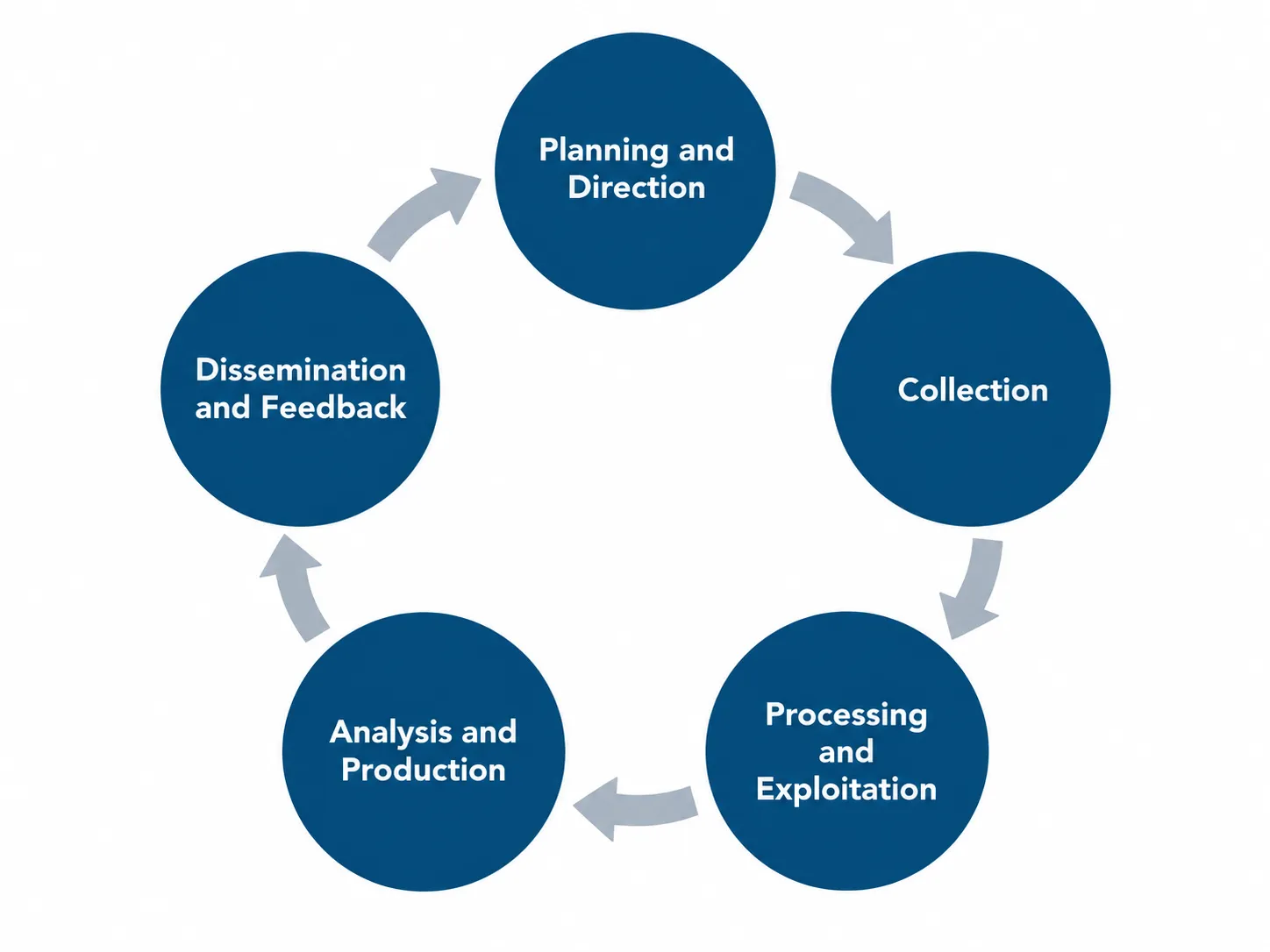
This framework is central not only to collection, but to the full lifespan of intelligence work across government, military, and commercial applications. This adequately reflects the processes that are subordinate to the cycle that allows transition from data to information to intelligence. This cycle can be repeated in several contexts, whether kinetic or digital, in a variety of Intelligence disciplines. Due to the nature of this being a standardized framework with varying tolerances and desired outcomes, the ability to uniformly define tolerance, timing, and quality creates a significant hurdle for the implementation of AI in any intelligence program.
Many organizations are saying that they want AI in their intelligence programs. They aren’t stopping to ask where it may fit into their programs and assessing what such an implementation would look like. Furthermore, the cart is being put before the horse in many instances where a vendor is selected for implementation, and then the tool defines the scope, which is the wrong sequence. Using the intelligence cycle, we have a principled way to establish boundaries and capabilities. Introducing an autonomous or semi-autonomous system without understanding limitations, or without policies and procedures for the added risks and workflow changes, can amplify the consequences of getting it wrong, since each phase of the cycle has a unique weight and scoring assigned to it, and those are not uniform.
Let us discuss each phase and how AI can and cannot assist in implementation. We will also assess whether an Agentic implementation is appropriate or whether a generative implementation is sufficient.
AI in Threat Intelligence Planning and Direction
Starting with planning and direction, this is the least AI-friendly phase to complete. We cannot rely on AI models to plan and direct our workforce and define our Intelligence Requirements (IR) for us. Of course, AI also plays into this phase in that we should be planning our use of AI here. Which models, and what levels of generative and agentic use should be defined? Generative AI across knowledge bases can be leveraged to help develop hypotheses in controlled environments to assist in prioritizing IRs.
In this context, Generative AI in controlled settings can help understand and identify the TTPs and other behaviors threat actors use, and how they may relate to a specific region or industry. Agentic AI in this context could be leveraged as a secondary mechanism to identify coverage gaps and make suggestions, not decisions, about collection priorities. In summary, the use of AI in the planning and direction phase should be enforced with heavy guardrails but could be implemented in a manner to assist in recommending IRs, collection priorities, and identifying coverage gaps.
How Agentic AI Can Support Threat Intelligence Collection
Agentic AI can shine in the collection phase. This is especially true in the use of Model Context Protocols (MCPs) for a variety of existing data sources, akin to APIs tying into existing tooling, only that the tooling that the MCP connects to is an AI Application like Claude, Gemini, Copilot, or ChatGPT. Agentic AI could establish collection agents that scrape data from a variety of sources, such as forums, leak sites, TIPs, and code repositories. In conventional open source (OSINT) and Cyber Threat Intelligence (CTI), these sources are already heavily relied upon, so leveraging an agent to automate the collection and processing of the results is in favor of the analyst.
To elaborate, the agents are not making judgment calls about what is collected; they are simply using the same collection and storage methods. In terms of error recovery, adopting Agentic tooling here carries low risk. If something is hallucinated, it will be detected in subsequent phases. If agents miss something, an analyst can manually collect the results and revise the agent before subsequent use. Because collection happens early and this is not finished Intelligence yet, it is fully recoverable to adjust over- or under-collection. Both over- and under-collection create workload issues, but both can also be tuned. Under-collection creates a coverage gap that could have a greater impact on subsequent phases.
Using AI for Threat Intelligence Processing and Exploitation
Shifting to processing and exploitation, we must apply more scrutiny to our implementation of AI in the cycle. Normalizing and de-duplicating data are both tedious tasks for humans that AI can excel at. Other reasonable uses include indicator extraction, Optical Character Recognition (OCR), and translation. From here, results are less reliable and can introduce elements of the AI asserting something as probable or plausible rather than rooted in fact and supported by collected data.
Using AI, whether Generative or Agentic, to label based on a taxonomy or framework is possible but requires more oversight. For example, you could query indicators against known MITRE ATT&CK techniques. This could be a simple and easy task for AI, until it is not. Until the AI hallucinates a technique, provides the wrong corresponding technique ID, or makes up a technique entirely.
Errors in Processing and Exploitation occur at a point in the cycle where maturity is paramount, and improperly labeled data or poorly completed translations can derail the rest of the cycle. To offset and mitigate these concerns, periodically audit a reasonable sample of the processed output for accuracy and completeness. While this may sound like additional work, it is better viewed as a quality assurance function rather than a duplicative workload. In the context of AI, it should be baked into the underlying processes and procedures early and often, like traditional conversations about implementing security controls early and often.
AI in Threat Intelligence Analysis and Production
At the Analysis and Production point in the cycle, we are well beyond data. The collected data starts to answer questions, becoming classified as information. Judgment calls and assertions are starting to take shape. The information is starting to mold itself through refinement into an intelligence context for decision-making. We are assigning confidence and intent. We are starting to brainstorm the recommendations we will make based on what we have collected and observed.
Our mindset is well along the path of shifting from a technical framing to informing the CISO and Executive team’s risk picture. The outcome thus far is starting to influence incident response priorities and communications. Plausible and possible are not good enough anymore, and the rift between plausible and probable versus factual is wide enough now that all asserted intelligence must be auditable.
During this phase, both Agentic and Generative AI have defensible use cases for pattern detection and matching in large datasets. Connections that would otherwise be buried in the data may be apparent to the analysts. Tracking changes like the Linux diff command across data collected in multiple iterations or investigations can be done easily.
The aforementioned scenarios are legitimate. Using AI to perform the complete analysis and generate a report is not. This position is not evergreen, as technology, implementations, and new, currently unknown models can and likely will change this statement in the future. For now, we still need analysts to provide context, insight, and reasoning for a quality intelligence product. Agentic and Generative AI both still lack accountability that exists only with a human analyst. Are organizations already doing this? Possibly, but it is ill-advised. While this may seem overly conservative, it is a risk-aware position that, at least in the current landscape, is worth a CISO defending to the board.
Using AI in Threat Intelligence Dissemination
Dissemination is arguably the most important phase in the cycle. While collection, analysis, and production are vital, dissemination gets the most attention. This is what Intelligence teams are paid for. Collected intelligence that is not disseminated is busy work. Intelligence must be disseminated to be acted upon.
The use of AI in this phase is nuanced. AI could be used to proofread and QA the writing or improve the report's readability, prose, and use of active voice. AI could assist with formatting the document and confirming that the bottom line up front (BLUF) and executive summaries are accurate and read appropriately for the intended audience.
To be clear, using AI, whether Generative or Agentic, to assist and improve the human-produced content is a relatively safe, risk-averse approach to employing strong guardrails. Failing to keep a human in the loop during dissemination creates opportunities for incorrect assertions, writing to the wrong audience, or inserting hallucinations based on flawed prompts or models. The dissemination products should be AI-assisted, but still human-analyzed and human-authored.
How to Evaluate AI-Powered Cyber Threat Intelligence Tools
Not as an attack on vendors, but an important question for any vendor is where and how their product fits into the intelligence cycle. If they cannot answer this, caution in implementation is warranted. A product that uses MCPs or other Agentic implementations to automate and scale collection is vastly different from a product that generates finished assessments without humans in the loop. Both are marketed as “AI-Powered CTI tools,,” but the risk profile organizations inherit from deployment varies greatly. Answering the question of where a product fits as “all of them” is not only just information overload, but also a red flag.
Why Human Oversight Still Matters in AI-Powered Threat Intelligence
The final perspective to examine in this is proportionality. An intelligence or cybersecurity team would never allow a non-reviewed report to make its way to the boardroom or in front of executive decision-makers. Why should we allow something without any review to do the same, just because it is “AI-Powered?” The Intelligence cycle can make such inconsistencies visible by forcing the exact phase to be named. AI producing an output that a human analyst reviews, confirms, and opines on is different from the output of a tool that writes a professional-sounding report that doesn't make sense under scrutiny.
The intelligence cycle has been around and has withstood criticism and scrutiny, and it holds up. Experienced CTI practitioners have been exposed to the framework long enough to take it for granted. The intelligence cycle is not some new, untested idea to “promote synergy.” It is a proven structure that maps cleanly to the questions around human judgment and automation. The most successful organizations understand and embrace starting with the structure of the Intelligence Cycle, rather than acquiring a product and finding a way to “make it fit.”
Need Help Applying AI to Your Threat Intelligence Program?
If you’re exploring how AI can support your threat intelligence program, Kudelski Security can help you understand where it fits, where human oversight still matters, and how to introduce it in a practical, risk-aware way.
Get in touch with our team to start the conversation.


.webp)